BB: Taming of the Shrew, Act III

Welcome Brawlers to our third Taming of the Shrew podcast.

Listen to the podcast – here

Download the podcast.

Before we move on to this weeks show notes, just a reminder to everyone listening to us in the greater Montreal area: be sure to visit Stephanie’s art installation at the VAV Gallery. The “Finissage” will take place this Friday, November 9th from 7pm to 9pm. Several of the first and second line Brawlers, as well as sonneteers and artists, will be there. Now is your chance to meet the people behind the voices. Hope we’ll see you there!

For a sneak peek of the project, visit Stephanie’s Tumblr page.

Bard Brawlers are clockwise Andre Simoneau, Eric Jean, Miki Laval, Stephanie E.M. Coleman, and Jay Reid. Not pictured Daniel J. Rowe and David Wheaton

In Act II, Tranio (disguised as Lucentio, remember?) manages to convince to Baptista to agree to Lucientio’s marriage to Bianca. Baptista thinks Tranio is Lucientio but they’re planning to pull a bait and switch on old Baptista Minola so the real Lucentio gets the girl. That could be a problem though when the two schemers make their move. However, by getting Baptista to sign on the dotted line, Tranio and Lucentio plan to take shelter behind the letter of their contract: in the end Lucentio will indeed marry Bianca. It just won’t be the Lucentio Baptista was expecting. But more on that next week.

In the mean time, Lucentio (as the language tutor Cambio) and Hortesio (as the music teacher Licio), find themselves alone with Bianca in Baptista’s house at the start of act III, scene 1. While Hortensio is tuning his musical instrument, Lucentio shares his plan with Bianca: the two of them will get married in secret. As Tranio already has Baptista’s permission for Lucentio to marry Bianca, he’s confident it will all work out. Of course, Hortensio by this point strongly suspects that something is up between Bianca and ‘Cambio’ and watches them closely while they talk. Eventually, they swap places and it’s Lucentio’s turn to watch as Hortensio puts the moves on Bianca. He doesn’t get very far before a servant comes and calls Bianca away. Hortensio realises that Bianca might not prove as faithful as he’d like.

The next day, preparations are underway for Kate and Petruchio’s wedding at Baptista’s manor. However, when act III, scene 2 opens, Petruchio appears to be running late for his own wedding. Baptista and Kate are beginning to despair but Biondello arrives to tell them that he’s on his way. However, he’s dressed on old mismatched clothing and looks rather ridiculous. When Petruchio finally does arrive, the others in attendance try to convince him to change into something a little more suitable. He dismisses all of them and goes off to get married. The wedding happens off-stage, but Gremio gives us a pretty vivid description of the event. When the wedding party returns, Petruchio says he has no intention of sticking around but plans to take his bride home with him immediately. The others plead with him to stay but he refuses. When Kate asks, he answers that the others should all go inside and feast but Kate and Petruchio will leave.

Is any of this funny? Why do we laugh at this stuff? In the next post, I plan to talk about some of the aspects of the play which make us cringe but this week I wanted to raise the question of humour in the Taming of the Shrew.

I mentioned in my previous post that Calvino differentiates Shakespeare from someone like Boccaccio. The main difference he points to is how Shakespeare marks are turning away from the bodily humour which was such an important part of the medieval stories he uses as the source materials for many of his comedies. But is that what’s happening here?

In a lot of ways, The Taming of the Shrew is not a typical Shakespearean comedy. You’ll notice as you listen to the play that so much of this play relies on either physical comedy or jokes about sex (or bodily functions). Which means that, without the actors, a lot of the humour is lost. How many times does Petruchio beat Grumio? The first scene in which we are introduced to these characters hinges on a misunderstanding about ‘knocking:’ Pretruchio asks Grumio to knock (on the door) but Grumio thinks Petruchio is asking Grumio to ‘knock’ his master. Petruchio rewards him with a knock of his own.

Another example is in act II, where Petruchio and Kate are left alone for a few minutes. Petruchio tells Kate that he will rob her of her sting with his tongue (ie: he’ll outwit her). When she states that in order to do that he’ll need to find her sting, which, she states, a wasp keeps in its tail. He replies: “What, with my tongue in your tail? nay, come again, / Good Kate; I am a gentleman.”

Not exactly PG.

The Brawlers have mentioned that this is a difficult play to read. Part of this comes from the fact that, unlike many of Shakespeare’s other comedies, The Taming of the Shrew relies on the body (or bodies) for much of its effect: the sight of characters in disguise, the enactment of Petruchio striking Grumio, or even the effect of watching Petruchio walk on stage for his wedding dressed like a clown, are what ensure that this play gets staged again and again.

artwork – Leigh Macrae

Stay in touch, Brawlers!

Follow @TheBardBrawl on Twitter.

Like our Facebook page.

Email the Bard Brawl at bardbrawl@gmail.com


The Taming of the Shrew (1967), Franco Zeffirelli (director)

Miki Laval

I’m certainly not the first to say it; for modern audiences the Taming of the Shrew is often a problem. Yes, there’s plenty of boisterous and bawdy slapstick comedy, and some hilarious and confusing role reversals, but how to accept a play that so thoroughly breaks the spirit of its lead female character? There’s no possible way to address the role of Katherine without touching on the play misogynistic elements, yet instead of a literary or feminist critique allow me to bring up two iconoclastic females: Cinderella and Elizabeth Taylor.

We all know the story of Cinderella, or Cendrillion. But shew tales, as they were called, were once as widely known as the story of maltreated daughter and her glass slipper. Different shrew versions mucked about with the details, but the basic plot stayed constant: a good husband, saddled with a surely wife, turns her obedient through intimidation and violence. The violence is always brutal, on par with the Brother’s Grimm’s or Charles Perrault. (In one version the wife is sewn up in the skin of a dead horse and beaten.) Yet shrew tales share another trait with the fairytale or fable; they function around a dependable and repetitive plot in order to convey a moral lesson. In allegory, plot takes precedent over individual character, the sine qua non of modern literature. Why exactly is Cinderella’s stepmother evil? Hard to say, really, because in most versions she’s devoid of any personal qualities. Why does Cinderella get the prince? As a moral lesson that the oppressed and long suffering will eventually be rewarded. (A witty feminist view on a similar fairytale Beauty and the Best can be found here.) For a Shakespearean audience to ask why the shrew is tamed would be akin to asking why Cinderella’s stepsisters are bitchy. The general fairytale plot dictates that stepsisters are jealous, and so they are a dependable nasty piece of work. Or, in other words, the shrew is tamed because the shrew is always tamed.

It’s fare to conclude that a play peopled with allegorical type characters isn’t concerned with individual behavior or personality. In Shrew, Shakespeare seems more interested in the comedic friction of common love tropes, intertwining two well-known love narratives, the shrew tale of Petruchio and Kate, with the courtly love story of Bianca and Lucentio. Still, Kate’s transition, or capitulation, from feisty broad to tamed submissive wench, has always left some audiences uncomfortable, and any director or actress taking on Kate does so fully aware of the sexual politics.

Franco Zeffirelli’s solution is to cast the all mighty Taylor as Katherine against Richard Burton as Petruchio. The couple, together in real life, poured millions into the production and took a salary cut, which probably edged them out over his original choice, Sophia Loren and Marcello Mastroianni. (Pause for a moment to envisage that screen version.)

Taylor and Burton’s notorious love affair works perfectly for Shew. Much like in Who’s Afraid of Virginia Woolf the power struggle often seems snatched from the dynamics of Liz and Dick’s private off screen relationship, which was epic, scandalous, fiery, and loud. More importantly, in the Liz and Dick saga, everyone knew Elizabeth Taylor was no push over.

Liz was a powerful screen presence, with an off screen taste for excessive jewelry, for men, for furs, and for all round luxury. The woman had appetite. It’s hard to imagine, in our world of corporate produced starlets, such a fiery, fleshed out female allowed demi-goddess status, but in her prime, Liz was magnificent, and she brings all that hot loud beauty to Katherina Minola. She hurls furniture and ripostes at a world that allows no place for her enormous energy, or the largeness of her personality. Defenders of the play claim Petruchio and Kate are an equal match, and in Zeffirelli’s version the statement passes. When Burton, as Petruchio, comes swaggering into Kate’s life the films slows to a swoon as one pair of blue eyes size up the violet gaze staring straight back.

Watch Kate, or Liz as Kate. She moves from anger, to desire, to fear, then back to anger again usually in a single scene, skipping across the gauntlet of emotions as smoothly as a peddle skips across a lake. That’s Liz. Petruchio throws her a slew of humiliations and in return she takes control of his house, and wins over his servants. She  seethes. She schemes. She smirks. She quite likely has the hots for him. Their relationship falls into the angry passionate sexy category. We’ve all had those friends, the couple who bicker in public, and make everyone uncomfortable. At least in this version the dynamic plays out, building as a climax towards the famous final scene.

Endings, whether in plays, film, or novels, are usually read as the summation on whatever themes have been explored. When Kate declares obedience to Petruchio, offering to place her hand under his foot, Shakespeare stays faithful to the shrew tale formula.

The scene often falls flat, not only due to the sexual politics, but also because the comedic shenanigans drop completely, leaving not a pin prick of humor in Kate’s final speech. The debate is still ongoing over the how-to-be-a-good-wife lecture because who wants to believe the greatest writer in the English language was an all out misogynist?

The words alone, on paper, can make you wince.

Whatever Shakespeare’s true intentions, Zefferelli’s version makes Katherina’s speech work. Liz delivers it straight without knowing winks, or ironic smirks, yet she summons up a fury that hurls the definition of an obedient woman back at the society that came up with the classification in the first place.

And then she declares love to a man.

And then in the next instant she bests him.

Kate’s speech is delivered as a knock out punch to her family and society, as well as her husband, before she exits head up, triumphant. As for Petruchio, he’s left to stumble through a crowd after her.

Advice for young girls from a princess.

Miki Laval is a Bard Brawl first liner and finishing a masters in creative writing at Concordia University.

BB: Taming of the Shrew, Act II

This is the Bard Brawl and we’re back – post-nuptuals – with act II of Shakespeare early Italian-style comedy, The Taming of the Shrew.

Listen to the podcast – here.

Download the podcast.

Bard Brawlers are clockwise Andre Simoneau, Eric Jean, Miki Laval, Stephanie E.M. Coleman, and Jay Reid. Not pictured Daniel J. Rowe and David Wheaton

By the end of act I, Bianca’s three suitors – Gremio, Lucentio and Hortensio – have called a temporary truce to their wooing war in order to help Petruchio win and marry Kate. Not out of the goodness of their hearts, of course, but because Bianca’s father Baptista won’t let any of them have his youngest daughter until he manages to marry off the older one, Kate.

The only scene in act II starts with a cat fight: Bianca asks Kate to get married ASAP so Bianca can marry one of her three suitors. When Kate asks her who her favourite one is, Bianca assumes that Kate must be jealous of her. Kate doesn’t like that and she strikes her and stars running after her. Their father shows up and breaks up the fight. As he’s busy feeling sorry for himself, Petruchio arrives and declares that’s he’s looking to hook up with Kate. To show his seriousness, he offers his friend Hortensio – disguised as the music teacher Licio – to tutor Baptista’s daughters. The Gremio shows up and offers Lucentio (disguised as Cambio the language teacher) as his tutor.

Petruchio and Baptista then work out the financial details of the wedding. Baptista’s happy to agree to let Petruchio marry Kate provided he can win her over. Petruchio says “no problem, I got this.” While they talk, Hortensio comes back on stage wearing a broken lute. Seems that Kate didn’t like his fingering lesson. This just gets Petruchio excited. Baptista calls Kate over to meet Petruchio and leaves them alone. Petruchio and Kate get into a pretty intense battle of wits. By the end of it, Petruchio tells Kate they’re getting married.

Baptista and the others return. Petruchio says that Kate has agreed to marry him. Kate protests but Petruchio just says that she’s just pretending to be upset not to break character. The wedding is arranged for Sunday. Gremio and Tranio (as Lucentio) waste no time and now make their case to Baptista as to who should get Bianca. Hortensio drops out of the race early but Tranio (as Lucentio) and Gremio get into a bidding war. The old man loses and Baptista agrees to have Bianca marry ‘Luciento’ (who is actually Tranio in disguise at this point). There is one condition however: Lucentio’s father Vincentio will have to agree to all of the promises ‘Lucentio’ has just made.

Everyone still with me? Good.

Unlike both Merchant of Venice and Coriolanus, where the primary source text adapted by Shakespeare is pretty clear, that’s not really the case with The Taming of the Shrew. The most likely scenario is that Shakespeare adapted the Christopher Sly episode and the Kate and Petruchio storyline from popular folk tales. (Apparently, ‘shrew taming’ stories were pretty popular back in the day.) In the case of The Taming of the Shrew, the only source text which most people seem to agree on is an Italian play called I Suppositi. It was translated into English by George Gascoigne as Supposes (first staged in 1566, published in 1574) and it’s the basis of the Bianca and Lucentio plotline.

I tried to find us some online versions but I haven’t been able to get my hands on it. If you do find them online, leave us a comment and we’ll add some links! That means you’ll have to take my word for this but the main difference between Gascoigne’s The Supposes and Shakespeare’s The Taming of the Shrew is this: in Shakespeare, the whole point of the deceptions and of Petruchio’s actions (we’ll talk about those next week) is to get married; in The Supposes, the whole point is to get laid. The play is important less as a plot and much more as an indication of the type of comedic tradition that Shakespeare inherited in the 1590s.

Taming of the Shrew, for all of the ways in which it’s different from the rest of Shakespeare’s other comedies, does mark the first step in Shakespeare’s ongoing investigation of the purpose and usefulness of comedy. In the older play, the story ends once the guy gets the girl. It’s all in good fun. It’s entertainment. In Shakespeare, getting the girl is only half of the problem. While it’s still good fun, there’s generally something at stake which is more than a quick fling.

If you read through Shakespeare’s comedies in order, you’ll notice a trend: as he ages and matures, he leaves more and more of the funny antics, penis jokes and slapstick humour out of it and he increases the seriousness of what’s at stake. (If you want to test that out, I suggest you subscribe to The Bard Brawl!)

Here’s what Italo Calvino has to say:

The weightless gravity […] reappears in the age of Cervantes and Shakespeare: it is that special connection between melancholy and humor[:] As melancholy is sadness that has taken on lightness, so humor is comedy that has lost its bodily weight (a dimension of human carnality that nonetheless constitutes the greatness of Boccaccio and Rabelais). It casts doubt on the self, on the world, and on the whole network of relationships that are at stake. Melancholy and humor, inextricably intermingled, characterize the accents of the Prince of Denmark, accents we have learned to recognize in nearly all of Shakespeare’s plays on the lips of so many avatars of Hamlet. (Italo Calvino’s Six memos for the Next Millennium, p. 19)

I love this quote. One of my favourites.

I mentioned in my previous post that Taming of the Shrew is one of Shakespeare’s first plays. It’s sensibilities are still a far cry from a Hamlet or a Twelfth Night but it marks one of Shakespeare’s first real efforts to make comedy serious, to use it not only to entertain but to teach… though what the lesson is exactly, I’m not sure.

Go here if you’re interested in a short rundown of some the possible sources for Taming of the Shrew.

Artwork - Leigh Macrae
Artwork – Leigh Macrae

Bonus Sonnet 20 read by Melissa Myers.

(Podcast recorded and edited by Daniel J. Rowe, show notes by Eric Jean)


Stay in touch, Brawlers!

Follow @TheBardBrawl on Twitter.

Like our Facebook page.

Email the Bard Brawl at bardbrawl@gmail.com

The Taming of the Shrew (2004), Jonathan Miller (director)

Daniel J. Rowe

Jonathan Miller‘s The Taming of the Shrew revels in misogyny, role-reversal and slap stick comedy, and for purists, the 1980 BBC production staring John Cleese remains solid, and of use in the Shakespearean film canon.

——-

Shrew is a tricky one. It doesn’t make a whole lot of sense, but it is very entertaining. It does not have the depth or cleverness of say Much Ado About Nothing, but it is produced a lot. It works if done right, and can be very bad if done poorly.

Shrew begins and ends with Petruchio and Katherine. You get them right, and you’ve got a good production.

Cleese, as Petruchio, makes the film work with his manipulative, schizophrenic and quasi-sociopathic bullying through the role. Cleese seems to hate everyone around him, and glares at, taunts or screams at almost everyone in the cast while he tears through scenes. It’s a joy to watch.

His few soliloquies (II, i; IV, i) give the smallest glimpse at his honest intentions, and they are, simply put, to tame Kate like one would a falcon.

Sarah Bedel as Katherine runs the gamut of shrew emotions and pulls it off. Bedel is a match for Cleese, and evens the playing field.

Cleese and Bedel chew up the scenery and highlight the great thing about their characters: they hate the world they live in, and those around him, and must find a way to join forces. Bedel’s knowing glances at the end of the production are very nice. Petruchio and Katherine are together and ready to mock, bully and destroy the flaky aristocrats around them (Hortensio, Gremio, Bianca etc.)

Joining Cleese and Bedel are joined by a stellar cast of theatrically trained actors, who know the bard, and know how to play their parts.

Jonathan Cecil as Hortensio is great verging on the brink of a nervous breakdown at times chattering to the air. Anthony Pedley does Tranio’s transformation from servant-to-lord then back again really nicely with Simon Chandler‘s Lucentio doing the opposite.

One goes to the BBC productions not for camera work, cinematography or set design, but rather to see Shakespeare in its barest form. Most of the BBC’s productions work because they cast the plays right, and Shrew is no different.

That is not to say that sets and design are absent. The transition from Padua with its bright sun to Petruchio’s country house with its bleak darkness and spartan dining area do well to show the transition from the chase for the girl (act I-III) to married life (act IV). Shakespeare mocks the Comedia del Arte ideal of marriage in Shrew and Miller’s clever use of sets and lights does well to show this intention. In Shrew one needs to fight through marriage and be beaten down to be happy. Well, for the women at least.

The play is not one of Shakespeare’s deepest, and is problematic from a modern viewpoint. The insanity of it, though, is what makes it enjoyable. Why is everyone always switching roles? Why are we laughing as Petruchio is torturing Kate through sleep and food deprivation? What is the point of the banquet at the end? These are issues with the play itself, however, and the production does well to somewhat answer if not cover up the deficiencies in the story with quality acting and clever sylistic choices.

Daniel J. Rowe is the co-creator of the Bard Brawl.

Daniel J. Rowe, co-creator of the Bard Brawl.

BB: Taming of the Shrew, Act I

In this podcast, the Brawlers take on the first act of the confusing and controversial Taming of the Shrew.

Listen to the podcast –here

Download the podcast.

The Brawlers clockwise: Shaun Malley, Daniel J. Rowe, Virginie Tremblay, David Wheaton, Eric Jean, Andre Simoneau, and Stephanie E.M. Coleman.

The Taming of the Shrew opens with a prologue which takes place in front of an alehouse. It seems the drunk Christopher Sly’s been kicked out of the bar by the hostess after refusing to pay for his tab. The hostess threatens to call the watch but instead of leaving Sly falls asleep in front of the tavern. Soon, an unnamed lord and his huntsmen show up and, for some reason, the nobleman decides it would be fun to take Sly back to his estate, clean the drunkard up and make him think he’s an amnesiac lord whose just awoken from a long illness. Just then an acting troupe shows up and the lord hires them to help him with his prank.

By the start of scene 2, Sly has just woken up and he calls out for some more booze. He’s expecting Pabst Blue Ribbon but greeted by servants who offer him wine and want to know which of his many outfits he plans to wear today. Sly argues with them but the servants and the lord manage to convince him at last that he’s a rich lord and that the cross-dressing page is his wife. Sly wants to sleep with his wife, but the page instead convinces him to watch a play first, in case having sex might bring about a new bout of madness. Doctor’s orders. So instead they decide to watch a play.

The actual play itself begins in act I, scene 1 with the young bachelor Lucentio’s arrival in Padua where he hopes to pursue his studies. He’s accompanied by his servant Tranio who reminds him that while he’s here he may as well have a good time. While they talk, Baptista, his daughters Katharina and Bianca, as well as Bianca’s suitors Gremio and Hortensio, walk by them. The suitors are trying to plead their case with Bianca’s daughter but Baptista won’t budge: neither of them can marry Bianca unless his eldest daughter Katharina (Kate) is married off first. The problem? Katharina’s a shrew which no man in Padua wishes to marry. As soon as they leave, Lucentio admits that’s he’s smitten by Bianca and he and Tranio devise a plan to allow Lucentio to woo her freely: Tranio will pretend to be Lucentio and take care of his master’s affairs in the city while Lucentio will pretend to a scholar which Gremio will offer to Baptista as a tutor for his daughters. This will give him access to Bianca. When Biondello, one of Lucentio’s father’s servants, arrives, Lucentio convinces him to go along with their plan.

The start of act I, scene 2 is similar to the previous scene: a young bachelor, called Petruchio, arrives in Padua with his servant Grumio (not to be confused with the suitor Gremio). There’s a short slapstick scene where Grumio gets slapped around by Petruchio just outside Hortensio’s house. The two friends talk for a few moments and Hortensio learns that Petruchio is in the market for a rich wife. Seeing an opportunity to open the way to Bianca, he tells Petruchio about Katharina. Petruchio decides that he’s the one to take on Kate and the two head off to Baptista’s house. When they get there, they see Gremio, Bianca’s older suitor, and with his is Lucentio disguised as a tutor who promises to woo Bianca on the old man’s behalf. Hortensio and Gremio exchange words until Tranio – disguised as Lucentio – shows up and tells them he also intends to woo Bianca. While they’re not happy to see him, they realise that neither of them can get Bianca unless they first marry off Kate. They agree to collaborate to help Petruchio win Katharina.

If you’re already confused about who’s who in the play, you’re not alone. Taming of the Shrew is a tough play to read because the characters are constantly disguising themselves. Some invent entirely new names while others (to make it even more confusing) pretend to be other characters in the play. With that in mind, here’s a short list of some of the characters and the roles they take on in the play:

Lucientio:

      A young bachelor and scholar. He pretends to be one of Katharina and Bianca’s tutors,

Cambio

      , so he can woo Bianca.

Tranio:

      Lucentio’s servant. He pretends to be Lucentio so his master can woo Bianca without arousing suspicion.

Biondello:

      A servant of Lucientio’s father.

Baptista Minola:

      The father of Katharina and Bianca.

Katharina (Kate):

      Baptista’s eldest daughter, a shrew which Petruchio will marry for money.

Bianca:

      Baptista’s youngest daughter, who has three suitors: Gremio, Hortensio and Lucentio.

Gremio:

      An old man and friend of Baptista’s who wants to marry Bianca. He hires the tutor Cambio (Lucentio in disguise) to woo Bianca on his behalf.

Hortensio:

      A younger suitor to Bianca and one of Petruchio’s friends. He disguises himself as a music teacher named

Licio

      .


      Petruchio: a young impoverished bachelor looking to marry into money. Katharina’s suitor.

Grumio:

      Petruchio’s servant. He often gets slapped around by his master.

Peddlar:

    Later on, this character will be recruited to play the part of Lucentio’s father.

I’d bookmark this page: I’m sure you’ll want to jump back here more than once over the next few weeks.

If you’ve ever seen this play staged, or watched an adaptation of it, you won’t remember the prologue. That’s because it’s almost always edited out. In fact, if anyone out there is aware of any production that does include the prologue, let us know.

Truth is, ignoring the prologue is the easy thing to do and removing it doesn’t affect the action of the play at all. So why is it there in the first place? This is a tough question to answer.

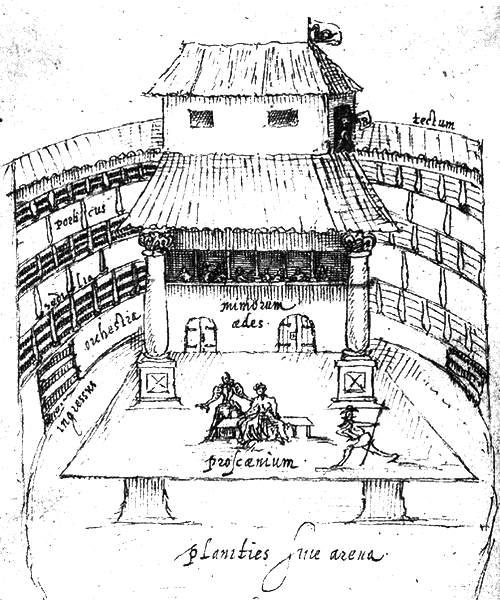
Let’s try to imagine how The Taming of the Shrew might have been stage back in 1592. For that, it might be helpful to know what the actual theatre might have looked like as well:

If we’re lucky, we can afford to by a spot in the covered balconies but most likely we’re just groundlings who paid a cheap rate to stand in the pit all around the stage.

Once the play starts, Sly, the hostess, the lord and his attendants come on stage. They play out the first scene of the prologue. Then, after they’ve dragged Sly off-stage, he reappears on the balcony at the back of the playhouse with the page disguised as Sly’s wife. There’s a good chance the lord and the household servants are up there as well. However, at the end of the scene, the players hired by the lord walk out onto the main stage and start performing a play. This is where act one of the actual play starts.

Sly has a few more lines after act I, scene 1 so we know he’s still around. And it’s likely that he’ll stay up on that balcony for the entire show. That means that we’re watching Sly and the page watch the Taming of the Shrew as we watch the Taming of the Shrew. It also means that the actors the lord has hired for his prank on Sly are the same ones acting out the Taming of the Shrew for us, the audience. Are we supposed to be the butt of a strange joke like Christopher Sly? I’m not sure. If so, I don’t really get it. What this weird half-frame does though is make us aware that we’re watching a play because it keeps the audience of the play – Sly – in view the whole time.

Shakespeare’s big on theatre metaphors in his plays. He’s constantly reminding us that we’re watching a play, and that everything else in our lives also involves a lot of acting and pretending too. However, Taming of the Shrew is an early play, one of Shakespeare’s first. Later in his career, Shakespeare will really become a master of using theatre to comment on theatre and life. He just hasn’t really figured it out yet and this experiment falls a little flat.

That about does it for this week. Be sure to read Jay Reid’s critique of Ralph Fiennes’ recent film adaptation of Coriolanus. If you don’t want to miss anything, subscribe to the blog as well as the podcast on iTunes.

(Podcast recorded and edited by Daniel J. Rowe, show notes by Eric Jean)

Artwork - Leigh Macrae
Artwork – Leigh Macrae

Stay in touch, Brawlers!

Follow @TheBardBrawl on Twitter.

Like our Facebook page.

Email the Bard Brawl at bardbrawl@gmail.com

BB: Merchant of Venice, The Speeches

This week, we present the first of our new series of ‘Speeches’ podcasts!

Daniel and I have picked out a handful of our favourite moments from The Merchant of Venice and we’ve gathered them together into one awesome show. Then poured ourselves some drinks and had a chat about our selections. Feel free to do the same as you listen in!

Daniel and Eric go through some of their favourite speeches in the Merchant of Venice

Listen to the podcast here.

Download the podcast.

So you can follow along with the text if you’d like, here are the passages we’re discussing in this episode.

“I hold the world but as the world, Gratiano…”Act 1, Scene 1 lns 79-107
Speakers: Antonio and Gratiano
Gratiano offers up this speech to Antonio who he accuses of playing the role of the melancholic older man to make himself seem more wise and dignified than he really is. His basic point: forget what anybody else thinks and lighten up! Is Antonio’s sadness just an act, though?

“When Jacob grazed his uncle Laban’s sheep…” Act 1, Scene 3 lns 68-93
Speakers: Shylock and Antonio
In this passage, Shylock and Antonio confront each other about their differing business philosophies: Shylock argues in favour of thrift and cleverness, Antonio in favour of risk-taking and faith. Which is the better ‘Merchant of Venice’?

“Why, I am sure if he forfeit thou wilt not take his flesh.” Act 3, Scene 1 lns 42-60
Speakers: Salerio and Shylock
Probably the most famous speech in this play, Shylock makes it clear that he’s serious about getting revenge on Antonio if he doesn’t get his money on time. He certainly has plenty of reasons to be pissed off. Is it possible to listen to this speak and not be moved to sympathy for Shylock?

A song, the whilst BASSANIO comments on the caskets to himself.Act 3, Scene 2 lns. 64-116
Speakers: Portia (singing) and Bassanio
This the scene where Bassanio finally tries his luck at picking from the three caskets. He offers his justification for his choice: one shouldn’t judge by appearance but by the weight of one’s feelings. Portia’s not supposed to cheat but she clearly wants Bassanio to make the right choice. She’s seen the other two – Morocco and Aragon – mess up, so she knows which choice is correct. Does she slip him any hints or does his reasoning just make sense?

“Now, Balthazar…” Act 3, Scene 4 lns. 46-80
Speakers: Portia, Balthazar and Nerissa
The mandatory Shakespearean comedy’s gender-reversal scene. Portia sends a letter to the lawyer Bellario for some legal advice and a cover story. She and Nerissa then dress up as a lawyer and clerk to play dress-up at court and brag about women with the boys. I was never clear on how she knew to contact the same guy the Duke of Venice had consulted with or how she convinced Bellario to go along with her plan.

“What judgement shall I dread, doing no wrong?” Act 4, Scene 1 lns. 90-104
Speaker: Shylock
We picked this scene instead of the equally famous “The quality of mercy” speech which comes a little later in the scene (lns. 188-209). Shylock delivers his speech about property rights. He argues that just as the nobles in attendance are free to do what they wish with their slaves, he should be free to use his own legally obtained property as he sees fit. Aren’t we inclined and encouraged to agree with his point?
For the full effect, you really should go back and listen to the (in studio!) recording of act iv.

“How sweet the moonlight sleeps upon this bank.” Act 5, Scene 1 lns. 61-76
Speakers: Lorenzo and Jessica
Daniel selected this passage because it contains Jessica’s last line of the play. Lorenzo is waxing poetic about the power of poetry and music but Jessica calls bullshit. Totally oblivious, Lorenzo then gives her a patronizing speech about why she doesn’t get it. Are Lorenzo and Jessica living in a dream world or is this a nightmare waiting to happen?

Hope you enjoy the show!

Feel free to download and listen to any of the previous recordings of The Merchant of Venice.

(Podcast recorded and edited by Daniel J. Rowe, Show notes by Eric Jean)

Stay in touch, Brawlers!

Follow @TheBardBrawl on Twitter.

Like our Facebook page.

Email the Bard Brawl at bardbrawl@gmail.com

BB: Merchant of Venice, Act V

We did it! We’ve finished recording our first complete play!

Welcome to the Bard Brawl’s fifth and final episode of The Merchant of Venice.

Listen to the podcast here.

Download the podcast.

Bard Brawlers for this act are (Clockwise from top left) Melissa Myers, John dit Jack, Stephanie E.M. Coleman, Eric Jean and Daniel J. Rowe

The final act of The Merchant of Venice has only one scene in which all of the loose ends and threads get tied up. Portia and Nerissa beat Bassanio, Gratiano and Antonio back to Belmont. After the couples are reunited, the women ask for the rings which they gave their husbands back in act III, scene 2. Awkwardness and humour ensue as the women sweat their husbands for giving away their rings to the doctor and his clerk. Portia and Nerissa even go so far as to suggest to Bassanio and Gratiano that they’ve been sleeping with these men seeing as they had the rings which the ladies gave their husbands. In the end, they give the rings back to their husbands but only after Antonio offers himself up once again as surety for the sincerity of Bassanio’s and Gratiano’s wedding vows.

After the high-stakes, high-tension court scene of act IV, act V can seem like a bit of a letdown: each of the three couples are happily reunited once again on stage, and Antonio learns, that because some of his ships have made it back to port, he’s not going to spend the rest of his days totally broke. Since we know (because we’re in on the gender-swapping disguise game) that the boys are not really in trouble, there just doesn’t seem to be that much at stake. There’s just no way Shakespeare’s going to write a comedy and not give us our three weddings, right? However, that doesn’t mean that all of these weddings have to be created equal.

Gratiano and Nerissa are clearly a doubling of the Bassanio and Portia couple, once removed from true nobility (Portia is the lady, Nerissa the maid, after all). The play seems to believe that they’ll live happily together as one big happy sitcom family (it’s hard to imagine that they would have kicked Antonio out to starve if he’d ended up penniless). But what about Lorenzo and Jessica in all of this?

I mentioned in an earlier post that Shakespeare gives us some hints that Lorenzo and Jessica’s relationship may not be all it promises to be (and that it’s probably Lorenzo’s fault). As act V opens, the couple sits outside of idyllic Belmont, gazing up at the moon. Lorenzo and Jessica compare their love story to those of other well-known literary love affairs.

Here’s the list of allusions:

  • Troilus and Cressida: Troilus and Cressida fall in love during the Trojan war but Cressida is traded to Diomedes. Cressida knows she’ll have to submit in the hopes of saving her people. Troilus renounces his love for her as a result.
  • Pyramus and Thisbe: Two lovers enemy household are forbidden to marry. They set up a meeting place. When Pyramus arrives he thinks that Thisbe was killed by a lion so he falls on his sword. Thisbe arrives later, sees him dead, then kills herself as well. (Sound familiar?)
  • Dido and Aeneas: In his travels, Aeneas arrives in Carthage and woos Dido. Soon afterwards, he leaves Carthage never to return. Dido kills herself by throwing herself into a pyre.
  • Medea and Jason: Jason promises to marry Medea in exchange for some help getting the Golden Fleece. He leaves her in the lurch and marries another woman instead.

Will Jessica and Lorenzo take their place among these infamous couples? Jessica certainly seems to think so, and she compares Lorenzo to all of these infamous lovers, casting herself as the victim of a faithless lover’s promise.

Lorenzo’s love of music (which in this context likely means poetry) is telling. He sees his relationship with Jessica in poetic terms, is inattentive to the actual words, the weight, behind these stories. (Remember that Bassanio, the successful suitor, reasons that love is purchased by the weight and passes the test because of it.) While Lorenzo can afford to make promises lightly in love, to pursue it as though it were just another beautiful story, Jessica cannot afford to be so light-hearted with her affections. When we consider the potential consequences to Jessica should Lorenzo choose to abandon her, we can understand why her last line is “I am never merry when I hear sweat music.” She – like many women before and since – has been fooled by Lorenzo’s music. She’s worried about what will happen when the music stops.

So with that, we close the book on The Merchant of Venice but feel free to leave us some comments. We’d love to hear from you.

Next week, we change gears and tackle our next play, Coriolanus.

Stay in touch, Brawlers!

Follow @TheBardBrawl on Twitter.

Like our Facebook page.

Email the Bard Brawl at bardbrawl@gmail.com

BB: Merchant of Venice, Act IV

A special treat this week: a studio recording of Act IV, scene 1! The recording was done a few months as a pilot for a radio show. Unfortunately, the show was never picked up but why let the recording go to waste? Hope you enjoy it. (Act IV, scene 2 was recorded this week).

Listen to the podcast here.

Download the podcast.

Act IV, scene 1 takes place in the courtrooms of Venice, presided over which presides the Duke, the ultimate authority of the city. However, as Shylock explains, the Duke doesn’t have the power to free Antonio because to suggest that the laws of Venice can be overturned arbitrarily as the ruler wishes robs these laws of all their power. However, though some clever application of Venetian laws, engineered by Portia in disguise, Shylock is beaten at his own game. When Shylock’s life is placed in Antonio’s hands, he chooses not to have Shylock killed but to be ‘merciful’ and spare Shylock’s life. Antonio’s ‘mercy’ leaves half of Shylock’s wealth to Antonio – who is in dire need of cash at this point – with the rest being turned over to Lorenzo, the man who stole away his daughter. However, it also forces Shylock to convert to Christianity.

The Merchant of Venice is, among other things, about justice and judgement. The play opposes two conceptions of justice. The first model goes something like this: what is just is what is in accordance to the law. The second model, however, sounds more like this: perfect law is not perfect justice but tyranny.

Representing the first form of justice is Shylock. Whatever the moral implications of his demand, Shylock is perfectly within his legal rights to claim his pound of flesh. Both Antonio and the duke recognise that this is the case as well, which is what creates the problem for Antonio in the first place. Representing the second form of justice is Antonio, who stands for the principle of law tempered by mercy. (This parallel, incidentally, can also be thought of as sketching out an Old Testament – Jewish – vs. New Testament – Christian – conception of justice.)

In act IV, scene 2 is when Portia and Nerissa manage to make good on their promise and obtain their rings from Bassanio and Gratiano. There’s not much to say about this scene except that it’s brought about at Antonio’s wish, it seems. Antonio tells Bassanio that he should give the clerk the ring: “My Lord Bassanio, let him have the ring: / Let his deservings and my love withal / Be valued against your wife’s commandment” (IV,1). Basically Bassanio decides that Antonio’s value and love trumps Portia’s wish that he keep his ring. Hell of a catch, this Bassanio…

Throughout Act IV, scene 1 several references are made to the Old Testament prophet, Daniel. Daniel represents the figure of the wise judge, able to see through falsehoods and reach a verdict that is truthful. This reputation is largely inspired from the story of Susanna (from the Book of Daniel).

In the biblical story, Susanna is approached by two old judges while she is bathing in the garden. They tell her that unless she agrees to have sex with them, they will instead tell her father that she had sent away her servants in order to have sex with a young man. Susanna refuses to do so and was brought before her people and sentenced to death. Daniel interrupted the judges, however, and suggested that they be interrogated separately about their testimony. Having questioned them about which type of tree the young man slept with Susanna, he caught them in a lie and they were sentenced to death and Susanna was saved.

You can find a version of the story of Susanna, from the apocrypha of the King james bible, here. (I can also highly recommend reading Wallace Steven’s poem “Peter Quince at the Clavier” which makes use of the story of Susanna in a more explicit way. Peter Quince, some of you might remember, is one of the members of Bottom’s acting troupe in A Midsummer Night’s Dream.)

In a sense, what Antonio’s sentence does is rewrite the ending of that story: given the right to exact his vengeance on Shylock for having sought to kill him, Antonio chooses instead to spare Shylock from the tyranny of law. Shylock should die, but instead he lives. This would certainly have resonated with the contemporary English Protestant idea that it is through divine grace alone, through God’s mercy, that we ourselves are spared despite our having transgressed God’s law.

The Brawlers have discussed the nature of Antonio’s ‘mercy’ at length but we haven’t managed to agree about how we feel about that sentencing. Is Antonio really being merciful? Is he being cruel to Shylock in asking him to give up his ‘Talmudic law’ for ‘Christian mercy’? Why not weight in and tell us what you think about the nature of Antonio’s mercy? We’d love to hear from you!

Bard on!

Stay in touch, Brawlers!

Follow @TheBardBrawl on Twitter.

Like our Facebook page.

Email the Bard Brawl at bardbrawl@gmail.com

BB: Merchant of Venice, Act III

Following a hiatus of a few weeks in which Daniel has much improved his French, the brawlers return en force for The Merchant of Venice, act III.

Listen to the podcast here. Download the podcast.

In act III, scene 1 we have what is probably the most famous speech of the play: “Hath not a Jew eyes…” This comes right after Shylock has heard of his daughter’s disappearance with a good sum of Shylock’s money. It seems unclear from the scene whether he’s more upset at the theft than at Jessica’s eloping with Lorenzo but he is intent on revenge against Antonio. One of Shylock’s friends, Tubal, then arrives with news of Jessica’s activities. It’s never clear if these are just rumours or if this is the truth, which is interesting because what Tubal next tells Shylock – that Antonio’s ships have all been lost –  turns out to be false by the end of the play. We’ll see Tubal again, particularly in courthouse scene, when he’ll seem much less interested in fanning the fire of Shylock’s vengeance. (Another excellent line from this scene: “I would not have given it for a wilderness of monkeys.”)

In act III, scene 2 we have our final casket scene, where Bassanio picks the lead casket and wins the hand of Portia. In true Shakespearean comedic style, Gratiano immediately declares his intention to marry Nerissa during Bassanio and Portia’s ceremony. Their happiness is short lived, however, as Bassanio receives a letter that tells him Antonio is going to die at Shylock’s hands for forfeiting the bond. Portia sends Bassanio to Venice with a bunch of money to pay back Shylock and save Antonio. The women give their paramours each a ring as a sign of their new relationships. These rings will become very important in the next two acts.

After a brief scene in which we Shylock basically tells Antonio he’s a dead man (and Antonio seems not to bothered by his impending death), we see Portia and Nerissa slip away from Belmont. They plan to dress up as boys and make their way to Venice to see what their husbands are up to. Portia is clearly intending to take an active role in the events to come, however, as she sends some letters for legal counsel to a cousin of hers in Padua. (Not sure how she knows she’ll need the help.)

The last scene is a strange (funny? disconcerting?) scene involving Lancelot, Jessica and Lorenzo on the subject Jessica’s conversion. With Bassanio and Portia gone, Lorenzo and Jessica take their place as interim rulers of Belmont and some of the potential cracks in their relationship start to be hinted at.

I wrote in the last post about the source of the three caskets love test in The Merchant of Venice. I mentioned it in general terms, but there are a few interesting differences between the source and its treatment in Shakespeare’s play. In the Gesta Romanorum the lottery is designed to test the virtue of a woman who wishes to marry the king’s son. In The Merchant of Venice, it is the men who are being tested: by the caskets but also – as we’ll see in the following acts – by their wives. If the casket test is a sort of moral test (as it is in the original text), it raises the question of what do we discover about Bassanio’s character? Or about Portia’s? If we look closely at song in act three, scene one, there is a conspicuous rhyming scheme that seems to suggests that Bassanio might have been tipped off…

The principal source for The Merchant of Venice, however, is the tale of “The Merchant of Venice” from Ser Fiorentino’s 14th century collection of stories, Il Pecorone (The simpleton, loosely). Most of the main story elements are found in the original, with some differences. For instance, the Bassanio character needs to win the Portia character by spending the night with her without falling asleep. He’s eventually helped out by the Nerissa character who tells him not to drink the drugged wine. A night of crazy sex ensues and he wins the girl and the kingdom, saving his merchant benefactor in the process. Added bonus, the merchant gets to shack up with ‘Nerissa.’ (As the merchant in this version is also ‘Bassanio’s’ uncle, this is slightly creepy.) The main difference though is Shylock. The Jewish merchant in the original seems to have no personal reason for wanting to harm the merchant, his hatred is stereotypical. In The Merchant of Venice, Shakespeare goes to great lengths to humanize Shylock. The story provides him with ample reasons for despising Antonio: Antonio prevented Shylock from collecting interest on loans by bailing out his friends who were late with their payments, he regularly spits on him (and promises to keep doing so) and he was accessory to his daughter’s elopement. Further, Shakespeare gives Shylock some of the most compelling lines in defense of his actions and feelings.

I’ve mentioned this passage before, and I think it’s worth citing it in its entirety:

SALARINO:  Why, I am sure, if he forfeit, thou wilt not take
his flesh: what’s that good for?

SHYLOCK: To bait fish withal: if it will feed nothing else,
it will feed my revenge. He hath disgraced me, and
hindered me half a million; laughed at my losses,
mocked at my gains, scorned my nation, thwarted my
bargains, cooled my friends, heated mine
enemies; and what’s his reason? I am a Jew. Hath
not a Jew eyes? hath not a Jew hands, organs,
dimensions, senses, affections, passions? fed with
the same food, hurt with the same weapons, subject
to the same diseases, healed by the same means,
warmed and cooled by the same winter and summer, as
a Christian is? If you prick us, do we not bleed?
if you tickle us, do we not laugh? if you poison
us, do we not die? and if you wrong us, shall we not
revenge? If we are like you in the rest, we will
resemble you in that. If a Jew wrong a Christian,
what is his humility? Revenge. If a Christian
wrong a Jew, what should his sufferance be by
Christian example? Why, revenge. The villany you
teach me, I will execute, and it shall go hard but I
will better the instruction.

Perhaps most provocatively, as we see in this passage, Shakespeare opposes Shylock’s catalogue of reasons for hatred with Antonio’s one: the Shylock is a Jew. It’s enough to make one wonder at the nature of the Christian charity which ‘triumphs’ at the end of the play.

Keep on brawlin’ on!

(I tried to find an English translation of Il Pecorone online but after about an hour of searching I wasn’t able to find any that included the “Merchant of Venice” story. If anybody finds one, please let me know and I’ll post a link to it.)

Stay in touch, Brawlers!

Follow @TheBardBrawl on Twitter.

Like our Facebook page.

Email the Bard Brawl at bardbrawl@gmail.com

BB: Merchant of Venice, Act II

The Bard Brawlers go through Act II of the Merchant of Venice.

Listen to the podcast – here -. Download the podcast.

(and, yes, you do hear Daniel J. Rowe say “Bard Ball.” The play on words still works.)

A lot of scenes in this one, but most of them pretty short.

In scene one, the action returns to Belmont. While most of the suitors have left the estate, the Prince of Morocco has remained and intends to try his luck. The conditions of the game are made explicit for our (the audience’s) benefit: if he picks the box with her picture in it, he wins the girl, the estate and all of her father’s fortune. If he fails, he has to leave and can’t ever marry. This thread is continued in scene seven where he actually makes his choice.  It works out great for Portia, so poorly for him. In scene nine the second suitor, the Prince of Aragon, makes his choice and doesn’t fare any better. The way is now clear for Bassanio’s big move.

A common complaint about the Merchant of Venice concerns the contrived nature of the three casket test to win Portia. There’s a very simple reason for that. Shakespeare adapted that aspect of the story from a tale in a collection of medieval romances called the Gesta Romanorum. This was a long collection of stories originally compiled in Latin but eventually translated into most of the vernacular languages of Europe. These stories were supposed to serve (among other things) as exemplars of morality in Christian sermons. Therefore, they were not expected to be realistic. It is very likely that many people in Shakespeare’s audience would have understood the reference to the Tale of the Three Caskets as well.

In scene two, Lancelot – Shylock’s servant – debates to himself whether he should stay and serve a bad master, or break his promise to serve Shylock and flee to a new master. He plays a trick on his father and together they ask Bassanio to allow Lancelot to serve him. He embarks with Bassanio and Gratiano for Belmont on the evening tide. (I’m not sure what happens to Old Gobbo in the end. Hmm…)

Scene three is very short but introduces us to the character of Jessica for the first time as Lancelot says his goodbyes to her.

In scene four – one of the many ‘dude scenes’ – Lorenzo explains to his buddies how he intends to steal away with Jessica and enlists their help to sneak her away from her father and Venice.

Shylock takes his leave of Jessica in scene five when he leaves to meet Antonio and some of the others for a supper he has no desire to attend. Shylock instructs Jessica to lock the doors and windows and to ignore the masquers outside. He has no idea that she intends to run away.

In scene six Salerio, Solanio and Gratiano are waiting on Lorenzo who is late to meet them. When he finally arrives, they go together to steal Jessica away. She brings a bunch of Shylock’s money with her and they run off and eventually meet up with Bassanio and company at Belmont.

Scene eight has Solanio and Salerio discussing Shylock’s reaction to Jessica elopement with Lorenzo. They describe Shylock walking through the streets screaming and crying about his loss of his daughter and of his money. Antonio and his ships are mentioned, which recalls the bond he has agreed to for Bassanio’s sake.

Some characters appearing in this act for the first time:

  • Morocco and Aragon: Princes and suitors to Portia. (She’s not a big fan for either).
  • Lancelot Gobbo: He’s Shylock’s servant, though the nature of his duties is not entirely clear. He leaves Shylock’s service in order to serve Bassanio. The dramatis personae often describes him as a clown. I can’t imagine his name is an accident but I’m not sure what the connection might be.
  • Old Gobbo: This is Lancelot’s father. He’s mostly blind and deaf and he seems to be senile as well. I suppose we’re meant to laugh at him but I can’t help feeling sorry for him.
  • Jessica: Shylock’s daughter and Lorenzo’s wife to be. She converts to Christianity and abandons her father in order to follow Lorenzo.

We’ll talk about the relationship between Lorenzo and Jessica a little more as it develops in subsequent acts (particularly in acts 4 and 5). However, I would pay very close attention to the exchanges between Lorenzo and Jessica throughout the play. Even in the very first scene where we see them together, there are signs that their relationship is off to a potentially rocky start. What’s surprising about Jessica is not only does she give at least as good as she gets in these exchanges but she also seems to suspect Lorenzo’s motives and sincerity right from the get go. I think Shakespeare’s asking us to seriously consider the costs and risks of love and trust. After all, this relationship is an invention on Shakespeare’s part and he doesn’t tend to invent lightly. I think he intends us to compare Lorenzo and Jessica to Bassanio and Portia (and maybe Antonio and Bassanio as well). Think about what Jessica is risking in running off with Lorenzo: if he should leave her, she would be left with nothing. And notice how flippant Lorenzo seems to be about the whole thing (douche!). In this respect, Jessica’s plight (and Antonio’s too, for that matter) is similar to the test with the caskets: the inscription on the lead casket says: “‘Who chooseth me must give and hazard all he hath.”

Bard on!

Stay in touch, Brawlers!

Follow @TheBardBrawl on Twitter.

Like our Facebook page.

Email the Bard Brawl at bardbrawl@gmail.com

Up ↑