Jonathan Miller‘s The Taming of the Shrew revels in misogyny, role-reversal and slap stick comedy, and for purists, the 1980 BBC production staring John Cleese remains solid, and of use in the Shakespearean film canon.
——-
Shrew is a tricky one. It doesn’t make a whole lot of sense, but it is very entertaining. It does not have the depth or cleverness of say Much Ado About Nothing, but it is produced a lot. It works if done right, and can be very bad if done poorly.
Shrew begins and ends with Petruchio and Katherine. You get them right, and you’ve got a good production.
Cleese, as Petruchio, makes the film work with his manipulative, schizophrenic and quasi-sociopathic bullying through the role. Cleese seems to hate everyone around him, and glares at, taunts or screams at almost everyone in the cast while he tears through scenes. It’s a joy to watch.
His few soliloquies (II, i; IV, i) give the smallest glimpse at his honest intentions, and they are, simply put, to tame Kate like one would a falcon.
Sarah Bedel as Katherine runs the gamut of shrew emotions and pulls it off. Bedel is a match for Cleese, and evens the playing field.
Cleese and Bedel chew up the scenery and highlight the great thing about their characters: they hate the world they live in, and those around him, and must find a way to join forces. Bedel’s knowing glances at the end of the production are very nice. Petruchio and Katherine are together and ready to mock, bully and destroy the flaky aristocrats around them (Hortensio, Gremio, Bianca etc.)
Joining Cleese and Bedel are joined by a stellar cast of theatrically trained actors, who know the bard, and know how to play their parts.
Jonathan Cecil as Hortensio is great verging on the brink of a nervous breakdown at times chattering to the air. Anthony Pedley does Tranio’s transformation from servant-to-lord then back again really nicely with Simon Chandler‘s Lucentio doing the opposite.
One goes to the BBC productions not for camera work, cinematography or set design, but rather to see Shakespeare in its barest form. Most of the BBC’s productions work because they cast the plays right, and Shrew is no different.
That is not to say that sets and design are absent. The transition from Padua with its bright sun to Petruchio’s country house with its bleak darkness and spartan dining area do well to show the transition from the chase for the girl (act I-III) to married life (act IV). Shakespeare mocks the Comedia del Arte ideal of marriage in Shrew and Miller’s clever use of sets and lights does well to show this intention. In Shrew one needs to fight through marriage and be beaten down to be happy. Well, for the women at least.
The play is not one of Shakespeare’s deepest, and is problematic from a modern viewpoint. The insanity of it, though, is what makes it enjoyable. Why is everyone always switching roles? Why are we laughing as Petruchio is torturing Kate through sleep and food deprivation? What is the point of the banquet at the end? These are issues with the play itself, however, and the production does well to somewhat answer if not cover up the deficiencies in the story with quality acting and clever sylistic choices.
Daniel J. Rowe is the co-creator of the Bard Brawl.
The Merchant of Venice is a tragicomic tale of hypocrisy, pride and revenge, and Michael Radford’s beautiful production is a subtle and faithful interpretation of Shakespeare’s ambiguous and highly controversial play.
——-
Though ultimately it serves as a compelling case for mercy and the value of love, The Merchant of Venice has, over the centuries, come to be seen as one of Shakespeare’s most controversial plays, thanks in no small part to the cruel and complex depiction of the Jew Shylock, portrayed by Al Pacino.
While he acknowledges the inherent judeophobia of the time, Radford (1984, Il Postino) takes great care in bookending the piece with scenes that help impart a deeper context than may have been evident to modern audiences in the original text.
In a written prologue added by Radford, we are told of the pitiful conditions in which the Jewish community lived in 16th century Venice, confined to guarded ‘gettos’ and forbidden from owning land. Shylock himself describes in detail the pains which he has suffered at the hands – and feet – of the Christian bourgeoisie. In fact, there are several passages in the play which point to the hypocrisies of the ruling class and which highlight the humanity of the oppressed. All this only serves to amplify the ambiguity of Shakespeare’s villain and to further the case for Shylock as a tragic figure.
The infamous debt at the heart of the story involves Antonio, a nobleman who has agreed to take out a loan from Shylock on behalf of his bankrupt young friend Bassanio, to help him in the pursuit of the beautiful Portia. Though highly sought after, Portia may only select a suitor by means set out to her by her late father, and Bassanio wants to make a worthy impression. Meanwhile, Shylock’s daughter Jessica runs off with one of Bassanio’s men, never to return, and they all sail to Portia’s court. As Bassanio wins Portia’s hand in marriage, Shylock slips into a depression. When Antonio is unable to repay his debt, Shylock vows to avenge the injury dealt to him by exacting the horrific – though lawful – execution of his bond.
In his portrayal of Shylock, Pacino is at the top of his game, delivering the famous ‘hath not a jew eyes?’ speech with empathy and his trademark unrestrained passion. He is aptly matched by, the sexually ambiguous Jeremy Irons as frail Antonio, the title merchant who is sworn by bond to deliver a pound of flesh to his creditor. The cast is rounded out by the excellent Lynn Collins as Portia, who delivers an equally well-known speech on the ‘quality of mercy’, and Joseph Fiennes as her suitor Bassanio (Antonio’s lover?). There is also a number of highly skilled comic actors who step in to fill the play’s many clown parts.
Add to that an exquisite production design by the late Bruno Robeo and costume design by Sammy Sheldon to imbue the story with texture and atmosphere. Venice’s inimitable canals and unique architecture are on full display here, and lend an authenticity to the film which enhances the moral and historical undertones of the source material.
The Merchant of Venice is a problematic play for a variety of reasons, and poses many challenges to would-be performers. Little wonder then that it had never been filmed (with sound) before this. With his production, Radford and co. succeed in delivering a nuanced and intelligent reading of Shakespeare’s text, while managing to create a detailed visual palette to serve as its backdrop.
Andre Simoneau is a first line bard brawler and regularly reads for the Bard Brawl podcasts.
The Brawlers clockwise: Shaun Malley, Daniel J. Rowe, Virginie Tremblay, David Wheaton, Eric Jean, Andre Simoneau, and Stephanie E.M. Coleman.
The Taming of the Shrew opens with a prologue which takes place in front of an alehouse. It seems the drunk Christopher Sly’s been kicked out of the bar by the hostess after refusing to pay for his tab. The hostess threatens to call the watch but instead of leaving Sly falls asleep in front of the tavern. Soon, an unnamed lord and his huntsmen show up and, for some reason, the nobleman decides it would be fun to take Sly back to his estate, clean the drunkard up and make him think he’s an amnesiac lord whose just awoken from a long illness. Just then an acting troupe shows up and the lord hires them to help him with his prank.
By the start of scene 2, Sly has just woken up and he calls out for some more booze. He’s expecting Pabst Blue Ribbon but greeted by servants who offer him wine and want to know which of his many outfits he plans to wear today. Sly argues with them but the servants and the lord manage to convince him at last that he’s a rich lord and that the cross-dressing page is his wife. Sly wants to sleep with his wife, but the page instead convinces him to watch a play first, in case having sex might bring about a new bout of madness. Doctor’s orders. So instead they decide to watch a play.
The actual play itself begins in act I, scene 1 with the young bachelor Lucentio’s arrival in Padua where he hopes to pursue his studies. He’s accompanied by his servant Tranio who reminds him that while he’s here he may as well have a good time. While they talk, Baptista, his daughters Katharina and Bianca, as well as Bianca’s suitors Gremio and Hortensio, walk by them. The suitors are trying to plead their case with Bianca’s daughter but Baptista won’t budge: neither of them can marry Bianca unless his eldest daughter Katharina (Kate) is married off first. The problem? Katharina’s a shrew which no man in Padua wishes to marry. As soon as they leave, Lucentio admits that’s he’s smitten by Bianca and he and Tranio devise a plan to allow Lucentio to woo her freely: Tranio will pretend to be Lucentio and take care of his master’s affairs in the city while Lucentio will pretend to a scholar which Gremio will offer to Baptista as a tutor for his daughters. This will give him access to Bianca. When Biondello, one of Lucentio’s father’s servants, arrives, Lucentio convinces him to go along with their plan.
The start of act I, scene 2 is similar to the previous scene: a young bachelor, called Petruchio, arrives in Padua with his servant Grumio (not to be confused with the suitor Gremio). There’s a short slapstick scene where Grumio gets slapped around by Petruchio just outside Hortensio’s house. The two friends talk for a few moments and Hortensio learns that Petruchio is in the market for a rich wife. Seeing an opportunity to open the way to Bianca, he tells Petruchio about Katharina. Petruchio decides that he’s the one to take on Kate and the two head off to Baptista’s house. When they get there, they see Gremio, Bianca’s older suitor, and with his is Lucentio disguised as a tutor who promises to woo Bianca on the old man’s behalf. Hortensio and Gremio exchange words until Tranio – disguised as Lucentio – shows up and tells them he also intends to woo Bianca. While they’re not happy to see him, they realise that neither of them can get Bianca unless they first marry off Kate. They agree to collaborate to help Petruchio win Katharina.
If you’re already confused about who’s who in the play, you’re not alone. Taming of the Shrew is a tough play to read because the characters are constantly disguising themselves. Some invent entirely new names while others (to make it even more confusing) pretend to be other characters in the play. With that in mind, here’s a short list of some of the characters and the roles they take on in the play:
Lucientio:
A young bachelor and scholar. He pretends to be one of Katharina and Bianca’s tutors,
Cambio
, so he can woo Bianca.
Tranio:
Lucentio’s servant. He pretends to be Lucentio so his master can woo Bianca without arousing suspicion.
Biondello:
A servant of Lucientio’s father.
Baptista Minola:
The father of Katharina and Bianca.
Katharina (Kate):
Baptista’s eldest daughter, a shrew which Petruchio will marry for money.
Bianca:
Baptista’s youngest daughter, who has three suitors: Gremio, Hortensio and Lucentio.
Gremio:
An old man and friend of Baptista’s who wants to marry Bianca. He hires the tutor Cambio (Lucentio in disguise) to woo Bianca on his behalf.
Hortensio:
A younger suitor to Bianca and one of Petruchio’s friends. He disguises himself as a music teacher named
Licio
.
Petruchio: a young impoverished bachelor looking to marry into money. Katharina’s suitor.
Grumio:
Petruchio’s servant. He often gets slapped around by his master.
Peddlar:
Later on, this character will be recruited to play the part of Lucentio’s father.
I’d bookmark this page: I’m sure you’ll want to jump back here more than once over the next few weeks.
If you’ve ever seen this play staged, or watched an adaptation of it, you won’t remember the prologue. That’s because it’s almost always edited out. In fact, if anyone out there is aware of any production that does include the prologue, let us know.
Truth is, ignoring the prologue is the easy thing to do and removing it doesn’t affect the action of the play at all. So why is it there in the first place? This is a tough question to answer.
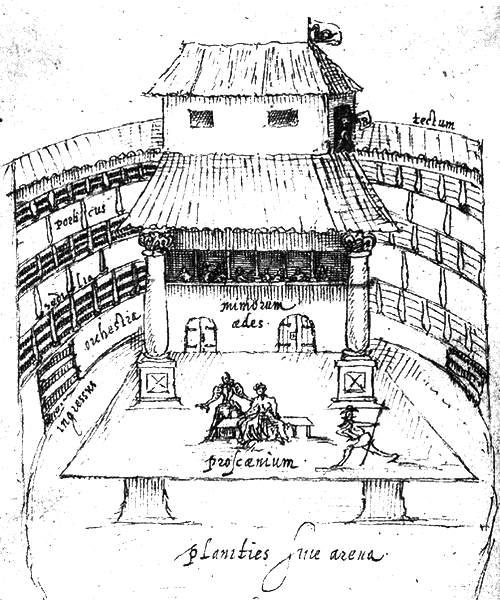
Let’s try to imagine how The Taming of the Shrew might have been stage back in 1592. For that, it might be helpful to know what the actual theatre might have looked like as well:
If we’re lucky, we can afford to by a spot in the covered balconies but most likely we’re just groundlings who paid a cheap rate to stand in the pit all around the stage.
Once the play starts, Sly, the hostess, the lord and his attendants come on stage. They play out the first scene of the prologue. Then, after they’ve dragged Sly off-stage, he reappears on the balcony at the back of the playhouse with the page disguised as Sly’s wife. There’s a good chance the lord and the household servants are up there as well. However, at the end of the scene, the players hired by the lord walk out onto the main stage and start performing a play. This is where act one of the actual play starts.
Sly has a few more lines after act I, scene 1 so we know he’s still around. And it’s likely that he’ll stay up on that balcony for the entire show. That means that we’re watching Sly and the page watch the Taming of the Shrew as we watch the Taming of the Shrew. It also means that the actors the lord has hired for his prank on Sly are the same ones acting out the Taming of the Shrew for us, the audience. Are we supposed to be the butt of a strange joke like Christopher Sly? I’m not sure. If so, I don’t really get it. What this weird half-frame does though is make us aware that we’re watching a play because it keeps the audience of the play – Sly – in view the whole time.
Shakespeare’s big on theatre metaphors in his plays. He’s constantly reminding us that we’re watching a play, and that everything else in our lives also involves a lot of acting and pretending too. However, Taming of the Shrew is an early play, one of Shakespeare’s first. Later in his career, Shakespeare will really become a master of using theatre to comment on theatre and life. He just hasn’t really figured it out yet and this experiment falls a little flat.
That about does it for this week. Be sure to read Jay Reid’s critique of Ralph Fiennes’ recent film adaptation of Coriolanus. If you don’t want to miss anything, subscribe to the blog as well as the podcast on iTunes.
The tragedy of Coriolanus is that a brutish man, prone to burst of violence can be undone by an act of compassion towards those he loves.
Director Ralph Fiennes and screenwriter John Logan make the choice to trim down Shakespeare’s text, conveying that tragedy visually, while creating a film adaptation of the play that is not restrained by absolute faithfulness to the source material.
Fiennes stars at Gaius Martius Coriolanus, a Roman general, whose skills as a warrior makes him something of an anti-hero among the people whom he has open contempt for. They love and hate him within the same scene at times. The scowl on Fiennes face makes his every word seem like it comes from pure rage. His performance gives the film an intensity that would otherwise be lost on stage. He doesn’t even need to spit out the Bard’s words or stab an enemy for the viewer to know that he is a man fueled by anger. A simple glare conveys all we need to know about him.
Early in the film, Coriolanus, after brutally killing an enemy, emerges victorious, walking towards a group of soldiers, his face streaked with blood, almost like war paint. There is no doubt that this is a man who will fight to his last breath, and that makes him a compelling character to watch. Fiennes’ performance can evoke sympathy from the viewer, even when he is at his most monstrous.
His mother, Volumnia, played by Vanessa Redgrave and his wife Virgilia, played by Jessica Chastain, allow Fiennes tender moments in between his bursts of violence and anger. They are his Achilles heel, and yet the only thing that really makes the character anything else than a single-minded warrior.
Redgrave steals most scenes. She gives a tender and powerful performance, showing the strength of a determined, politically minded woman and the compassion of a mother at the same time, while Chastain does her best, but is rarely captivating. Chastain is usually a solid actress, but her performance seems underwhelming when compared to heavy hitters such as Fiennes, Redgrave and Brian Cox as the Roman Senator Menenius. She seems to drop the ball on more than one occasion and often fades into the background.
Performances make or break any Shakespeare film and there can be very little room for weak links in the chain.
Although the film is set in some place called Rome, Coriolanus was shot in Belgrade, Serbia, and the location works well, especially after Coriolanus’ exile. He is shown walking through the cold, gray towns, conveying the harshness of his expulsion in a way only an Eastern European shooting location provides.
The film is transposed into modern day times, where swords become automatic weapons, and discussions between citizens in the play become television news panels. This modernizing of the play gives the film modern day significance, especially when exploring the idea of a patriot exploited by politicians for their own gain, and what happens when they can no longer control that patriot. Coriolanus is a wild guard dog that can never be made to behave, and it’s no wonder that as soon as he develops political aspirations, the politicians turn against him because they are afraid he is going to bite them. They are soon faced with the choice of putting the dog to sleep or casting him out into the wilderness.
Coriolanus is especially strong when we see the titular character unleashed. The film is bloody, as any Shakespearean tragedy should be, but not gratuitous. The violence is never artsy, but brutal in a way that a dogfight can be. The handheld shots of Fiennes stabbing enemies give the brutal scenes of violence a frenetic energy that conveys Fiennes rage. The most effective fight scene is the first between Martius and Tullus Aufidius, played by Gerard Butler. Close, tight shots of Martius and Aufidius, wrapped around each other, almost in a bear hug, are reminiscent of a UFC fight at its bloodiest, and if they were given knives. With bombs going off in the background, the fight scene makes it seem like the entire war is being fought by two men.
Although Fiennes’ film takes certain liberties with the source material, it is loyal to Shakespeare’s vision, capturing the tragedy of a man that has become a killing machine, manipulated by the politicians, lauded as a hero and loved by his family, but lost in his own hate.
It is the Shakespeare film for the person who doesn’t usually like Shakespeare. It’s a compelling piece of work that tries to stand apart from typical film adaptations of Shakespeare’s work, and succeeds as a film by being quiet, relying on the performances of the actors rather than the words of the immortal Bard.
Every week we cap off our recording with a sonnet. In this episode of the Bard Brawl, we gather some of them up and discuss the first five of Shakespeare’s sonnets. Join us as we take you through them and add our many voices to 400+ years of debate: just who are these things supposed to be addressed to? Are they even supposed to go together? Why should we care?
From fairest creatures we desire increase,
That thereby beauty’s rose might never die,
But as the riper should by time decease,
His tender heir might bear his memory:
But thou, contracted to thine own bright eyes,
Feed’st thy light’st flame with self-substantial fuel,
Making a famine where abundance lies,
Thyself thy foe, to thy sweet self too cruel.
Thou that art now the world’s fresh ornament
And only herald to the gaudy spring,
Within thine own bud buriest thy content
And, tender churl, makest waste in niggarding.
Pity the world, or else this glutton be,
To eat the world’s due, by the grave and thee.
Argument: We want beautiful creatures to reproduce so that when they age they leave behind a fresh, young replacement to carry on the legacy. But you’re so enamoured with yourself that you’ll end up denying us an offspring. If you keep this up, you’ll burn up all of your beauty by keeping it for yourself to look at.
When fourty winters shall besiege thy brow,
And dig deep trenches in thy beauty’s field,
Thy youth’s proud livery, so gazed on now,
Will be a tatter’d weed, of small worth held:
Then being ask’d where all thy beauty lies,
Where all the treasure of thy lusty days,
To say, within thine own deep-sunken eyes,
Were an all-eating shame and thriftless praise.
How much more praise deserved thy beauty’s use,
If thou couldst answer ‘This fair child of mine
Shall sum my count and make my old excuse,’
Proving his beauty by succession thine!
This were to be new made when thou art old,
And see thy blood warm when thou feel’st it cold.
Argument: When you’re old (apparently 40 meant something different then than now) your beauty will be a thing of the past. If anyone asks you where you’re beauty’s gone you’ll have nothing to say unless you have a child with whom to leave your beauty in trust. In this way you’ll still feel young even if you’re old.
Look in thy glass, and tell the face thou viewest
Now is the time that face should form another;
Whose fresh repair if now thou not renewest,
Thou dost beguile the world, unbless some mother.
For where is she so fair whose unear’d womb
Disdains the tillage of thy husbandry?
Or who is he so fond will be the tomb
Of his self-love, to stop posterity?
Thou art thy mother’s glass, and she in thee
Calls back the lovely April of her prime:
So thou through windows of thine age shall see
Despite of wrinkles this thy golden time.
But if thou live, remember’d not to be,
Die single, and thine image dies with thee.
Argument: Tell your reflection that now is the time to sire another copy of yourself in the flesh. By keeping to your reflection you rob mothers of sons and daughters. After all, you are your mother’s reflection and she re-lives her youth through yours. If you don’t have any children whose looks will be the memory of yours, you’ll die alone and forgotten. (Weren’t these supposed to be about love or something?…)
Unthrifty loveliness, why dost thou spend
Upon thyself thy beauty’s legacy?
Nature’s bequest gives nothing but doth lend,
And being frank she lends to those are free.
Then, beauteous niggard, why dost thou abuse
The bounteous largess given thee to give?
Profitless usurer, why dost thou use
So great a sum of sums, yet canst not live?
For having traffic with thyself alone,
Thou of thyself thy sweet self dost deceive.
Then how, when nature calls thee to be gone,
What acceptable audit canst thou leave?
Thy unused beauty must be tomb’d with thee,
Which, used, lives th’ executor to be.
Argument: Why do you store up your wealth of beauty? Nature doesn’t give out gifts but rather lends them. You should give back freely of what nature has given you. What account of your fortune can you give if you hoard your beauty? It will just be buried along with you, no one will remember you and you will have nothing to show for it. (Compare this sonnet with the character of Shylock in The Merchant of Venice who is accused of hoarding both his money and his daughter.)
Those hours, that with gentle work did frame
The lovely gaze where every eye doth dwell,
Will play the tyrants to the very same
And that unfair which fairly doth excel:
For never-resting time leads summer on
To hideous winter and confounds him there;
Sap cheque’d with frost and lusty leaves quite gone,
Beauty o’ersnow’d and bareness every where:
Then, were not summer’s distillation left,
A liquid prisoner pent in walls of glass,
Beauty’s effect with beauty were bereft,
Nor it nor no remembrance what it was:
But flowers distill’d though they with winter meet,
Leese but their show; their substance still lives sweet.
Argument: Just as the passage of time turned you from a boy into a man, it will keep passing until you reach your winter years and eventually die. Then, if you haven’t distilled your beautiful essence while it was still time, it will be snowed over and lost forever. But, if you pass your beauty on to another it will survive even though you won’t.
Next week the Brawlers begin a new play. Which one will it be? You’ll have to listen to find out!
Like Caius Marius Coriolanus standing before Rome, we’ve reached the end of our exile’s path and we must now make our choice: which of Coriolanus‘ speeches are worthy of our podcast?
The more popular Julius Caesar is a parade of speeches delivered by master orators. Coriolanus though is a much messier play where dialogue, not monologue, is the norm. That makes it hard to decide where a selection should start and stop which means that I’m sure your favourites were unceremoniously sacrificed or cut short in the making of the show. But fear not! They’re still hale and whole in our five last Coriolanus podcasts. Subscribe on iTunes or download them from this blog to find out what you’ve missed!
“Hail, noble Marcius!”Act I, Scene 1 lns. 173-215 Speakers: Meneniuns, Caius Martius (Coriolanus), Second Citizen
Caius Martius barges in on this scene of civil unrest. While Menenius has been trying to appease the crowd, Martius tells them that he’d rather kill the lot of them than negotiate with them. He also suggests that while the people are quick to assume the food shortage is artificial – that the nobles are hoarding food at their expense – Coriolanus suggests that the people of Rome have done nothing to merit a dole of grain but take to the streets in protest when they should be out fighting Rome’s enemies. Are we swayed by Martius’ argument or does the play’s initial sympathy for the common people make Martius into a despot?
“How many stand for consulships?”Act II, Scene 2 lns. 1-36 Speakers: First Officer, Second Officer
Two officers, sent ahead to the Capitol to put cushions on the patricians’ seats, are speaking about Coriolanus’ nomination to the post of consul. This exchange, and others like it, are central to Coriolanus. The play is not so much about portraying Coriolanus’ actions for their own sake but rather it is about how we should interpret those actions, about the place of Coriolanus’ name in history. Is Coriolanus a victim of history, or of his pride? Should he be reviled as a tyrant or is he a hero of the Roman Republic? Is he the ultimate Stoic or a brat?
“We do it not alone, sir.”Act II, Scene 1 lns. 32-49 Speakers: Brutus, Menenius, Sicinius
This one of many exchanges where the tribunes have at it with the patrician Menenius. Menenius reminds the tribunes of their insignificance and takes them for self-serving and petty politicians. They remind Menenius that he’s got a reputation for drinking. However, Menenius sees nothing wrong with a good drink in its proper time and place. This offers an interesting contrast between two political philosophies: Menenius as the old order, the tribunes as the new. Can we tell where Shakespeare’s sympathies lie?
“It is a mind that shall remain a poison…”Act III, Scene 1 lns. 115-145 Speakers: Sicinius, Coriolanus, Cominius
Coriolanus has so many amazing lines, particularly in act III, but this is one of my favourites. Coriolanus is clearly interested in mocking and abasing the common people, but is he wrong in what he says? It seems to me that he makes a valid point: when two parties struggle for leadership, it weakens the states to outside threats. What is particularly interesting in this passage is that his remarks are addressed as much to the patricians as to the plebeians. While he describes the tribunes as the leader of a school of tiny fish and as two of the heads of the fire-breathing Hydra, he’s also quick to point out that in some ways the patricians are no better. Either they have no real authority – and should stop pretending – or they should flex their muscles and stop giving in to the tribunes’ demands.
“All places yield to him ere he sits down…”Act IV, Scene 7 lns. 30-61 Speaker: Tullus Aufidius
Menenius and Aufidius are possibly the two individuals who have the clearest understanding of Coriolanus’ character, of his strengths and weaknesses. In this speech, Aufidius paints a portrait of a Coriolanus seemingly able to conquer through force of will and presence. But even as he praises Coriolanus the soldier, he identifies the tragedy of Coriolanus’ story: so long as he can wage war, his greatness is uncontested but his inability to adapt his behaviour to new situations – to peace – mean that his greatness will be eclipsed by his own insistence on his greatness.
“Nay, go not from us thus.”Act V, Scene 3 lns. 152-212 Speakers: Volumnia, Coriolanus
Volumnia, Valeria, Virgilia and Young Martius stand before Coriolanus and beg him to spare Rome. Coriolanus makes to leave but his mother calls him back. In a last-ditch effort to sway him, they kneel in front of him. They make a show of being resigned to die with their neighbours in the his pending attack. Volumnia then suggests that Coriolanus is a bastard Volscian and as he is finally moved to make peace between the Volsces and Rome. In the end, does Volumnia move him to compassion or – as his mother suggests – is his renouncing his war on Rome just another selfish act to preserve the integrity of his name to history?
Let us know what you think!
Next week, prepare for our first ever sonnets podcast. Daniel and I will discuss Shakespeare’s sonnets 1 through 5, read each week by our wonderful sonneteers. You won’t want to miss it!










 The Bard Brawl