The Segal Center‘s production of Scapegoat Carnivale Theatre‘s Othello is a version of Shakespeare’s play in which the humours of the rain and sea seem to mirror the tempest at the heart of Othello.
Taking their cue from Othello’s accusation that Desdemona is “false as water,” Alison Darcy (director) and Joseph Shragge (dramaturgy) created a version of Othello which highlights the watery imagery which permeates Shakespeare text.
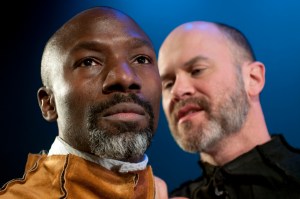
Andrew Moodie is Othello at the Segal Centre. Currently playing. Photo by Andrée Lanthier
As they describe, “water is present in the geography and language” throughout the play in the canals of Venice, the sea at Cyprus, the hypnotic currents of Othello’s storytelling and of course in Desdemona’s tears. This is foregrounded in this production in the ongoing sounds of waves and rainstorms and in the flickering blue light which submerges us in the same dramatic depths as the action taking place on stage.
The bare and unadorned dramatic space is used to great effect. The traditional Renaissance rapier-and-dagger sword fights were greatly appreciated by this Shakespeare and D&D nerd.
The staging of the final act of the play is particularly striking as a drape drops and hangs from the ceiling, serving triple duty as bed covering, curtain and murder weapon. A chilling portrayal of one of Western drama’s most famous homicides.
Despite this strong staging, the play does suffer from uneven acting at times.
As Othello, Andrew Moodie often lacked intensity and presence. In the first scene, when Othello is discovered by Brabantio and his men, Othello admonishes both his men and Brabantio’s to “Keep up [their] bright swords.” However, the delivery of the passage seemed flat, without conviction. While he did deliver some admirable performances at time – the seizure scene in act III springs to mind as particularly noteworthy – Moodie seemed to be searching for his character at various times throughout the play.
Moodie with Sean Arbuckle as Iago. Photo by Andrée Lanthier (courtesy the Segal Centre)
In contrast, Amanda Lisman quickly found her character and, particularly after the first act, delivered a strong performance as Desdemona. However, Julie Tamiko Manning, in the role of Emilia, was one of the stand-out roles of the evening.
Sean Arbuckle’s Iago was also excellent, switching seamlessly between counselling Roderigo to keep sending him money, implanting his poisonous suggestions into Othello’s psyche and playing at being just one of the boys with Cassio.
Maurice Podbrey offered a commanding performance as Brabantio in act I but Paul Hopkins’ Montano was, in my view, the weakest member of the company and made one thankful that he had only a minor part.
While the synergy between Iago and Othello seemed forced at times, the exchanges between Iago and Cassio, as well as those between Emilia and Desdemona, were not only inspired but made the Shakespearean verse seem as natural to the ear as everyday speech. Fortunately, Moodie and Lisman seemed well-matched as husband and wife and if this Othello failed to convince that he could command armies, he could at least persuade that he could charm Desdemona’s heart.
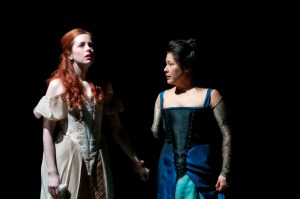
One of the most successful scenes of the production took place in act IV, scene 3 between Emilia and Desdemona. Emilia and Desdemona’s conversation about the infidelities of men, delivered so matter-of-factly by Julie Tamiko Manning and Amanda Lisman only a few moments before Othello arrives in the bedroom, perfectly captures and prepares the tragedy which is about the follow.
Despite its’ imperfections, this production of Othello remains a very successful staging of Shakespeare’s text and one definitely worth seeing.
Or why not offer the gift of jealousy and murder for the holidays this year?
Tickets can be purchased from the Segal Center box office, either by phone at 514-739-7944 or directly on the Segal Centre website site. Prices start from $24. The play runs until December 1st.
What did you think of act I? Kind of makes you want to have a good look at your own friends, doesn’t it?
Nonsense! You are rich in your friends, aren’t you? 😉
While the party’s in full swing within, a Senator arrives at Timon’s gate at the start of act II, scene 1. He’s disgusted that Timon should spend so much money on parties with his friends while he has outstanding debts to this senator. The Senator commands his servant Caphis to take debt bonds to Timon and not return until Timon pays up. The senator suspects that, when the money runs out, so will Timon’s friendships.
Flavius is just complaining about Timon’s careless spending when Caphis walking in to scene 2, speaking with Varro and Isidore’s servants. These men are also looking to collect on some outstanding debts. They intercept Timon as he returns from hunting. Timon tried to talk his way out of it but Caphis reminds him that his money was due six weeks ago and won’t take no for an answer. Flavius promises to deal with it for them right after supper and ushers Timon away.
The servants hang back to be made fun of by the Fool and Apemantus who, as Daniel points out, seem to be competing for the job of “guy who gets to say whatever he wants to Timon’s ‘friends’.”
After hearing about the current state of his finances, Timon tries to blame Favius for not mentioning any of this sooner. Flavius of course tell him that he tried to but that Timon wouldn’t hear it before. And now, even if Timon were to sell everything he has, that would only be enough to pay back about half the debt. While Falvius freaks out Timon calms him down and reminds him that as he has so many friends in good financial situations surely a few of them will be willing to help bail him out of this. But, turns out that Flavius has already approached some of these friends who gave him a bunch of excuses as to why they couldn’t help Timon. No big deal though: Timon’s buddy Ventidius – who he bailed out of jail in act 1 – just struck a rich inheritance so he’s sure that he’ll be more than happy to help out Timon.
Here are some of the characters introduced in this act:
Senator: This senator has lent money to Timon who does not appear to be in any hurry to pay him back. He comes armed with his legal documents to collect his debt.
Caphis: A servant to the Senator who comes knocking at Timon’s door to get the money he is owned.
Timon of Athens is a tragedy set in – you guessed it – Athens. Timon is a well-loved aristocrat who is extremely generous with his wealth. In other words, he’s a sucker surrounded by sycophants but he’s the only one who doesn’t see it.
First order of business, this is how you pronounce Timon’s name: /ˈtaɪmən/.
Seeing as that’s basically gibberish, here’s a clearer pronunciation guide: it’s Timon like Simon, not Timon like Timon and Pumba.
Moving on.
Only two scenes in this opening act but they cover a lot of ground. The play opens on a scene set inside one of the (probably richly appointed) halls of Timon’s house in Athens. A painter, poet, jeweller and merchant are discussing the fact that they each are hoping to win Timon as a patron, or to sell their products to him at an inflated price. We learn that this appears to be common practice and that Timon seems to operate under the motto of ‘no unreasonable offer refused.’
Eventually Timon arrives, followed by a messenger who tells him that his friend Ventidius is about to be carted off to debtor’s prison because he’s been unable to pay his debts. (Yes, unpaid invoices used to result in jail time, indentured service or flat-out slavery.) Of course, Timon cannot let his friend go to jail so he accepts to pay the debt on his behalf and asks the servant to bring him to dinner so he can eat the shirt of Timon’s back as well.
Hot on the heels of the this messenger comes an old Athenian gentleman who is upset because one of Timon’s poor servants wants to marry his daughter. No problem for Timon; he offers to match the dowry offered to allow Lucilius to marry her. No sooner has the old man walked off that the painter, poet, jeweller and merchant swoop in. However Apemantus, an ornery Athenian lord, calls them out for their self-interested flattery. Timon accuses Apemantus of being an arrogant and proud ass; Apemantus calls Timon out for being a sucker who spends his money buying false friends. (Apemantus is still going to eat Timon’s food though, and Timon isn’t going to kick Apemantus out for berating his guests.)
Scene II features the actual banquet itself. A bunch of lords and senators of Athens are in attendance, partying it up on Timon’s dime. Ventidius is there and thanks Timon for his hep in bailing him out of jail. In this short span, he has had a sudden and mysterious windfall: his father died and Ventidius inherited his fortune. He offers to pay Timon back twice the amount of his bail but Timon refuses to take his cash. In fact, he says, his bank account is always open for his friends.
More banter between Apemantus and Timon ensues and Timon threatens to banish Apemantus to the kiddy table. Timon then starts making speeches about how great his friends are and how he’s lucky to be able to take care of all of them. Some women dressed as Cupid and some Amazons then arrive to crash to party. After a dance, Timon feeds them too.
In the mood to hand out more gifts, Timon calls his servant Flavius to bring him a box of jewels. It would seem that Timon is in the habit of giving more than he can afford. Flavius tries to warn him that he’s broke even as he’s handing out jewels like they’re business cards. The party wraps up with everyone running off with their loot. Only Apemantus remains and he tries to get Timon to see that’s he’ being taken advantage of. Timon, of course, refuses to see it.
With that , here’s a short list of the major characters appearing in this act.
Poet, Painter, Jeweller and Merchant: Their titles pretty much sum it all up. These aren’t really fully fledged characters but are there to give Timon opportunities to give out more money than he can afford.
Timon: A naive and generous Athenian lord who’s not quite as wealthy as he thinks he is, in both his friends and his funds.
Apemantus: Honestly, Apemantus is a bit of a jerk. Is he right? Yes. Timon is being taken for a ride by all of his so-called friends. However, if your ‘friend’ was trying to point out your mistakes by being a sarcastic jerk, how likely would you be not to tell him to f-off? There’s a difference between flattery and tact, Ape-Mantis! (Sorry, I can’t help thinking ‘Godzilla vs Ape-Mantis’)
Alcibiades: He’s an Athenian general recently returned from battle. He’s actually one of Timon’s real friends.
Ventidius: This is the guy Timon bails out of jail. And who we now know is rich because his dad died and he inherited the fortune. Remember that because it might come back later.
Flavius: Timon’s servant and, it would appear, his chief bookkeeper. He’s the only guy who seems to know just how little money Timon actually has.
Surrounded by great friends, full of food and wine, where else could this play go but down, down, down! Should be entertaining.
Terry stopped by to give his interpretative reading of sonnet 38. Trust me, you want to stay for this one.
Stay tuned, Brawlers.
Join us by contributing to the Bard Brawl journal volume I at our Indiegogo page.
Not one of Shakespeare blockbusters, this play will keep you guessing with its string of improbable twists and turns. The verdict? More people should read it.
You can help popularize Pericles by dropping some of this bardic wisdom (which you’ll have fully memorized by then) the next time you’re at a party. Bonus points for you if you can flash mob one of these.
(We accept video submissions.)
“Of all say’d yet, mayst thou prove prosperous!”Act I, scene 1 Speakers: Antiochus’ daughter, Pericles, Antiochus
So. Pericles gets on a boat and travels to Antioch to try to score this world-renowned princess to be his wife. He’s already managed to impress the girl who is won over by his big bucks and his sexy looks. Like all good potential father-in-laws, Antioch decides he better test this guy to make sure he’s the real deal… by asking him to decipher a riddle.
Okay, no problem. Pericles is up for it. And then he discovers that this pervert is advertising his incestuous relationship with his daughter. Thing is, Antiochus is so used to being surrounded by ‘yes men’ that he’s not prepared for the fact that Pericles is ready to call him out on how disgusting this is. As for the girl? Looks can be deceiving.
“By Juno, that is queen of marriage”Act II, scene 3 Speakers: Thaisa, Simonides, Pericles
Freshly fished out of the sea with his rusted armour, Pericles is hard at work out-jousting the competition at Simonides’ “Marry my Daughter” Royal Rumble when he catches Thaisa’s eye. While she is busy imagining herself getting with that dreamy Pericles, he’s more interested in Thaisa’s dad. “Wow, that guy would totally be an awesome replacement for my dead dad.”
It’s a strange play.
“Thou god of this great vast, rebuke these surges”Act III, scene 1 Speakers: Pericles, Lychorida
Pericles is on his way home to Tyre with his wife when Thaisa goes into labour. Unfortunately, as she’s trying to give birth, a huge storm is raging around them. He is asking the gods to call off the storm. And when the midwife and nurse Lychorida arrives, he hopes that she can help speed things up. Instead, she hands him his daughter, Marina, introduced to her father for the first time as a piece of his dead wife.
“I hold it ever”Act III, scene 2 Speakers: Cerimon, Second Gentleman
Our play’s miracle worker affords himself a moment of moralistic speechifying before going to work bringing Thaisa back from the edge of death. Virtue and cunning > nobles and riches. What type of ‘virtue and cunning’? Alchemy. So you can learn the power over life and death, and use it only for good, right? Well, yes. That’s exactly what Cerimon does. He even takes Thaisa’ crown jewels… for safe keeping, of course.
“My commission”Act IV, scene 1 Speakers: Leonine, Marina
So pirates. Maybe we were a little excited about reading a Shakespearean play with pirates in it so we inflated their importance in our recollection of play. Still, the pirates here actually end up saving Marina’s life, in a very twisted sex-trade driven way. Dionyza ordered Leonine to kill her Marina and he decides that after they have scooped her up and ran off with her to their ship, he should follow along to make sure that they kill her after they have raped her. (I thought my job sucked.) Except, they didn’t rape her. They ‘only’ sold her into slavery where she transformed the lustful governor of Mytilene into a noble, Pericles-approved husband.
Artwork – Stephanie E.M. Coleman.
“Of Antiochus and his daughter you have heard”, Epilogue (Act V, scene 3) Speaker: Gower
Are you ready for the moral of the story? I mentioned in the show that I couldn’t think of too many of Shakespeare’s plays which ended with epilogues. Actually, that’s not really accurate. I can name several which do end with some form of epilogue: As You Like It, The Tempest, Twelfth Night, A Midsummer Night’s Dream.
However, Shakespeare’s not generally so heavy-handed. In case we missed it (because being struck down by lightning or burned alive in your palace by a mob are very subtle forms of divine retribution), ‘Gower’ spells out who the heroes and villains are. Pericles, Helicanus and Cerimon: good; Antiochus, Cleon and Dionyza: bad.
Don’t sleep with your daughter and don’t kill your neighbour’s kid.
Geez, good thing you spelled it out for us, Shakey!
Welcome back to the Bard Brawl! I know you’ve missed us over the past few weeks but here at last – and just in time for the new school year – is act III of Pericles, Prince of Tyre!
At the end of act 2, we learn that Pericles is finally getting married and the lucky winner is Thaisa, the daughter of Simonides. Once they get hitched, it’s off to Tyre! Gower, as usual, brings us up to speed in his prologue.
(FYI, the Shakespeare edition which we use for the show is a little messed up for Pericles. In this case, the prologue for act III is about halfway down the page. It starts with: “Now sleep y-slaked hath the rout”. Act III, scene 1 then start right afterwards, on the same page.)
Of course, what happens on the return trip in act III, scene 1? Yup. Another storm at sea. To make matter worse, Thaisa goes into labour while the storm rages around the ship. The child, Marina is born but Thaisa is pronounced dead and is given a hasty burial at sea. Pericles orders the mariners to set sail for the nearby coast which – as it happens – is the coast of Tarsus.
In scene 2 the action shifts to the home of a Ephesian physician, Cerimon (Not to be confused with this guy). A few men have come to him after they found a sealed casket washed ashore. When they open it, they discover Thaisa and Cerimon realises that she’s not dead. With the help of some cutting edge medical procedures he revives her. It seems strange to me that given the opportunity to really set up a surprise later on, Shakespeare doesn’t even wait a few scenes before revealing to us that Thaisa is still alive. Not to mention that Gower is constantly telling us what’s about to happen in the next scene…
Anyhow.
Pericles has made it to Tarsus and after a brief stop to refit the ship, is ready to embark on the final leg of the journey which will take him home to Tyre. For some reason that’s not really clear to me, Pericles leaves his daughter Marina in the care of Clear and Dioniza who accept to raise her as their own until she is old enough to be married. It’s your standard kind of exchange: Pericles has provided Cleon with corn to feed his people, so the only fair thing is for Pericles to ask him to care for his daughter for 15 years.
We return to Thaisa and Cerimon in the last scene of the act. Cerimon has brought her up to speed on where she is. She seems to think that there is no way she will ever be reunited with Pericles so she decides that she going to do the only sensible thing she can and become a nun at Diana’s temple.
Here are some of the characters introduced in act III:
Cerimon: He’s a physician in Ephesus. He revives Thaisa. He’s kind of like Miracle Max in The Princess Bride. (I guess she was only mostly dead…)
Welcome Brawlers to another episode of the Bard Brawl!
Next week, pirates. But before we get to that, we’re back with another one of our sonnets podcasts. In this recording, we pick up where we left off with sonnets 18-23.
You’ll remember that sonnets 1-17 were the so-called Procreation sonnets because they were trying to convince a young man to have kids. Seems that didn’t go so well, either because the young man didn’t follow his advice or because the poet decided that human lives are too fleeting.
This means that the sonnets are still being addressed to the same young, at least until we get further along into the sonnet sequence and Shakespeare starts writing about a mysterious (but hot) dark lady who is somehow involved with both men.
I guess that if you want to immortalise someone for all time, nothing does it better than poetry, right?
It’s kind of ironic that no one knows for sure who the hell these sonnets are actually addressed to.
Shall I compare thee to a summer’s day?
Thou art more lovely and more temperate:
Rough winds do shake the darling buds of May,
And summer’s lease hath all too short a date:
Sometime too hot the eye of heaven shines,
And often is his gold complexion dimm’d;
And every fair from fair sometime declines,
By chance or nature’s changing course untrimm’d;
But thy eternal summer shall not fade
Nor lose possession of that fair thou owest;
Nor shall Death brag thou wander’st in his shade,
When in eternal lines to time thou growest:
So long as men can breathe or eyes can see,
So long lives this and this gives life to thee
Argument: The totally predictable thing to do would be to compare to a summer’s day and point out how you’re just as awesome. But actually, that doesn’t work because you are even better than summer could ever be. Here’s what’s wrong with summer: it’s too hot, the winds are too violent and it’s too short. Luckily, thanks to the awesome power of poetry, that won’t happen to your summer (as long as people keep reading these poems).
Devouring Time, blunt thou the lion’s paws,
And make the earth devour her own sweet brood;
Pluck the keen teeth from the fierce tiger’s jaws,
And burn the long-lived phoenix in her blood;
Make glad and sorry seasons as thou fleets,
And do whate’er thou wilt, swift-footed Time,
To the wide world and all her fading sweets;
But I forbid thee one most heinous crime:
O, carve not with thy hours my love’s fair brow,
Nor draw no lines there with thine antique pen;
Him in thy course untainted do allow
For beauty’s pattern to succeeding men.
Yet, do thy worst, old Time: despite thy wrong,
My love shall in my verse ever live young.
Argument: Here’s the deal, Time: feel free to make the lion old, to make the tiger lose his teeth, to kill off the phoenix and everything else in the world. Go ahead and ruin everything. But, Keeps your hands of my beloved! Don’t you dare spoil a single one of their features. In the end though, joke’s on you: they’ll be young forever because I have encased them in poetic carbonite.
A woman’s face with Nature’s own hand painted
Hast thou, the master-mistress of my passion;
A woman’s gentle heart, but not acquainted
With shifting change, as is false women’s fashion;
An eye more bright than theirs, less false in rolling,
Gilding the object whereupon it gazeth;
A man in hue, all ‘hues’ in his controlling,
Much steals men’s eyes and women’s souls amazeth.
And for a woman wert thou first created;
Till Nature, as she wrought thee, fell a-doting,
And by addition me of thee defeated,
By adding one thing to my purpose nothing.
But since she prick’d thee out for women’s pleasure,
Mine be thy love and thy love’s use their treasure.
Argument: You have a beautiful woman’s face and a tender woman’s heart – but none of those unpredictable mood swings. You’re also way more faithful and not easily attracted by each passing hottie. In fact, whatever you look at is made better because of it. Both man and women want (to be) you. You were clearly intended to be woman but Nature was so enamoured with your that she decided to give you a penis. So women can use your for sex all they want so long as I can have your love.
So is it not with me as with that Muse
Stirr’d by a painted beauty to his verse,
Who heaven itself for ornament doth use
And every fair with his fair doth rehearse
Making a couplement of proud compare,
With sun and moon, with earth and sea’s rich gems,
With April’s first-born flowers, and all things rare
That heaven’s air in this huge rondure hems.
O’ let me, true in love, but truly write,
And then believe me, my love is as fair
As any mother’s child, though not so bright
As those gold candles fix’d in heaven’s air:
Let them say more than like of hearsay well;
I will not praise that purpose not to sell.
Argument: These other poets see a person with way too much Botox and then pretend like they’re more beautiful than all of the wonders of nature. I’m not going to do that. I’m just going to be honest with you and tell you that my love is very beautiful but there’s no way they (or anyone else) are as beautiful as the stars. Since I’m not trying to impress you or trying to sell you anything, I’m not going to insult your intelligence by feeding you a load of BS.
My glass shall not persuade me I am old,
So long as youth and thou are of one date;
But when in thee time’s furrows I behold,
Then look I death my days should expiate.
For all that beauty that doth cover thee
Is but the seemly raiment of my heart,
Which in thy breast doth live, as thine in me:
How can I then be elder than thou art?
O, therefore, love, be of thyself so wary
As I, not for myself, but for thee will;
Bearing thy heart, which I will keep so chary
As tender nurse her babe from faring ill.
Presume not on thy heart when mine is slain;
Thou gavest me thine, not to give back again.
Argument: I don’t care what my mirror says, I won’t be old as long as you remain young. Once I do see that you are old, then I’ll be ready for my grave. Really though, you look so good and young because I’ve got my ‘love delusion’ goggles on. Until I take them off, there’s no way we’ll be old. So, take care of yourself for my sake. I’ll take care of your heart carefully but don’t expect to ever get it back: it’s mine now, no take-backs.
As an unperfect actor on the stage
Who with his fear is put besides his part,
Or some fierce thing replete with too much rage,
Whose strength’s abundance weakens his own heart.
So I, for fear of trust, forget to say
The perfect ceremony of love’s rite,
And in mine own love’s strength seem to decay,
O’ercharged with burden of mine own love’s might.
O, let my books be then the eloquence
And dumb presagers of my speaking breast,
Who plead for love and look for recompense
More than that tongue that more hath more express’d.
O, learn to read what silent love hath writ:
To hear with eyes belongs to love’s fine wit.
Argument: I know I sound like a blubbering idiot when we’re together but I swear it’s just that my love for you is so strong that it overwhelms me and I just can’t speak. Kind of like and actor who forgets his lines because they’re nervous or like someone who is so too pissed for words. Instead, I hope that you will read these poems and let them speak for me. Wouldn’t that be an impressive trick – letting your eyes ‘hear’ what a have to say?
Fair warning Brawlers: things are liable to get a little weird next week.
But it probably won’t be any worse than your last family gathering where your drunk uncle hit on your girlfriend before spending the rest of the night trying to kill one of your second cousins
As usual, we’ve picked out a few memorable or interesting moments from our recording of Twelfth Night. It was a blast to read and record.
No nobles were maimed in the recording of this podcast.
“O that I served that lady…”Act 1, Scene 2, lns 42-60 Speakers: Captain, Viola
In this scene, Viola washes up on shore and realises the following two things:
“I am a young, unmarried woman with no chaperone. I have no father or brother around to guard me from any potential suitors. This is a dangerous situation. I could be raped or claimed as booty at any time!“
“I am a young, unmarried woman with no chaperone. I have no father or brother around to guard me from any potential suitors. This is an awesome situation. If I play my cards right, I will actually get the choose my own husband!“
So what is her proposed solution? Dress up in her twin brother’s clothes and hide out as an eunuch. By the way, eunuch here doesn’t necessarily mean a castrated man but rather a chamberlain, someone who takes care of someone’s bedchamber. It’s a pretty good description of what Viola is supposed to be doing: finding a way to get Olivia into Orsino’s bedchamber. Instead she manages to put exactly who she wants in that bedchamber – herself. Clever girl.
Daniel thought it was pretty interesting to consider that in a play where the main character spends over 95% of the length of the play in disguise, she should be so quick to judge the captain’s trustworthiness based on his looks. I agree.
“Come, sir, you peevishly threw it to her; and her…”Act 2, Scene 2, lns 13-41 Speakers: Malvolio, Viola
We were pretty sure that Malvolio and Viola didn’t really interact in the play but this scene proves us wrong. It’s especially shameful on our part given that this is one of the most well-known speeches in Twelfth Night.
Olivia, who is trying to nail Cesario, send him a ring via Malvolio. It’s as soon as he leaves Viola with this ring that she realises what’s going on here: Viola loves Orsino but can’t have him without exposing her identity; Orsino is expecting Viola to win Olivia for him which means that Viola won’t be able to get him. To make matters worse, Olivia seems to be in love with Cesario… but has no clue that Cesario is actually a woman.
Does Viola freak out? Nope. She just assumes that this will all work itself out in the end somehow in time.
Huh. I guess she must have read this play already.
By the way, what will we ever do without Zoey nearby?
“What a caterwauling do you keep here! If my lady…”Act 2, Scene 3, lns 68-112 Speakers: Maria, Sir Toby Belch, Feste the Clown, Sir Andrew Aguecheek
When it comes to Sir Toby, Aguecheek and company, there are so many entertaining moments that it’s hard to choose. Honestly, we picked this scene (and let it play for a while) because we love Jay Reid’s drunken singing so much.
Can you hear us all laughing our asses off in the background? Yeah, that’s the idea. Lest anybody get confused: we’re not interested in scholarship and research, deep insights and exploring the meaning of it all. We like reading Shakespeare because we find it fun to do, to mess around with and to mess up. Often.
There are enough people who take their Shakespeare like cod liver oil: good for you but tastes awful. I say you should let the kids have a damned hot-dog from time to time. They don’t need to know it’s a nitrate-free, 100% certified organic grass-fed beef super hot-dog that costs about $40 for a package of 12.
Pass the relish!
“M, O, A, I; this simulation is not as the former: and…”Act 2, Scene 5, lns 131-150 Speakers: Malvolio
This scene of Malvolio reading a letter aloud may contain one of the most often misquoted speeches in Shakespeare. It’s not that people get the words wrong, it’s that they use the quote completely out of context.
How many of you have heard some or all of this before?
be not afraid of greatness: some
are born great, some achieve greatness, and some
have greatness thrust upon ’em
Fellow trekkies may remember a certain episode of DS9 where Worf recalls a very similar speech which was allegedly spoken by Kahless to convince general Martok to claim the mantle of leadership of the Klingon high council.
Do you find these words encouraging? Do they make you want to risk everything on the chance of success? Do they inspire your to seek out your destiny?
On their own, they might. But this ‘speech’ is in a letter, written by Maria, which has only one purpose: to goad Malvolio into making a pass at his boss so Maria, Sir Toby and the other can make fun of him when he gets shot down.
I always thought that Worf liked you Martok but I seems he’s just an ass looking for a good laugh at your expense.
“This is the air; that is the glorious sun…”Act 4, scene 3, lns 1-21 Speakers: Sebastian
This is one another one of the commonly quoted speeches in this play. It’s Sebastian’s ‘pinch me now, I must be dreaming’ moment.
And why shouldn’t he think this? Antonio gave him a pouch of money to keep and hasn’t asked for it back and Olivia, a beautiful and wealthy widow, married him within moments of meeting him.
Easiest booty call ever.
What surprises me about this speech is that Sebastian is looking for Antonio so he can get an explanation for what is going. Why not ask Olivia: “Hi. Thank you for your interest in me. I am flattered and looking forward to our nuptial hour. However, could you please explain to me who you think I am so I can do my best to meet your expectations? Thank you.”
I guess he figures that if it is a dream, he’s not about to ruin it by risking an argument with his sugar mommy wife.
In the next two weeks the Bard Brawl is about to start its seventh play. How awesome is that?
Even more awesome: I promise you pirates! (Your experience may vary. Results not typical.)
But first, stay tuned for our next sonnets podcast which will be up shortly.
Only one scene in this act but it’s a pretty wild one.
Orsino, that lazy, pathetic ass, has finally decided that if he wants Olivia he should probably make some sort of effort himself to win her over. He runs into Feste and Fabian outside of Olivia’s house. Insert a couple of jokes about friends and asses before Orsino sends Feste to fetch Olivia. While he waits, Viola (yup, still disguised as Cesario) notices Antonio being lead before the Duke by an officer. Orsino immediately recognises him as a pirate, but Viola tries to plead for mercy as Antonio defended her from Sir Toby and Andrew Aguecheek’s attacks.
Antonio attempts to defend his presence in Illyria by explaining that he was bewitched by Sebastian’s good looks and obvious character into making stupid decisions like exposing himself to the death penalty by being caught wandering the streets of Illyria. To make matters worse, he accuses Viola (thinking it’s Sebastian) of having refused to give back the money he had given him in trust. Of course, everybody thinks he’s a little nuts because Viola honestly has no clue what the hell he’s talking about. Both Orsino and Antonio claim to have been with “Viola” for the last 3 months.
Olivia arrives and once again refuses Orsino’s advances. To make matters worse, she hits on ‘Cesario’ who she thinks she just married an act ago. When Viola says she plans on following the person she loves, Orsino, Olivia accuses her ‘husband’ of being unfaithful. Viola denies it, of course, but just then – by total coincidence – the priest comes in and backs Olivia.
Moments later, Aguecheek comes in asking for a doctor for Sir Toby who was just injured by ‘Cesario.’ More confusion as Aguecheek blames Viola for Sebastian’s actions. As Belch and his buddies are lead out, Sebastian walks on stage. Finally we have both siblings on-stage at once! Olivia seems particularly happy at the prospect of two Cesario’s: “Most wonderful!” I’ll let you finish the porn joke in whatever way seems best to you.
Sebastian and Viola tease out the moment where they finally admit that they’re brother and sister and that, strangely, all of this is totally okay in the end. Olivia is just as happy with Sebastian, Sebastian is all too happy with Olivia’s money; Viola finally gets to have Orsino, who now seems perfectly happy to give up his hot widow for woman he has spent the entire play confusing for a boy. This will make for some interesting swinger parties.
There are a few other loose ends to warp up. They read Malvolio’s letter and realise that maybe he’s not nuts so they may as well let him out of the asylum. Malvolio accuses Olivia of having toyed with him but Olivia denies that she had anything to do with it. Malvolio swears vengeance. I imagine everybody just laughs.
We also learn that Sir Toby and Maria are getting married but I’m sure they won’t be invited to the swinger party.
I have finally understood why, at least for the last 30 years, Henry VI, part 1 is not taught or read: Jane Howell’s BBC production of The First part of Henry the Sixth took it out back and shot it. Repeatedly.
Where to begin?
The First Part of Henry the Sixth (Tv 1983) is not, strictly speaking, a movie adaptation of Shakespeare’s play. While it does make use of some cinematic techniques, it is essentially a filmed staging of a stage play without any of the energy or tension which accompanies the live theatre experience.
That, I think, may be exactly where the problems start for Howell: she doesn’t seem to be able to decide whether this is a movie or a play. The result is a schizophrenic blend of kitsch costumes, tired stage conventions and amateurish camera work. It’s a distracting hot mess that seems especially designed only to confirm the popular opinion, that Henry VI part 1 is a bad play.
The sets and costumes look like they were produced for and by a high school drama class. One possible reason cited for this choice is to showcase the often petty and childish nature of the infighting which characterises the War of the Roses. However, I feel that it backfires in The First part of Henry the Sixth: instead of showing us the petty nature of the War of the Roses (which seems plain enough in Shakespeare’s language anyway), it turns Henry VI part 1 into a bit of a joke by cheapening what are also the very serious consequences of these wars. Very unfortunate.
Jane’s First Part of Henry the Sixth is part of a larger collection of made-for-TV movies produced by the BBC in the late seventies and early eighties. The BBC television Shakespeare was an ambitious project not entirely unlike the Bard Brawl’s in scope: to produce a filmed version of each one of Shakespeare’s plays. And to their credit, they did manage to complete the project – you can order the complete 38 DVD set from the BBC or on Amazon and then you will own this gem forever! Or you can buy something you’ll actually watch. Whatever.
Given that the purpose of the BBC’s project was to produce largely faithful to the text versions of these plays, Howell’s film works its way through Shakespeare’s play without any noticeable leaps, omissions or inventions on Howell’s part. The setting of the play is fifteenth century Europe and it opens with English nobility gathered for Henry V’s funeral. The language is Shakespeare’s and the movie ends where Shakespeare’s play ends.
One of the few differences: Howell chose to open the film with a dirge sung by Henry V’s son who was played by 40 year-old Peter Benson.
I guess they missed the part where Henry VI was nine months old when his father was killed, and about 12 years-old during the rest of the play.
I’ll spare you the plot synopsis seeing as we’ve already done one for each act and Howell’s film follows almost exactly Shakespeare’s Henry VI, part 1. (You can refer to our previous posts on Henry VI, part 1 if you need a quick plot reminder.)
After all of this, is The First Part of Henry VI a total wash? No. There are a few, precious – oh, so very rare and precious – pearls locked up within this clam.
Trevor Peacock manages to deliver a Talbot which is every bit the hardened, noble English warrior of Shakespeare’s Henry VI, part 1. Brenda Blethyn plays a very energetic and active Joan who has the entire French court wrapped around her fingers. Too bad the stage fighting, a large part of Shakespeare’s Henry VI, part 1, is so bad. It just turned Pucelle’s fight with Talbot – which is one of many great action scenes in this play – into a farce
As I watch this, I wonder why Howell insists on draining just about every one of the action sequences of its dramatic potential?
In my opinion, however, the strongest and most successful character is Richard Planatagent, Duke of York who is played by none other than the brilliant Bernard Hill. If that name doesn’t sound familiar, it should. But maybe you know him by his other name, King Théoden of Rohan.
While the BBC’s project to adapt every one of Shakespeare’s plays to film verbatim was an excellent initiative from an archival perspective, it really failed to produce something that brings Shakespeare to a new audience in a way which is both easily accessible and engaging. In the end, Howell’s choices in The First Part of Henry the Sixth results in a finished product which is alienating and off-putting.
The First Part of Henry the Sixth remains an excellent study… in how NOT to bring Shakespeare’s works to life.
Unlike with our previous play, The Taming of the Shrew, we had no trouble finding speeches to fill an episode.
Really, as we’ve been saying all along with one, Henry VI, part 1 deserves a closer look. Hopefully some of these speeches can encourage you to go back and listen to the episodes you missed. (Not that you missed any, right?)
“How I am braved and must perforce endure it!”Act II, scene 4, lns 112-127 Speakers: Richard Plantagenet (and eventual Duke of York), Warwick
This excerpt is from the flower-picking scene in act II. Here we learn that Richard Plantagenet, whose father was accused of being a traitor and stripped of his titles, is likely to be restored to his family’s former status as Duke of York. Warwick seems certain of it. Warwick’s short speech also ends with a prophetic foreshadowing about the War of the Roses: “this brawl to-day, / Grown to this faction in the Temple-garden, / Shall send between the red rose and the white / A thousand souls to death and deadly night.” That does about sum it up. (Also, big plus on the use of the word “Brawl,’ Bard!)
“Thus the Mortimers, / In whom the tide rested, were suppress’d.”Act II, scene 5, lns 91-118 Speakers: Mortimer, Richard Plantagenet
Mortimer only appears in one scene on this play but it is a very crucial scene. We pick up on the end of their discussion but Mortimer provides the necessary history earlier. The current king Henry VI is the descendant of Henry IV who actually usurped the throne of Richard II. Mortimer himself, connected with the old regime, has spent most of his life imprisoned or banished. Now Mortimer informs Richard Duke of York that he is in fact descended from the previous line of kings. While Mortimer cannot see yet how to topple the house of Lancaster, he counsels York to bide his time until an opportunity should present itself.
“Look on thy country, look on fertile France…”Act III, scene 3, lns 44-85 Speaker: Pucelle, Burgundy
This is the scene where Joan la Pucelle convinces the Duke of Burgundy to ally himself with the French cause. What we found particularly interesting in this passage is Burgundy’s short response in the middle of Pucelle’s longer speech: “Either she hath bewitch’d me with her words, / Or nature makes me suddenly relent.” It’s a very good question. Which is it? Is Burgundy simply doing the natural thing in seeking to defend the ‘country’ of his birth? Is he in fact French, or is he English? It’s easy for us to say that Burgundy is French but the whole point here is that Burgundy easily could have remained an English territory. And Burgundy’s actions are largely the reason it went to the French. So, was any of this ‘natural?’
“Come hither, you that would be combatants”Act IV, scene 1, lns 133-173 Speaker: King Henry VI
King Henry doesn’t say much in the play and when he does speak, he generally just shows us how ineffectual a ruler he is. We picked this passage though because it showcases one of the few moments where King Henry actually gets it at least partially right. One the one hand, the first part of Henry’s speech is spot on; the English court is in france fighting the Dauphin’s forces. Showing a strong, united front is necessary in order to discourage any further rebellion from the French forces. However, he grossly misunderstands the nature of the division in his forces. We’ve seen the argument boiling and bubbling under the surface just waiting to erupt but Henry seems entirely oblivious to the extent of the division in his court. This scene really shows us Henry’s character as an idealist ill-suited to the throne.
“O, my dear lord, lo, where your son is borne!”Act IV, scene 7, ln 17-32 Speakers: Servant, Talbot
Talbot really is the central point of most of the play. He drives the war effort in France and he sends the French forces packing at the very mention of his name. Unfortunately, York and Suffolk’s squabbling leaves him unsupported and he and his son are overwhelmed and killed in battle. This is Talbot’s final speech. His dead son is brought in and he cradles him in his arms as he dies. I wrote about his passage when we did act IV. I mentioned that Talbot mentioned Daedalus and Icarus, flying towards the sun but what would that look like? Two angels floating up to Heaven. I think it’s a great little speech.
“First, let me tell you whom you have condemn’d…”Act V, scene 4, lns 36-59 Speakers: Pucelle, York, Warwick
This is Joan la Pucelle’s execution scene. While her burning doesn’t actually happen on stage, this is the preamble leading up to it. Here she is trying to convince York not to burn her. She first starts by suggesting that she may be of noble birth and she insists that she is a virgin. When she sees that this is not working, she changes her tune and states instead the she is pregnant. This is a very strange scene. On the one had, we just saw Joan speaking with demon a few scenes ago so we now have a pretty good idea that she is a witch. On the other hand, this scene shows us a group of powerful, older men trying to burn a young (and potentially pregnant) woman alive. As Daniel has pointed out, this would be a tricky scene to stage for a contemporary audience. Come to think of it, it’s almost criminal to think that no one has written a play inspired by this scene which deals precisely with these gender and power issues.












 The Bard Brawl