The Taming of the Shrew (1967), Franco Zeffirelli (director)

Miki Laval

I’m certainly not the first to say it; for modern audiences the Taming of the Shrew is often a problem. Yes, there’s plenty of boisterous and bawdy slapstick comedy, and some hilarious and confusing role reversals, but how to accept a play that so thoroughly breaks the spirit of its lead female character? There’s no possible way to address the role of Katherine without touching on the play misogynistic elements, yet instead of a literary or feminist critique allow me to bring up two iconoclastic females: Cinderella and Elizabeth Taylor.

We all know the story of Cinderella, or Cendrillion. But shew tales, as they were called, were once as widely known as the story of maltreated daughter and her glass slipper. Different shrew versions mucked about with the details, but the basic plot stayed constant: a good husband, saddled with a surely wife, turns her obedient through intimidation and violence. The violence is always brutal, on par with the Brother’s Grimm’s or Charles Perrault. (In one version the wife is sewn up in the skin of a dead horse and beaten.) Yet shrew tales share another trait with the fairytale or fable; they function around a dependable and repetitive plot in order to convey a moral lesson. In allegory, plot takes precedent over individual character, the sine qua non of modern literature. Why exactly is Cinderella’s stepmother evil? Hard to say, really, because in most versions she’s devoid of any personal qualities. Why does Cinderella get the prince? As a moral lesson that the oppressed and long suffering will eventually be rewarded. (A witty feminist view on a similar fairytale Beauty and the Best can be found here.) For a Shakespearean audience to ask why the shrew is tamed would be akin to asking why Cinderella’s stepsisters are bitchy. The general fairytale plot dictates that stepsisters are jealous, and so they are a dependable nasty piece of work. Or, in other words, the shrew is tamed because the shrew is always tamed.

It’s fare to conclude that a play peopled with allegorical type characters isn’t concerned with individual behavior or personality. In Shrew, Shakespeare seems more interested in the comedic friction of common love tropes, intertwining two well-known love narratives, the shrew tale of Petruchio and Kate, with the courtly love story of Bianca and Lucentio. Still, Kate’s transition, or capitulation, from feisty broad to tamed submissive wench, has always left some audiences uncomfortable, and any director or actress taking on Kate does so fully aware of the sexual politics.

Franco Zeffirelli’s solution is to cast the all mighty Taylor as Katherine against Richard Burton as Petruchio. The couple, together in real life, poured millions into the production and took a salary cut, which probably edged them out over his original choice, Sophia Loren and Marcello Mastroianni. (Pause for a moment to envisage that screen version.)

Taylor and Burton’s notorious love affair works perfectly for Shew. Much like in Who’s Afraid of Virginia Woolf the power struggle often seems snatched from the dynamics of Liz and Dick’s private off screen relationship, which was epic, scandalous, fiery, and loud. More importantly, in the Liz and Dick saga, everyone knew Elizabeth Taylor was no push over.

Liz was a powerful screen presence, with an off screen taste for excessive jewelry, for men, for furs, and for all round luxury. The woman had appetite. It’s hard to imagine, in our world of corporate produced starlets, such a fiery, fleshed out female allowed demi-goddess status, but in her prime, Liz was magnificent, and she brings all that hot loud beauty to Katherina Minola. She hurls furniture and ripostes at a world that allows no place for her enormous energy, or the largeness of her personality. Defenders of the play claim Petruchio and Kate are an equal match, and in Zeffirelli’s version the statement passes. When Burton, as Petruchio, comes swaggering into Kate’s life the films slows to a swoon as one pair of blue eyes size up the violet gaze staring straight back.

Watch Kate, or Liz as Kate. She moves from anger, to desire, to fear, then back to anger again usually in a single scene, skipping across the gauntlet of emotions as smoothly as a peddle skips across a lake. That’s Liz. Petruchio throws her a slew of humiliations and in return she takes control of his house, and wins over his servants. She  seethes. She schemes. She smirks. She quite likely has the hots for him. Their relationship falls into the angry passionate sexy category. We’ve all had those friends, the couple who bicker in public, and make everyone uncomfortable. At least in this version the dynamic plays out, building as a climax towards the famous final scene.

Endings, whether in plays, film, or novels, are usually read as the summation on whatever themes have been explored. When Kate declares obedience to Petruchio, offering to place her hand under his foot, Shakespeare stays faithful to the shrew tale formula.

The scene often falls flat, not only due to the sexual politics, but also because the comedic shenanigans drop completely, leaving not a pin prick of humor in Kate’s final speech. The debate is still ongoing over the how-to-be-a-good-wife lecture because who wants to believe the greatest writer in the English language was an all out misogynist?

The words alone, on paper, can make you wince.

Whatever Shakespeare’s true intentions, Zefferelli’s version makes Katherina’s speech work. Liz delivers it straight without knowing winks, or ironic smirks, yet she summons up a fury that hurls the definition of an obedient woman back at the society that came up with the classification in the first place.

And then she declares love to a man.

And then in the next instant she bests him.

Kate’s speech is delivered as a knock out punch to her family and society, as well as her husband, before she exits head up, triumphant. As for Petruchio, he’s left to stumble through a crowd after her.

Advice for young girls from a princess.

Miki Laval is a Bard Brawl first liner and finishing a masters in creative writing at Concordia University.

The Taming of the Shrew (2004), Jonathan Miller (director)

Daniel J. Rowe

Jonathan Miller‘s The Taming of the Shrew revels in misogyny, role-reversal and slap stick comedy, and for purists, the 1980 BBC production staring John Cleese remains solid, and of use in the Shakespearean film canon.

——-

Shrew is a tricky one. It doesn’t make a whole lot of sense, but it is very entertaining. It does not have the depth or cleverness of say Much Ado About Nothing, but it is produced a lot. It works if done right, and can be very bad if done poorly.

Shrew begins and ends with Petruchio and Katherine. You get them right, and you’ve got a good production.

Cleese, as Petruchio, makes the film work with his manipulative, schizophrenic and quasi-sociopathic bullying through the role. Cleese seems to hate everyone around him, and glares at, taunts or screams at almost everyone in the cast while he tears through scenes. It’s a joy to watch.

His few soliloquies (II, i; IV, i) give the smallest glimpse at his honest intentions, and they are, simply put, to tame Kate like one would a falcon.

Sarah Bedel as Katherine runs the gamut of shrew emotions and pulls it off. Bedel is a match for Cleese, and evens the playing field.

Cleese and Bedel chew up the scenery and highlight the great thing about their characters: they hate the world they live in, and those around him, and must find a way to join forces. Bedel’s knowing glances at the end of the production are very nice. Petruchio and Katherine are together and ready to mock, bully and destroy the flaky aristocrats around them (Hortensio, Gremio, Bianca etc.)

Joining Cleese and Bedel are joined by a stellar cast of theatrically trained actors, who know the bard, and know how to play their parts.

Jonathan Cecil as Hortensio is great verging on the brink of a nervous breakdown at times chattering to the air. Anthony Pedley does Tranio’s transformation from servant-to-lord then back again really nicely with Simon Chandler‘s Lucentio doing the opposite.

One goes to the BBC productions not for camera work, cinematography or set design, but rather to see Shakespeare in its barest form. Most of the BBC’s productions work because they cast the plays right, and Shrew is no different.

That is not to say that sets and design are absent. The transition from Padua with its bright sun to Petruchio’s country house with its bleak darkness and spartan dining area do well to show the transition from the chase for the girl (act I-III) to married life (act IV). Shakespeare mocks the Comedia del Arte ideal of marriage in Shrew and Miller’s clever use of sets and lights does well to show this intention. In Shrew one needs to fight through marriage and be beaten down to be happy. Well, for the women at least.

The play is not one of Shakespeare’s deepest, and is problematic from a modern viewpoint. The insanity of it, though, is what makes it enjoyable. Why is everyone always switching roles? Why are we laughing as Petruchio is torturing Kate through sleep and food deprivation? What is the point of the banquet at the end? These are issues with the play itself, however, and the production does well to somewhat answer if not cover up the deficiencies in the story with quality acting and clever sylistic choices.

Daniel J. Rowe is the co-creator of the Bard Brawl.

Daniel J. Rowe, co-creator of the Bard Brawl.

The Merchant of Venice (2004), Michael Radford (director)

Andre Simoneau

The Merchant of Venice is a tragicomic tale of hypocrisy, pride and revenge, and Michael Radford’s beautiful production is a subtle and faithful interpretation of Shakespeare’s ambiguous and highly controversial play.

——-

Though ultimately it serves as a compelling case for mercy and the value of love, The Merchant of Venice has, over the centuries, come to be seen as one of Shakespeare’s most controversial plays, thanks in no small part to the cruel and complex depiction of the Jew Shylock, portrayed by Al Pacino.

While he acknowledges the inherent judeophobia of the time, Radford (1984, Il Postino) takes great care in bookending the piece with scenes that help impart a deeper context than may have been evident to modern audiences in the original text.

In a written prologue added by Radford, we are told of the pitiful conditions in which the Jewish community lived in 16th century Venice, confined to guarded ‘gettos’ and forbidden from owning land. Shylock himself describes in detail the pains which he has suffered at the hands – and feet – of the Christian bourgeoisie. In fact, there are several passages in the play which point to the hypocrisies of the ruling class and which highlight the humanity of the oppressed. All this only serves to amplify the ambiguity of Shakespeare’s villain and to further the case for Shylock as a tragic figure.

The infamous debt at the heart of the story involves Antonio, a nobleman who has agreed to take out a loan from Shylock on behalf of his bankrupt young friend Bassanio, to help him in the pursuit of the beautiful Portia. Though highly sought after, Portia may only select a suitor by means set out to her by her late father, and Bassanio wants to make a worthy impression. Meanwhile, Shylock’s daughter Jessica runs off with one of Bassanio’s men, never to return, and they all sail to Portia’s court. As Bassanio wins Portia’s hand in marriage, Shylock slips into a depression. When Antonio is unable to repay his debt, Shylock vows to avenge the injury dealt to him by exacting the horrific – though lawful – execution of his bond.

In his portrayal of Shylock, Pacino is at the top of his game, delivering the famous ‘hath not a jew eyes?’ speech with empathy and his trademark unrestrained passion. He is aptly matched by, the sexually ambiguous Jeremy Irons as frail Antonio, the title merchant who is sworn by bond to deliver a pound of flesh to his creditor. The cast is rounded out by the excellent Lynn Collins as Portia, who delivers an equally well-known speech on the ‘quality of mercy’, and Joseph Fiennes as her suitor Bassanio (Antonio’s lover?). There is also a number of highly skilled comic actors who step in to fill the play’s many clown parts.

Add to that an exquisite production design by the late Bruno Robeo and costume design by Sammy Sheldon to imbue the story with texture and atmosphere. Venice’s inimitable canals and unique architecture are on full display here, and lend an authenticity to the film which enhances the moral and historical undertones of the source material.

The Merchant of Venice is a problematic play for a variety of reasons, and poses many challenges to would-be performers. Little wonder then that it had never been filmed (with sound) before this. With his production, Radford and co. succeed in delivering a nuanced and intelligent reading of Shakespeare’s text, while managing to create a detailed visual palette to serve as its backdrop.

Andre Simoneau is a first line bard brawler and regularly reads for the Bard Brawl podcasts.

Andre Simoneau

BB: Taming of the Shrew, Act I

In this podcast, the Brawlers take on the first act of the confusing and controversial Taming of the Shrew.

Listen to the podcast –here

Download the podcast.

The Brawlers clockwise: Shaun Malley, Daniel J. Rowe, Virginie Tremblay, David Wheaton, Eric Jean, Andre Simoneau, and Stephanie E.M. Coleman.

The Taming of the Shrew opens with a prologue which takes place in front of an alehouse. It seems the drunk Christopher Sly’s been kicked out of the bar by the hostess after refusing to pay for his tab. The hostess threatens to call the watch but instead of leaving Sly falls asleep in front of the tavern. Soon, an unnamed lord and his huntsmen show up and, for some reason, the nobleman decides it would be fun to take Sly back to his estate, clean the drunkard up and make him think he’s an amnesiac lord whose just awoken from a long illness. Just then an acting troupe shows up and the lord hires them to help him with his prank.

By the start of scene 2, Sly has just woken up and he calls out for some more booze. He’s expecting Pabst Blue Ribbon but greeted by servants who offer him wine and want to know which of his many outfits he plans to wear today. Sly argues with them but the servants and the lord manage to convince him at last that he’s a rich lord and that the cross-dressing page is his wife. Sly wants to sleep with his wife, but the page instead convinces him to watch a play first, in case having sex might bring about a new bout of madness. Doctor’s orders. So instead they decide to watch a play.

The actual play itself begins in act I, scene 1 with the young bachelor Lucentio’s arrival in Padua where he hopes to pursue his studies. He’s accompanied by his servant Tranio who reminds him that while he’s here he may as well have a good time. While they talk, Baptista, his daughters Katharina and Bianca, as well as Bianca’s suitors Gremio and Hortensio, walk by them. The suitors are trying to plead their case with Bianca’s daughter but Baptista won’t budge: neither of them can marry Bianca unless his eldest daughter Katharina (Kate) is married off first. The problem? Katharina’s a shrew which no man in Padua wishes to marry. As soon as they leave, Lucentio admits that’s he’s smitten by Bianca and he and Tranio devise a plan to allow Lucentio to woo her freely: Tranio will pretend to be Lucentio and take care of his master’s affairs in the city while Lucentio will pretend to a scholar which Gremio will offer to Baptista as a tutor for his daughters. This will give him access to Bianca. When Biondello, one of Lucentio’s father’s servants, arrives, Lucentio convinces him to go along with their plan.

The start of act I, scene 2 is similar to the previous scene: a young bachelor, called Petruchio, arrives in Padua with his servant Grumio (not to be confused with the suitor Gremio). There’s a short slapstick scene where Grumio gets slapped around by Petruchio just outside Hortensio’s house. The two friends talk for a few moments and Hortensio learns that Petruchio is in the market for a rich wife. Seeing an opportunity to open the way to Bianca, he tells Petruchio about Katharina. Petruchio decides that he’s the one to take on Kate and the two head off to Baptista’s house. When they get there, they see Gremio, Bianca’s older suitor, and with his is Lucentio disguised as a tutor who promises to woo Bianca on the old man’s behalf. Hortensio and Gremio exchange words until Tranio – disguised as Lucentio – shows up and tells them he also intends to woo Bianca. While they’re not happy to see him, they realise that neither of them can get Bianca unless they first marry off Kate. They agree to collaborate to help Petruchio win Katharina.

If you’re already confused about who’s who in the play, you’re not alone. Taming of the Shrew is a tough play to read because the characters are constantly disguising themselves. Some invent entirely new names while others (to make it even more confusing) pretend to be other characters in the play. With that in mind, here’s a short list of some of the characters and the roles they take on in the play:

Lucientio:

      A young bachelor and scholar. He pretends to be one of Katharina and Bianca’s tutors,

Cambio

      , so he can woo Bianca.

Tranio:

      Lucentio’s servant. He pretends to be Lucentio so his master can woo Bianca without arousing suspicion.

Biondello:

      A servant of Lucientio’s father.

Baptista Minola:

      The father of Katharina and Bianca.

Katharina (Kate):

      Baptista’s eldest daughter, a shrew which Petruchio will marry for money.

Bianca:

      Baptista’s youngest daughter, who has three suitors: Gremio, Hortensio and Lucentio.

Gremio:

      An old man and friend of Baptista’s who wants to marry Bianca. He hires the tutor Cambio (Lucentio in disguise) to woo Bianca on his behalf.

Hortensio:

      A younger suitor to Bianca and one of Petruchio’s friends. He disguises himself as a music teacher named

Licio

      .


      Petruchio: a young impoverished bachelor looking to marry into money. Katharina’s suitor.

Grumio:

      Petruchio’s servant. He often gets slapped around by his master.

Peddlar:

    Later on, this character will be recruited to play the part of Lucentio’s father.

I’d bookmark this page: I’m sure you’ll want to jump back here more than once over the next few weeks.

If you’ve ever seen this play staged, or watched an adaptation of it, you won’t remember the prologue. That’s because it’s almost always edited out. In fact, if anyone out there is aware of any production that does include the prologue, let us know.

Truth is, ignoring the prologue is the easy thing to do and removing it doesn’t affect the action of the play at all. So why is it there in the first place? This is a tough question to answer.

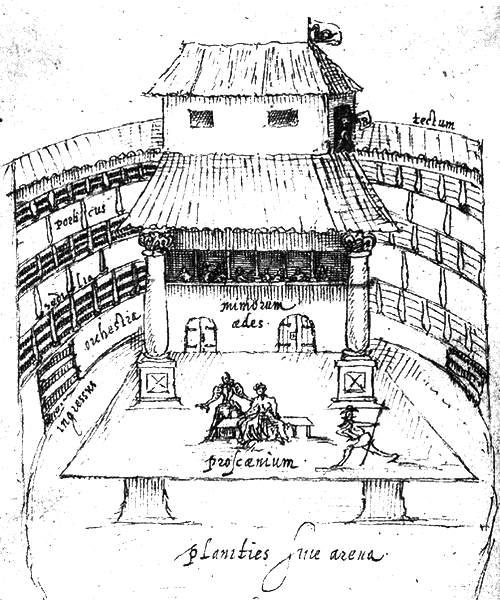
Let’s try to imagine how The Taming of the Shrew might have been stage back in 1592. For that, it might be helpful to know what the actual theatre might have looked like as well:

If we’re lucky, we can afford to by a spot in the covered balconies but most likely we’re just groundlings who paid a cheap rate to stand in the pit all around the stage.

Once the play starts, Sly, the hostess, the lord and his attendants come on stage. They play out the first scene of the prologue. Then, after they’ve dragged Sly off-stage, he reappears on the balcony at the back of the playhouse with the page disguised as Sly’s wife. There’s a good chance the lord and the household servants are up there as well. However, at the end of the scene, the players hired by the lord walk out onto the main stage and start performing a play. This is where act one of the actual play starts.

Sly has a few more lines after act I, scene 1 so we know he’s still around. And it’s likely that he’ll stay up on that balcony for the entire show. That means that we’re watching Sly and the page watch the Taming of the Shrew as we watch the Taming of the Shrew. It also means that the actors the lord has hired for his prank on Sly are the same ones acting out the Taming of the Shrew for us, the audience. Are we supposed to be the butt of a strange joke like Christopher Sly? I’m not sure. If so, I don’t really get it. What this weird half-frame does though is make us aware that we’re watching a play because it keeps the audience of the play – Sly – in view the whole time.

Shakespeare’s big on theatre metaphors in his plays. He’s constantly reminding us that we’re watching a play, and that everything else in our lives also involves a lot of acting and pretending too. However, Taming of the Shrew is an early play, one of Shakespeare’s first. Later in his career, Shakespeare will really become a master of using theatre to comment on theatre and life. He just hasn’t really figured it out yet and this experiment falls a little flat.

That about does it for this week. Be sure to read Jay Reid’s critique of Ralph Fiennes’ recent film adaptation of Coriolanus. If you don’t want to miss anything, subscribe to the blog as well as the podcast on iTunes.

(Podcast recorded and edited by Daniel J. Rowe, show notes by Eric Jean)

Artwork - Leigh Macrae
Artwork – Leigh Macrae

Stay in touch, Brawlers!

Follow @TheBardBrawl on Twitter.

Like our Facebook page.

Email the Bard Brawl at bardbrawl@gmail.com

Coriolanus (2011), Ralph Fiennes (director)

Jay Reid     

The tragedy of Coriolanus is that a brutish man, prone to burst of violence can be undone by an act of compassion towards those he loves.

Director Ralph Fiennes and screenwriter John Logan make the choice to trim down Shakespeare’s text, conveying that tragedy visually, while creating a film adaptation of the play that is not restrained by absolute faithfulness to the source material.

Fiennes stars at Gaius Martius Coriolanus, a Roman general, whose skills as a warrior makes him something of an anti-hero among the people whom he has open contempt for.  They love and hate him within the same scene at times. The scowl on Fiennes face makes his every word seem like it comes from pure rage.  His performance gives the film an intensity that would otherwise be lost on stage.  He doesn’t even need to spit out the Bard’s words or stab an enemy for the viewer to know that he is a man fueled by anger.  A simple glare conveys all we need to know about him.

Early in the film, Coriolanus, after brutally killing an enemy, emerges victorious, walking towards a group of soldiers, his face streaked with blood, almost like war paint.  There is no doubt that this is a man who will fight to his last breath, and that makes him a compelling character to watch.  Fiennes’ performance can evoke sympathy from the viewer, even when he is at his most monstrous.

His mother, Volumnia, played by Vanessa Redgrave and his wife Virgilia, played by Jessica Chastain, allow Fiennes tender moments in between his bursts of violence and anger.  They are his Achilles heel, and yet the only thing that really makes the character anything else than a single-minded warrior.

Redgrave steals most scenes. She gives a tender and powerful performance, showing the strength of a determined, politically minded woman and the compassion of a mother at the same time, while Chastain does her best, but is rarely captivating.  Chastain is usually a solid actress, but her performance seems underwhelming when compared to heavy hitters such as Fiennes, Redgrave and Brian Cox as the Roman Senator Menenius.  She seems to drop the ball on more than one occasion and often fades into the background.

Performances make or break any Shakespeare film and there can be very little room for weak links in the chain.

Although the film is set in some place called Rome, Coriolanus was shot in Belgrade, Serbia, and the location works well, especially after Coriolanus’ exile. He is shown walking through the cold, gray towns, conveying the harshness of his expulsion in a way only an Eastern European shooting location provides.

The film is transposed into modern day times, where swords become automatic weapons, and discussions between citizens in the play become television news panels.  This modernizing of the play gives the film modern day significance, especially when exploring the idea of a patriot exploited by politicians for their own gain, and what happens when they can no longer control that patriot.  Coriolanus is a wild guard dog that can never be made to behave, and it’s no wonder that as soon as he develops political aspirations, the politicians turn against him because they are afraid he is going to bite them.  They are soon faced with the choice of putting the dog to sleep or casting him out into the wilderness.

Coriolanus is especially strong when we see the titular character unleashed.  The film is bloody, as any Shakespearean tragedy should be, but not gratuitous.  The violence is never artsy, but brutal in a way that a dogfight can be.  The handheld shots of Fiennes stabbing enemies give the brutal scenes of violence a frenetic energy that conveys Fiennes rage.  The most effective fight scene is the first between Martius and Tullus Aufidius, played by Gerard Butler.  Close, tight shots of Martius and Aufidius, wrapped around each other, almost in a bear hug, are reminiscent of a UFC fight at its bloodiest, and if they were given knives.  With bombs going off in the background, the fight scene makes it seem like the entire war is being fought by two men.

Although Fiennes’ film takes certain liberties with the source material, it is loyal to Shakespeare’s vision, capturing the tragedy of a man that has become a killing machine, manipulated by the politicians, lauded as a hero and loved by his family, but lost in his own hate.

It is the Shakespeare film for the person who doesn’t usually like Shakespeare.  It’s a compelling piece of work that tries to stand apart from typical film adaptations of Shakespeare’s work, and succeeds as a film by being quiet, relying on the performances of the actors rather than the words of the immortal Bard.

Jay Reid is a Bard Brawler, writer and director. 

BB: Coriolanus, the Speeches

Like Caius Marius Coriolanus standing before Rome, we’ve reached the end of our exile’s path and we must now make our choice: which of Coriolanus‘ speeches are worthy of our podcast?

Welcome to the speeches podcast for Coriolanus!

Listen to the podcast here.

The more popular Julius Caesar is a parade of speeches delivered by master orators. Coriolanus though is a much messier play where dialogue, not monologue, is the norm. That makes it hard to decide where a selection should start and stop which means that I’m sure your favourites were unceremoniously sacrificed or cut short in the making of the show. But fear not! They’re still hale and whole in our five last Coriolanus podcasts. Subscribe on iTunes or download them from this blog to find out what you’ve missed!

“Hail, noble Marcius!” Act I, Scene 1 lns. 173-215
Speakers: Meneniuns, Caius Martius (Coriolanus), Second Citizen
Caius Martius barges in on this scene of civil unrest. While Menenius has been trying to appease the crowd, Martius tells them that he’d rather kill the lot of them than negotiate with them. He also suggests that while the people are quick to assume the food shortage is artificial – that the nobles are hoarding food at their expense – Coriolanus suggests that the people of Rome have done nothing to merit a dole of grain but take to the streets in protest when they should be out fighting Rome’s enemies. Are we swayed by Martius’ argument or does the play’s initial sympathy for the common people make Martius into a despot?

“How many stand for consulships?” Act II, Scene 2 lns. 1-36
Speakers: First Officer, Second Officer
Two officers, sent ahead to the Capitol to put cushions on the patricians’ seats, are speaking about Coriolanus’ nomination to the post of consul. This exchange, and others like it, are central to Coriolanus. The play is not so much about portraying Coriolanus’ actions for their own sake but rather it is about how we should interpret those actions, about the place of Coriolanus’ name in history. Is Coriolanus a victim of history, or of his pride? Should he be reviled as a tyrant or is he a hero of the Roman Republic? Is he the ultimate Stoic or a brat?

“We do it not alone, sir.” Act II, Scene 1 lns. 32-49
Speakers: Brutus, Menenius, Sicinius
This one of many exchanges where the tribunes have at it with the patrician Menenius. Menenius reminds the tribunes of their insignificance and takes them for self-serving and petty politicians. They remind Menenius that he’s got a reputation for drinking. However, Menenius sees nothing wrong with a good drink in its proper time and place. This offers an interesting contrast between two political philosophies: Menenius as the old order, the tribunes as the new. Can we tell where Shakespeare’s sympathies lie?

“It is a mind that shall remain a poison…” Act III, Scene 1 lns. 115-145
Speakers: Sicinius, Coriolanus, Cominius
Coriolanus has so many amazing lines, particularly in act III, but this is one of my favourites. Coriolanus is clearly interested in mocking and abasing the common people, but is he wrong in what he says? It seems to me that he makes a valid point: when two parties struggle for leadership, it weakens the states to outside threats. What is particularly interesting in this passage is that his remarks are addressed as much to the patricians as to the plebeians. While he describes the tribunes as the leader of a school of tiny fish and as two of the heads of the fire-breathing Hydra, he’s also quick to point out that in some ways the patricians are no better. Either they have no real authority – and should stop pretending – or they should flex their muscles and stop giving in to the tribunes’ demands.

“All places yield to him ere he sits down…” Act IV, Scene 7 lns. 30-61
Speaker: Tullus Aufidius
Menenius and Aufidius are possibly the two individuals who have the clearest understanding of Coriolanus’ character, of his strengths and weaknesses. In this speech, Aufidius paints a portrait of a Coriolanus seemingly able to conquer through force of will and presence. But even as he praises Coriolanus the soldier, he identifies the tragedy of Coriolanus’ story: so long as he can wage war, his greatness is uncontested but his inability to adapt his behaviour to new situations – to peace – mean that his greatness will be eclipsed by his own insistence on his greatness.

“Nay, go not from us thus.” Act V, Scene 3 lns. 152-212
Speakers: Volumnia, Coriolanus
Volumnia, Valeria, Virgilia and Young Martius stand before Coriolanus and beg him to spare Rome. Coriolanus makes to leave but his mother calls him back. In a last-ditch effort to sway him, they kneel in front of him. They make a show of being resigned to die with their neighbours in the his pending attack. Volumnia then suggests that Coriolanus is a bastard Volscian and as he is finally moved to make peace between the Volsces and Rome. In the end, does Volumnia move him to compassion or – as his mother suggests – is his renouncing his war on Rome just another selfish act to preserve the integrity of his name to history?

Let us know what you think!

Next week, prepare for our first ever sonnets podcast. Daniel and I will discuss Shakespeare’s sonnets 1 through 5, read each week by our wonderful sonneteers. You won’t want to miss it!


Artwork – Stephanie E.M. Coleman

(Podcast recorded and edited by Daniel J. Rowe, Show notes by Eric Jean)

BB: Coriolanus, Act V

“Mine eyes do sweat compassion,” Coriolanus, Act V, iii

The perfect line for all those who cry at inappropriate times. Sadly, just as perfect for those highly appropriate times like the funeral of your beloved’s grandfather.

We’ll miss you Zaida Harry.

Welcome all to the final act of Shakespeare’s Tragedy of Coriolanus.

Listen to the podcast here.

The last act ended one a conspiratory note where we overheard Tullus Aufidius and one of his lieutenants plotting Coriolanus’ downfall. However, in act V, scene I, we leave Aufidius to his scheming and turn our attention back to Rome. Cominius returns from his visit to the Volscian camp where he has pleaded with Coriolanus to lay down his arms and not strike against Rome. He gives the gathered tribunes and patricians a play by play of his petition but his mission is a failure: Coriolanus will not cease his hostile actions against Rome. Furthermore, he appears to have broken all of his bonds of affection with Rome and its citizens. He has become a relentless juggernaut of war. With few options available to them, the Romans convince Menenius – Coriolanus’ closet friend – to journey to the Volscian camp and see if he can leverage their friendship into compassion for Rome.

When Menenius arrives at the Volscian camp in scene 2, he is initially denied access to Coriolanus by the sentinels standing guard outside the camp. (Curiously enough, these are also identified as Senators in our online edition.) They say that Coriolanus has no interest in speaking with anyone from Rome. Menenius argues with them that Coriolanus will want to hear from him given their long friendship but they only respond that he should hate Rome, as Coriolanus does, because they banished its greatest warrior. Aufidius and Coriolanus arrive on the scene, drawn by the sound of the argument at the gates. Menenius tries to plead his case but Coriolanus tells him that he has cut all ties with Rome and won’t hear another word. He does, however, hand him a letter before sending him on his way.

After Cominius and Menenius’ failure to talk Coriolanus out of taking his vengeance on Rome, the desperate Romans go to their backup plan and send in the women: Coriolanus’ mother Volumnia, his wife Virgilia, his son (young) Martius, and Valeria, a friend of the family. Coriolanus has just sworn not to listen to any more petitions from Rome when they three women and the boy Martius are lead into the camp at the start of scene 3. Coriolanus swears to act “As if a man were author of himself,” as if his family was of no significance to him and he exists in the world unfettered by relationships. At first, he stands his ground but when the women kneel and Volumnia pleads with him he finds himself unable to remain unmoved. He agrees to broker a peace between the Volscians and the Romans but in convincing him to stand down, Coriolanus believes his mother has doomed him.

In scenes 4 and 5, the Romans receive the good news that they won’t be crushed beneath Coriolanus’ war machine thanks to the pleas of the three women. It seems Menenius is mistaken and that Coriolanus does, in fact, have “more mercy / in him than there is milk in a male tiger.” The news arrives just in time because the angry plebeians have captured the tribune Junius Brutus and are threatening to kill him slowly for having banished Coriolanus. As the people welcome the women home, they repeal his banishment.

Coriolanus, however, is not returning home in scene 6. As he has sworn to serve as a soldier to the Volscian cause, he returns to Antium to continue his service as well as to deliver the final terms of the peace treaty he has negotiated on behalf of the Volsces. Before he arrives, Tullus Aufidius has prepared a letter for the Volscian in which he accuses Coriolanus of being a traitor to the Volscian cause. Aufidius is worried that if he allows Coriolanus to address the people he will be able to sway them from sentencing him to death and se he decides to strike Coriolanus before he can give an account of his actions. Coriolanus presents the lords of Antium with the treaty but Aufidius tells them not to read it. He and his men fall upon Coriolanus and kill him. In the aftermath, Aufidius tells them that he just saved them from danger by killing Coriolanus. Moments later, he orders his body to be carried out and buried with honours.

The final act of Coriolanus seems like a bit of a letdown in the end. The tension builds in the first few scenes until at last the women talk him out of waging war and return to the city to great acclaim. The final scene in particular is very disappointing. Coriolanus returns to the city and before he can do anything, he’s once again accused of treason. He’s unceremoniously murdered by Aufidius and his lackeys and then, in the same breath, his body is carried off-stage and the play ends. This is actually an interesting trend we’ve noticed while reading our way through Shakespeare’s plays. A lot of them are really rockin’ through the first four-and-a-half acts but then they wrap up awkwardly or suddenly in a way that’s really unsatisfying or downright confusing. Either Shakespeare wasn’t good with endings or there’s something we haven’t quite understood about what made for a good ending in the late 16th century.

For instance, the short speech which caps this play, in which Aufidius claims to regret his actions, seems totally disingenuous. Is that intentional on Shakespeare’s part? While we’ve seen all of Aufidius’ plotting behind the scenes and have every reason to distrust his words, the lords of Antium have not. It’s likely he’s not saying these words for our benefit but for that of the Volscian lords in attendance. That would paint him as a sort of ‘Noble Brutus’ – the one who kills Julius Caesar because he believes him to be a tyrant, not the tribune Brutus in Coriolanus – who kills Coriolanus to avoid a greater danger to the Volsces.

It’s also interesting that Shakespeare ends the play here because in Plutarch, we learn that after Coriolanus’ death some of the Volsces’ other enemies saw their chance to attack them and picked them to pieces. Tullus Aufidius is eventually killed and the Volsces never recover. They’re eventually conquered by the Romans, making Coriolanus’ death one of the factors in the Roman Republic’s early expansion. Still, does Coriolanus in fact “have a noble memory”? Not so sure.

In our next podcast, we’ll be revisiting some of our favourite speeches from Coriolanus. If you have any passages you’d like us to discuss, please leave us a comment!

Also, don’t forget to check in on some of our Brawlers:

Check out David Wheaton‘s band page, and go to his show when in your town.

Jay Reid’s film page can be viewed here, and a trailer for his new film here.

Newest Bard Brawler Laura Pellicer reads Sonnet 6

(Podcast recorded and edited by Daniel J. Rowe, Show notes by Eric Jean)

BB: Coriolanus, Act IV

In our tenth episode, we return to our regularly scheduled program with act IV of Shakespeare’s Tragedy of Coriolanus.

Listen to the podcast here.

Act III ends with Coriolanus turning his back on Rome. In act IV, scene 1 he takes his leave of his friends and family. Coriolanus predicts that the people of Rome will miss him when he’s gone and Rome is once again threatened. Of course, he doesn’t say that he’ll be the one to lead the troops to its doors!

Act IV, scene 2 is another short scene. The tribunes of the people, having successfully banished Coriolanus from Rome, dismiss their mob. They spot Volumnia and Menenius and try to avoid them but Coriolanus’ mother makes straight for them and gives them a piece of her mind before they beat a hasty retreat.

The next scene recaps some of the information we already know: Coriolanus has been banished from Rome and the divided people of Rome are ripe for the picking. Is this for the benefit of some of the people in the audience who maybe haven’t been paying attention? Or is this just Shakespeare’s way of explaining how the Volsces know what’s going on in Rome?

Coriolanus’ wanderings have led him through the gates of Antium, right to Tullus Aufidius’ house. In act IV, scene 4, he approaches in disguise and in act IV, scene 5 makes his presence known to the servants of the household. Thinking he’ some vagrant, they refuse him access to the house. After beating one of the servants, Aufidus comes to investigate. He doesn’t recognize Coriolanus at first, who slowly reveals his face to Aufidius. Throughout the scene Tullus Aufidius keeps asking him for his name until at last Coriolanus identifies himself as the conqueror of Corioles. He explains how he has been betrayed by his city and offers up either his life or his service to Tullus Aufidius. Tullus Aufidius welcomes him with open arms and offers him half of his forces to exact his revenge and crush Rome beneath his boot for the Volsces. In one of the few funny moments of the play, Aufidius’ servants suddenly all claim to have known that Coriolanus was not some bum but a noble person.

We return to Rome for scene 6. Brutus and Sicinius are busy gloating to Menenius about how much betters things are now that Coriolanus is gone. However, while they are vaunting the great peace Coriolanus’ exile has brought to Rome, messengers arrive with some grim news: Coriolanus and Tullus Aufidius have joined forces and are heading for Rome. Ooops. Menenius and Cominius make it clear that this is all the tribunes’ fault but the tribunes try to quiet the people by suggesting that this is something the patricians have made up. The tribunes follow the patricians to the Capitol to confirm the news.

Act IV ends with a short scene involving Tullus Aufidius and one of his lieutenants. Seems that Coriolanus is more popular with the troops than Aufidius anticipated. The Lieutenant suggests that if Aufidius doesn’t do something soon, he’ll be eclipsed by Coriolanus’ legend. Aufidius realizes that he can’t do anything yet or they might not succeed in the campaign against Rome but hints that Coriolanus’ pride will give him the leverage he needs to get rid of him once their war is done.

One of the most interesting scenes in this act is the initial encounter between Coriolanus and Tullus Aufidius. As I mentioned above, when Coriolanus first arrives at Tullus Aufidius’ doorstep, Aufidius does not recognize him. He asks him several times to name himself but Coriolanus appears to say nothing at first. When he is not recognized, he starts dropping hints, suggesting that his name is “unmusical to the Volscians’ ears, / And harsh in sound to thine.” Aufidius doesn’t get the hint and while he seems to recognize some noble quality in Coriolanus, he asks him again for his name. Coriolanus again delays and tells him to “Prepare thy brow to frown.” He still doesn’t recognize him and at last Coriolanus reveals himself in a lengthy speech in which he reveals his entire recent history and his desire for vengeance. But why play this revelation game at all?

Coriolanus is the name he was given after he (almost) single-handedly conquered Corioles. Cominius will later, in the epic act V, describe how Coriolanus refuses to answer to ‘Coriolanus.’ After all, how can he still consider himself Coriolanus when he’s now fighting on the same side as the people who, not too long ago, he conquered? For Coriolanus, names represent action, and his past actions are his identity. When he’s exiled from Rome, his name ‘Coriolanus’ loses its meaning and by extension, so does the man called ‘Coriolanus:’ he becomes “a kind of nothing, titleless” who refuses all names. Coriolanus’ logic is simple but brutal: what is left for this juggernaut of war when his titles and history have been rendered obsolete, or when he has been displaced by ungrateful politicians? To forge himself a new name in the ashes of Rome.

As always, we’re looking forward your comments!

Welcoming Virginie Tremblay to our sonnet readers this podcast. Enjoy number 4

Also, you should visit Stephanie’s website here to see some of her awesome art!

(Podcast recorded and edited by Daniel J. Rowe, Show notes by Eric Jean)

BB: Coriolanus, Act III

(Podcast recorded and edited by Daniel J. Rowe, Show notes by Eric Jean)

After a break, the brawlers return and dive into the third act of the Tragedy of Coriolanus.

Listen to the podcast here.

Over the past two shows the Brawlers have brought up T.S. Eliot a number of times. He rather famously claimed that Coriolanus, and not Hamlet (as is commonly thought), is Shakespeare’s greatest tragedy. This Slate article looks at T.S. Eliot’s claim. There’s a link to Eliot’s original essay “Hamlet and His Problems” in the article, if you’re curious to read it first hand.

For those of you who won’t read the article (shame on you!), here’s a little synopsis of Eliot’s position: he argues that Hamlet is a bad play with a defective plot that barely holds together. He considers it an unfinished work, barely cobbled together. According to Eliot, the only reason Hamlet’s so popular is because others (Coleridge, notably) have written in a whole psychology and depth to the character which Eliot thinks was never there to begin with. Coriolanus, on the other hand, is all action and (according to Eliot) is one of Shakespeare’s best plotted plays. (As in, the plot and the timeline sort of makes as is.)

While I’m not sure I can agree that a better plot makes for a better tragedy, he wouldn’t be the first to argue that. Here’s a short outline of Aristotle’s theory of tragedy from the Poetics: you’ll note that plot is the most important thing to him. Maybe that’s why it’s so important to Eliot. Don’t know if Shakespeare would really agree or not. He didn’t seem to pay much attention to what Aristotle thought.

Which is more important: plot or character – Coriolanus or Hamlet?

Tell us what you think! (And read the article already!)

Bard Brawlers for Act III of Coriolanus are Benny Hedley, Jay Reid, Eric Jean, Miki Laval, David Wheaton and Daniel J. Rowe

We promised you an action-packed act this week and Coriolanus doesn’t disappoint!

Coriolanus’ appointment to the consulship was practically a done deal before the tribunes turned the people against him once again. Act III, Scene 1, start with Coriolanus hearing that his enemy, Tullus Aufidius, has returned to Antium after his defeat at Corioles. The common people of Rome have been swayed by the tribunes to revoke their support of Coriolanus’ election to the consulship. They have taken to the streets to protest his repeated mocking of them. The tribunes provoke Coriolanus who makes many fiery and hateful speeches targeting the common people of Rome. Seizing on their opportunity, the tribunes accuse Coriolanus of being a traitor to Rome and seeking to make himself king. (Side note: Even during the period of the Roman Empire, it was illegal for anyone to call themselves King of Rome.) The tribunes order their aediles to take Coriolanus into custody to answer the charge but he draws his sword and tries to resist. Menenius talks him down and sends him home to avoid a riot. He agrees to convince Coriolanus to answer to the people’s accusations.

I think every Brawler had their own pronunciation this week. Just to set the record straight:

ae·dile:  noun \ˈē-ˌdī(-ə)l, ˈē-dəl\: an official in ancient Rome in charge of public works and games, police, and the grain supply.

Act III, Scene 2 takes place in Coriolanus’ house. The patricians and his mother try to convince him to return to the people of Rome and make a show of begging their forgiveness. Coriolanus is incensed that she would suggest he abase himself  by bothering to lie to the commoners to gain their votes. She suggests that once he’s consul he’ll no longer have to do that but that he shouldn’t piss them off while they still have the power to deny him the honours he deserves. Menenius adds his own counsel to Volumnia’s and Coriolanus, despite himself, agrees to do as they suggest.

As Coriolanus prepares to return to the forum in Act III, Scene 3, the tribunes are busy preparing the crowd for his arrival. They instruct them to support whatever decision the tribunes will make. The tribunes agree on their strategy which is to provoke Coriolanus so he loses his temper then they’ll have free rein, and the support of the mob, to guarantee the outcome they want: getting rid of Coriolanus. Coriolanus tries to appease the crowd and Menenius reminds them that Coriolanus’ rough words should be considered as those of a soldier untrained in politics and flattery. He asks the people plainly why they’ve refused him the consulship which he feels he has deserved. At that, the tribunes waste no time and immediately accuse him of having tried to seize power and declare him a traitor to Rome. Coriolanus will have none of this and flies into a rage. As the tribunes banish Coriolanus from Rome, he turns his back on commoner and patrician alike and in one of the most dramatic stage exist in Shakespeare, declares that “there is a world elsewhere.”

You’ll need to download the next episode to find out where he finds that other world. I guarantee you it will be worth tuning in. You won’t want to miss it!

If you’ve missed any of the previous episodes, they’re just waiting to be downloaded! Better yet, subscribe on iTunes for your (mostly) weekly dose of Bard!

BB: Coriolanus, Act II

(Podcast recorded and edited by Daniel J. Rowe, Show notes by Eric Jean)

Politics heat up and the bard brawlers read through Act II of the Tragedy of Coriolanus

Listen to the podcast here.

In Act II, scene 1, Menenius accuses the tribunes Sicinius and Brutus of plotting against Coriolanus for selfish reasons. The tribunes continue to maintain that Coriolanus is prideful and should not be given the consulship. Volumnia shows up with news of Coriolanus’ triumphant return to Rome. She and Menenius catalogue the history of Coriolanus’ wounds, which they anticipate will speak favourably for him when he is called upon to show proof of his military service to Rome. Brutus and Sicinius remain determined to convince the people to withhold their consent to Coriolanus’ nomination.

The patricians and the tribunes are gathered at the capitol to elect a new consul in act II, scene 2. Though we are told of two other candidates, Coriolanus is clearly a shoe-in for the job. (Cominius currently holds the office but he’s not one of the candidates. Consuls were not allowed to serve consecutive terms at this point in roman history.) Cominius offers up his panegyric to Coriolanus, which recounts his military exploits and tells everyone how much Coriolanus is epic and awesome, but Coriolanus doesn’t care to hang around and hear himself be praised (jury is still out on whether Caius Martius Coriolanus is really as humble as he keeps saying he is). All the patricians support his nomination but Coriolanus has no desire to parade his wounds before the common people. Meanwhile, more plotting by the tribunes who hope to abuse Coriolanus’ temper to discredit him.

Menenius convinces Coriolanus to honour the custom of showing his wounds in public. Act II, scene 3 takes place in the forum, with Coriolanus dressed in a sort of ritual gown of humility. The peasants know the score: this whole ‘show us your wounds’ business is basically a formality. Though the tribunes and the people can veto the decision of the patricians, if Coriolanus shows them his wounds, they’re more or less forced to give him their support (as the Third Citizen explains in the opening moments of the scene.). Coriolanus meets with the citizens in groups of 2 or 3 and generally acts like an ass with them but manages to get their grudging support. As soon as he leaves the scene, Sicinius and Brutus play the crowd and convince the citizens to withdraw their support. They cleverly cast themselves in the role of well-meaning but misguided counselors and the enraged citizens head for the capitol to deny Coriolanus his consulship.

About these citizens. In most of Shakespeare’s plays, these anonymous characters serve an expository role – like Neo in The Matrix, they ask the questions and volunteer the information the audience needs to understand the background of the story. Sometimes, they’re given some interesting lines, but in most cases they’re minor, undistinguished characters that only exist to fulfil a necessary narrative function. However, in Coriolanus, these citizens seem to have substance, individual leanings and views. Many of them differ in their assessment of Coriolanus and whether or not he should be consul. In Coriolanus, there’s disagreement, lack of consent and even changing opinions in the multitude. This is in fact precisely what Coriolanus finds reprehensible in the plebeians, their lack of constancy and their divisiveness. Ironically, the tribunes themselves seem to take advantage of this: they are easily able to sway the people to withdraw their support for Coriolanus’ appointment. I wrote about the tribunes and the citizens on my sometimes-active blog if you’re interested in reading more about them.

(Unfortunately, the differences between the seven citizens might not come out so clearly in the podcast. You’ll notice that only André, David, Daniel and myself were reading this week so we were forced to sort of jumble together the citizens’ lines. We tried on different voices… with varying degrees of success.)

The play though opens up with these same hungry citizens who seem to have very legitimate reasons for being upset at Caius Martius and their lot in the new Roman Republic. The commoners in Coriolanus aren’t simply dismissed by the plot, making quick cameos and then disappearing. They’re active (if nameless) participants in the unfolding drama. They quite literally take center stage opposite to Coriolanus throughout the play, as a group and as individuals.

As we mentioned several times on the show, Coriolanus is adapted from Plutarch’s Lives of the Noble Grecians and Romans (often just called Lives, or Parallel Lives) which we highly recommend. It’s surprisingly readable. We’ll have more to say about Coriolanus and Plutarch as we read through the play but I wanted to leave you with one remark which is relevant to this scene. Coriolanus’ refusal to show his wound to the plebeians is Shakespeare’s invention. In Plutarch, Coriolanus does in fact parade his wounds for the people without complaint. The gown is made-up too. I wonder: does this make Coriolanus more of a petulant child for refusing to do what’s accepted tradition? Or is his objection to taking part in a politically expedient lie commendable?

There’s so much more that could be written about Plutarch and Shakespeare, but we’ll leave it for another episode.

Please leave us a comment to tell us what you think: is Coriolanus prideful or principled? Are the citizens just a bunch of lemmings for the tribunes to play with or do they deserve some names?

Looking forward to a totally explosive act III!

Up ↑