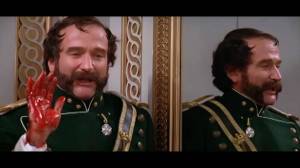
Robin Williams as Osric in Branagh’s epic production of Hamlet (1996)
Eric Jean and Daniel J. Rowe
Near the end of Kenneth Branagh’s epic version of himselfHamlet, a character named Osric trots on camera played by the veritable comedian Robin Williams.
Never heard of the character? Neither have most, but there is no doubt you’ve heard of the actor.
It’s always sad when the screen and/or stage loses a thespian and the Bard Brawl is especially sad when one of those has taken on Shakespeare. Williams was only in the one screen version, but when you think about it, he would have been great in so many roles.
He would have been a great brawler.
I immediately thought first of the Dromios from Comedy of Errors as an ideal dual role for obvious reasons, and of course any Fool or Clown would do. But wait a second. Wouldn’t he make a rad mad king? Or a depressed prince? Or a female character?
One of Williams’ greatest (if not thee greatest) performances is in the Fischer King. It’s probably his closest role to a classic Shakespearean character. Parry is bombastic, energetic, mad and fragile.
The more you think about Williams’ body of work, the more of the Bard’s roles you can start to slide him into. He has that presence that theatre and movie lovers are always eager to search out. Energy like that is indeed a rarity.
Can you picture him as Timon of Athens setting the table for his so-called friends? Or frantically running around Venice and Cyprus as Iago trying to keep his schemes on track? Imagine him speaking the words from Clarence’s speech from Richard III:
O, I have passed a miserable night, So full of fearful dreams, of ugly sights, That, as I am a Christian faithful man, I would not spend another such night Though ’twere to buy a world of happy days– So full of dismal terror was the time.
It’s really so sad that he’s gone. Such a talent.
The scene in Hamlet is simple and short, and is actually one of the many scenes that often gets cut from productions (Hamlet is a very long play).
I couldn’t track down the full scene, but did find this one of him refereeing the fencing match. It’s pretty good.
Clever, funny, and, in the end, a very sad person. Rest in Peace Mr. Williams. You will be missed.
Steam punk, Chuck Taylors, umbrellas, a lion and Daft Punk’s “Get Lucky,” and you’ve got yourself the ideal play by English Renaissance playwright William Shakespeare.
Wait. What?
Bard on the Beach, like almost every theatre company, just can’t resist the midsummer allure of a certain play. Photo – David Blue
The Bard on the Beach started its successful run as Vancouver, BC’s premier Shakespeare performance troupe with A Midsummer Night’s Dream, so it’s no surprise that in celebrating its 25th year, the players were at it again.
Actually, it’s no surprise that any troupe is doing the play during the summer; it gets put on a lot.
It’s glaringly obvious why. Midsummer has fairies, love triangles, wacky actors, and invites a style directors like Dean Paul Gibson can push and play with. Bard on the Beach has done the play six times now. Gibson’s done it twice. This one’s got a marionette.
A certain Brawler who may or may not be me, and another who may or may not be the other c0-creator of the brawl often gripe about the fact the play gets put on way too much. However, every time either of them read or see the play, they admit that it’s a pretty fun play. Gibson’s is no exception.
The Bard on the Beach production amps up the pop music, goes all-in on a melange of styles for the costumes, and misses no opportunity to push the whimsy and fun of the play. My dad and sister, who admitted to never liking Shakespeare, and who would rather pay for a six pack than a ticket to a play, both LOVED the production. My sister couldn’t believe how funny it was.
Purists poring over heavily dogeared and highlighted copies of the play probably will complain about Gibson’s use of Top 40 songs and some of the style choices. They complain about most things. Can’t please everyone. So it goes. Back to the library with you.
One critical friend of mine thought the choices bad, and suggested the director added the music to draw a bigger audience. Maybe. Then again, Midsummer always draws an audience.
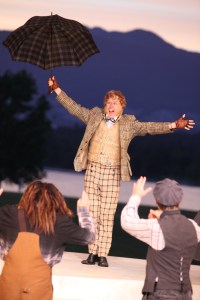
Founding Bard on the Beach member Scott Bellis steals every scene his has in Midsummer. Photo – David Blue
Bottom (Scott Bellis) and Puck (Kyle Rideout) steal the show. Both actors chew up the scenery when onstage, and act head-to-toe with the energy that must make all directors feel warm at night.
Bellis, as ‘lead’ in the theatre troupe rehearsing for the wedding of Duke Theseus (John Voth) and Queen Hippolyta (Adele Noronha), is a standout missing no chance to push his farcical talents. His hair, makeup and costume only add to the character.
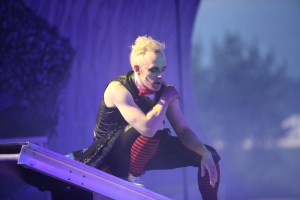
Rideout, as the fan favourite Puck, wears that tutu and pair of Chuck Taylors like a pro. Though purists will not appreciate the selfie he takes when accidentally self-medicating with a love potion herb, the audience loved it. In a particularly clever scene as the play is coming to a close that even the ultimate purist will appreciate, Puck mimics walking a tightrope down the middle of the stage cleverly highlighting the fine line between chaos and normalcy, love and hate, reality and fantasy, theatre and the real world: brilliant.
Eyeshadow, check; striped tights, check; tutu, check; time to play Puck. Photo – David Blue
The official program describes the plot as such:
Oberon, King of the Fairies, is upset with Queen Titania. He commands his servant Puck to produce a magical nectar that will cause love at first sight. The mischievous sprite arranges for Queen Titania to fall for Bottom, a simple weaver (now transformed into an ass) while hilariously misdirecting the affections of four runaway lovers.
Nothing is untrue in the description, but the more experience one has with the play, the more one gravitates to Bottom and Puck, and whatever they’re doing. The Lysander, Demetrius, Hermia, and Helena cat-and-mouse/love potion stuff is fun, but is upstaged by Bottom and Titania (Naomi Wright), and their wierd fairy-loves-donkey, Puck orchestrated subplot. I won’t lie. Writing that sentence was fun.
Gibson also chose to stage the “Indian boy” as a marionette puppet, which was a very clever touch even if it was a little confusing to some in the audience like my dad and sister, who hadn’t read the play. The choice added to that blurred line between reality and fantasy the play is always treading.
The purist in me (yes he is there scowling and shaking his head all the time) did have a touch of pshah at the opening scene when Theseus delivers the following line as if he’s Romeo:
Hippolyta, I woo’d thee with my sword,
And won thy love doing thee injuries;
But I will wed thee in another key,
With pomp, with triumph, and with revelling.
I tried this line on a girl once. Big mistake. Not a ton of romance there.
Bard Brawl Sonneteer and ‘Zounds! contributor Maya Pankalla told me the other day the play was her favourite.
‘It’s just so me,’ she said.
Those that know this particularly talented recently married brawler/zoundser (sorry boys) will get it right way.
For those that don’t: Midsummer is a must see for all who like the bard, fairies, whimsy, comedy, romance, and donkeys whenever it is produced. The Bard on the Beach production adds marionette aficionados to the list, and pulls the whole thing off with style.
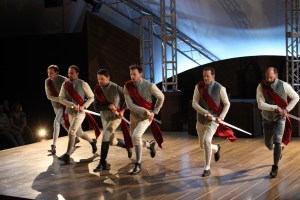
Anita Rochon took on Cymbeline in all its facets from comedy to drama to action to romance and all else in between. Photo Credits: Rachel Cairns as Imogen Photo & Image Design by David Cooper & Emily Cooper
The 2014 Bard on the Beach run included the not done often play Cymbeline. It’s a dramatic and exciting play that bounces between comedy, drama and sometimes shocking plot turns, and is one of the Bard Brawl’s favourites.
Director Anita Rochon discussed the production with the Bard Brawl.
Bard Brawl: Why did you pitch Cymbeline (to Bard on the Beach)?
Anita Rochon: It was a couple of things. It was a play that was really interesting to me and also interesting why it isn’t done very often… The last time it was done at Bard on the Beach was 2002, so I also saw that it wasn’t done in a long time, and with the particular casting breakdown I was working with, which was one women and five men (I asked for a sixth) because we were paired with Equivocation, I had to work within a particular cast breakdown, and I saw that Cymbeline had this women who was at the axis point of all these different narratives, so she really was the centre. That was a play that I could imagine staging with a smaller cast and having a women at the centre of it all.
BB: What was the direction you were trying to lead this play?
AR: One of the motifs and themes that was very strong for me in reading it was the idea that one can change. The idea that you may get forgiveness, that you may get a second chance. So the idea of changing, and changing identity, and not just going in disguise – as happens in a lot of Shakespeare’s plays – but even the idea that you sometimes have to change your idea of who you are in order to keep living in a way that’s satisfying, but also to receive forgiveness is something that I really emphasized, and took it quite literally to this idea of people changing identities right before our eyes.
BB: The one thing that I was surprised with was in the first half of the play, it was a lot lighter. Cloten and his mother, there were a lot of laughs where you or they pushed the humour. Was the difficult to rectify seeing as how dark it (the play) gets at the end?
The ensemble guides the performance of Cymbeline. Photo credit – David Blue
AR: I think what every director does is just try and do what the playwrite is telling us to do, and so that’s what I was trying to do. I didn’t feel like I was attempting to push any humour. Shakespeare has written those weird scenes between Cloten and the lords where you get such a clear dynamic of how the whole kingdom thinks of Cloten, and the queen has those fantastic asides to the audience. She’s really written like an evil stepmother in fairytale tradition.
So many speak about how it’s such a crazy play, and has so many things: comedy, romance, drama, tragedy. The only way that I could understand dealing with that was just playing everything for what it’s worth. Just playing everything for how it’s written. We can’t squeeze the whole thing into being a comedy; why would we try?
I think there is a precedent for that now, we’re used to that now with shows like Game of Thrones or probably better example would be Breaking Bad where sometimes you have these scenes that are almost clown-like and then you have high drama, and then you have a stylized scene. A show like Breaking Bad has all of those things, and so I just tried to commit to each scene from what I understood from each scene and put them all together with a container of this ensemble telling us this story.
We see the ensemble coming out presenting themselves, presenting the narrative they’re about to tell us, and then, at the end, with that little button where Rachel Cairns (Imogen) takes centre stage again and finishes up the play, and then throughout with the ensemble sometimes sitting upstage, I just had to believe that the ensemble telling us the story that contained comedy, contained tragedy, contained drama, that if I played each scene for what it’s worth and asked the actors to do the same that we’d be okay.
BB: Everything in the production is almost monotone, greys and beiges, as far as the design goes, but the tempo is very fast. They move quickly. How did you get all of these elements to work together.
AR: I think I took it similar to how I was saying I took the scenes scene-by-scene. I probably took all the elements element-by-element. The costumes for instance, we based them off of fencing uniforms, for three reasons. I wanted the ensemble to feel like a team. I wanted them to feel athletic. I wanted the production from the very beginning to feel athletic and muscular and fast-paced, and sometimes masculine, but with a feminine presence in there. Certainly the Rome scenes I wanted them to feel masculine, so that kind of athletic, nimble feeling was a priority for me. I began to think, we need a base costume because they’re switching between all of these different characters, so what can I have as a base costume? The worst idea would be a black turtleneck and black pants.
I was scouring all these books, and I came across this amazing image of a fencing uniform from 100 years ago, and I thought, ‘this is really interesting’ because we immediately associate it with a particular time. It feels a little bit old timey without it feeling specifically old timey. It references a period without it saying, ‘this takes place in 1409.’ Yet it encapsulates a little bit of that team feeling, that play fighting feeling, that we’re going to play at something in front of you. Of course, fencing is in preparation for a real fight. Like this play is a representation of a reality or a true story.
In terms of colour, we just wanted a fairly neutral palate, so that those other costumes could live off of there, but also be complimented by it, and of course, fencing uniforms are in those light grey tones.
In terms of the set, I was really interested in highlighting the theatre in its raw form, so the stage really nice and bare, and we used similar material…
I kind of just went element-by-element, and then try to keep the look of it all similar. Keep it all clean and always ask myself, what is the essential here. Let’s try and boil everything down to its essential and not have a lot of extra props and extra props and extra sets.
Anita Rochon artistic co-directs The Chop in Vancouver with Emelia Symington Fedy, which has produced numerous new works including KISMET one to one hundred and How to Disappear Completely which continues to tour internationally. She frequently collaborates with some of the city’s most celebrated companies including Theatre Replacement, Théâtre la Seizième, Vancouver Opera and Electric Company Theatre. She is a graduate of Studio 58 (Acting) and the National Theatre School of Canada (Directing). Anita is the recipient of a Siminovitch Protégé Prize and a Mayor’s Arts Award.
Like bust-your-gut, pop-a-button, get-dirty-looks-on-the-Metro-because-you’re-laughing-so-damn-hard funny. And, as my wife Rachelle “The Butcherette” can testify, that’s if you don’t understand a word of Shakespeare besides ‘Zounds!
See, here’s the deal with this summer’s edition of Shakespeare in the Park: Harry the King is actually a play adapted from Henry IV parts 1 and 2 and Henry V. Specifically, it grabs up a bunch of the bits involving prince Harry’s rise from being a good-for-nothing lay-about who spends all of his time in Eastcheap’s taverns drinking with his buddies to his ascension of the throne and eventual conquest of France.
At least that’s what it looks like at first but the whole thing never actually makes it out of the tavern.
The entire play takes place inside the tavern with Hal, Falstaff, Mistress Quickly, and company playing out all of the roles in Hal’s story. As such, you’ll see actors doubling up on roles in the same scene, frivolous funny voices and accents, whimsical posturing and funny walks, criticism and praise of the actors performances and of course off-the-cuff comments about what’s happening to the audience who is a stand-in for the other tavern patrons.
So really, the whole thing is like an epic and uproarious Bard Brawl on stage if the Bard Brawl had a budget, some sound and lighting equipment, a stage and a live audience!
On an unrelated note, we still have a donate button and plenty of copies of ‘Zounds! for sale.
If you’re a purist who likes their Shakespearean histories untouched, their iambic speechifying solemn and formal, and their Salic law needlessly obscured and overly complicated to all except for those 2 guys in the front row who have been involved in 15th century Renaissance re-enactment for 20 years, maybe this won’t be the production for you.
But if you’re a person with a pulse and at least a few friends, particularly if you are a person subscribed to the Bard Brawl, there’s a good chance you’ll be thinking to yourself as you fold up your lawn chair or picnic blanket: “Well that was well worth the price of admission.”
Shakespeare in the Park is free so that was a free joke. (You’re welcome.)
But don’t be like that guy who refuses to tip: Repercussion Theatre lives on donations so when the actor who just made you pee your pants at the end of the first half of the play comes by with a hat during the intermission, hide your shame and drop a few bucks in please. (Or you can click here and donate.)
Pack up your cooler with a few snacks and a couple of drinks, bring a blanket and go see Repercussion Theatre’s Harry the King in a park near you before it’s too late! I won’t come to your house and force you to go see this (because I don’t know where you live, mostly), but I’ll just leave this last remark here for you to do with as you please.
This is the one play that made my wife say, for the first time ever since I have known her: “I want to go back and see it again!”
The Harry the King tour ends on August 3rd. You can check out Repercussion Theatre’s website for dates and locations of upcoming performances.
It’s always sad when a bard legend leaves us. Unfortunately for us youngins’ we will simply have to suck it up and get used to it, as the legends who brought us great stage performances since the 60s are turning 70, 80 and 90.
I’ll admit, it takes a second and a little swallowing of appropriateness when Anthony Hopkins (not Moorish) steps on camera as the Moor, Othello. Othello has been portrayed in a number of ways with some actors going full on blackface (always a ‘treat’), some producers amping up the orientalist look (still not completely appetizing), and some productions getting a black actor to play it. The last choice is the best to be sure, but some of the others are not all bad. Are Orson Welles, Laurence Olivier or Paul Scofield racist for wanting the best role or maybe just arrogant to think that they can pull it off?
Pick another part guys. Hey! Why not Iago?
That being said, Hopkins is very good in this Othello. He travels the gauntlet that is the role, and encapsulate the power of the tragedy. He works well alongside the other impressive talent in this play, and is great on-screen with Hoskins.
Speaking of which.
(Hey! Hopkins and Hoskins. That’s fun)
Iago is one of the most complicated and important roles in all of Shakespeare, and if you miscast the sadistic murdering villain, the production’s doomed. Just ask Kenneth Brannagh (Actually, don’t ask. he won’t admit he was the wrong choice. It’s best not to ask).
Hoskins is able to nail the key question about Iago: why does anyone like/believe him? The answer is in the performance. Hoskins is blunt, crude, and a little nasty, but not in the way any of those friends you know you have are. It’s that bluntness and hamminess that allows Iago to throw the other characters off his scent, so he can mess with them and litter the stage with bodies.
That, and the verbal missiles he fires through the fourth wall are great.
Take Act V, scene i, the scene where all of Iago is on display.
Hoskins will be missed as an actor for simply being able to pull of this scene. He, as Iago, first manipulates Roderigo into doing something he’s not entirely sure he wants to do, then laughs at his plan, then realizes he might get found out, decides to kill Cassio, actually kills Roderigo, tears his shirt in two to help mend Cassio (everyone totally buying the act), blames Bianco for being a strumpet and has her carted off, and then nails this killer line:
This is the night that either makes me, or foredoes me quite.
…And scene.
Man this play is great.
It’s worth the three hours to watch Hoskins in this scene. He uses his whole body, and can deliver so much expression with his face. It’s really quite a performance, and he hasn’t even killed his wife yet.
The rest of the cast is also very good.
Just before Act V,i, check out Penelope Wilton (yes Isobel Crawley to those Downton Abbey devotees (poor Matthew)) nail the heartbreaking IV,iii all while being stared at by a skull. Very good.
Sheesh this play is intense.
Oh, and then there’s the final scene. Not to spoil anything for those who haven’t seen the play or movie version, but let’s just say the final line is not, “all in all it was a really weird trip to Cyprus.”
Miki Laval When I was 15, I knew exactly what loved looked like. Love was a slim blond boy with lanky legs, and hair I wanted to sweep back from the sides of his pretty face. He walked quickly and sat quickly. He came and left rooms quickly, every muscle always ready to go. To me, his speed was beauty and grace. Yet love was also languid and brooding, a poet, of course, who scribbled in a notebook between long stretches of staring into space while smoking a cigarette. In other words, this:
Sigh… To a 15-year old girl, one still plastering her walls with rock star posters, love sure looks a lot like a young Leonardo DiCaprico. He’s my generation’s definition of a heartthrob, and so a delicious fit for the world’s most epic teenage love story. Yes, he’d already shown rare talent in What’s Eating Gilbert Grape? and The Basketball Diaries, yethe and co-star Claire Danes were essentially darlings from TV land back in 1996. Then Romeo + Juliet hit theatres, and both actors proved they had serious chops, capable of moving from puppy love to the grand passion all tragedy requires. So how did the duo handle the Elizabethan dialogue? Well, at the time, there was a lot of clamour from outraged purists, but I’ve re-watched the film twice in the past few days and the Bard’s iambic pentameter sounds pretty good to my ear. Or I’ll say this, though neither Danes or DiCaprio have perfect elocution, the words flow with an intensity and ardor you don’t learn in theatre school. Besides, the point of Romeo and Juliet (the play) is that the central characters are children, and what acting skills Leo and Claire bring to the film is all in their baby faces, their creamy skin, their youth, not in their tongues. Yes, they are that pretty. Just watch them steal looks at each other in the infamous fish tank scene.
Forget Leo as Romeo. Isn’t Danes as Juliet melting loveliness? She clearly lusts for Romeo, yet despite what’s coming – a head spinning series of kisses that will leave her in a state of prickly heat – she keeps her wits about her. Later, the two swirl around each other from ballroom, to elevator, to balcony, to swimming pool, all the while bandying words back and forth with passion and spirit. Danes and DiCaprio understand that language is foreplay and an artful, erotic pleasure. To the naysayers who claim the dialogue isn’t up to snuff, I say these two make Shakespeare sound sexy. As for the film itself? There are throbs of neon in the night. Gobs of neon. Blazing fireworks explode across the black skies. There is all the razzle-dazzle, costumery, bubbles, bells and whistles anyone could dream of. Director Baz Luhrmann opens his film like the bullet-spraying master Tarantino; he choreographs the fight scenes as beautifully as John Woo, meanwhile, the frenzy of jump cuts make MTV (you remember MTV) seem like a stumble on Quaaludes. All this whirlwind action serves to convert the play’s intense emotions and language to vision. This is a play you see more than hear. And, boy, in the switch from the ear to the eye, does Luhrmann go wild with the modern images. Instead of gold, wads of cash are flaunted. Instead of swords, flashy semi-automatic pistols are drawn. Horses are doffed for retro convertibles that burn up the urban streets. It’s a nice touch too, having the two gang families dress in opposing “colours,” the Montagues favouring Hawaiian shirts, while the Capulets mobster up in dude suits. The film also features a gifted gaggle of players, most notably Harold Perrineau as a black gender-bending Mercutio, Pete Postlewaith as the splendid, scene-stealing Father Lawrence, and a corpolent Paul Sorvino who plays Juliet’s daddy like a bizarro wiseguy from Goodfellas. “Paulie may have moved slow, but it was only because Paulie didn’t have to move for anybody,” Henry Hill. Throw in some castles, some choppers, some bulletproof vests, and boom, Luhrmann shakes up a 400-year-old play without bowdlerizing or breaking its central and touching innocent idea. Which is what exactly? Only that love, sweet love, still blooms despite the violent world that usually steamrolls over it. The tragedy of Romeo and Juliet is nothing new, of course. Besides the innumerable theatrical productions, it’s been made over as a ballet, as well as a Broadway musical, and now there’s a new British film adaptation based on a Julien Fowles screenplay. To the latter, I say, Yea Gads! go rent Baz Lurhmannn’s rabidly flamboyant version instead. The fervour and grace of his Romeo and Juliet will have you free falling into the giddy, head-tripping, crush of epic love.
Few theatre companies delve into the lesser-known Bard play Pericles, and what’s up with that? There are pirates! The Shakespeare Theatre Company of New Jersey, however, has done the right thing and dove right in. Director Brian B. Crowespoke with the Bard Brawl about the company’s reasons for staging Pericles, and some of the ideas the production followed. The production runs until January 29, 2013.
Bard Brawl:Why did the theatre decide to do Pericles, such and obscure play?
Brian B. Crowe: We are first and foremost a theatre that is excited about classics of all ilks – specifically Shakespeare – but we will also try lesser known pieces as well, and there are some lesser known Shakespeares as well and that certainly falls into that category.
This particular season we were looking for something for the holiday spot, and I had workshopped a production of Pericles with some of our students a few years ago, and didn’t know much about it prior to that, and kind of fell in love with the magic of it, and the intrigue and the great resolution at the end; this family reunited, good wins out, and there’s honour in it and the bad guys get what they deserve, which doesn’t always happen in real life so it’s nice to have it on stage once and a while.
B.C.: …and there are pirates, and there’s incest and there’s a brothel, which is everything you need for the holidays.
B.B.: Was it a challenge to introduce the audience to the play? Did you get a lot of reaction right away? When you do Romeo and Juliet, you know it’s going to be packed. When you do Pericles, a lot of producers/directors might be a little nervous they won’t get the audience.
B.C.: We have a pretty exciting audience in the fact that they love to come to the smorgasbord of things that we’ll give them and they’ve got a well-refined palate, I guess you could say. They know that whatever piece we do we will find some form of elegance and artistry to bring to it. Obviously the play itself has it.
It’s mainly just really pushing the fact that we’ve all seen A Christmas Carol 9,000 times, we’ve all seen the Nutcracker. I can’t even tell you how many variations of A Christmas Carol I’ve seen; some of them are great, some of them are really not.
A lot of people want an alternative to it.
We had an audience member who said, ‘I had no idea what I was coming to.’ She said she had been to the theatre before and like the work that we did. Pericles could have been anything to her. She sat down in the theatre and she said, ‘let’s see what happens.’
She had a blast, and she said it was not a problem to follow. We actually changed up the Gower narrator to be a three-woman chorus that is present throughout the entire show as opposed to him just popping in throughout the show. They become extensions of the goddess Diana. She said for her particularly that was a great way to navigate the show and she had a blast.
B.B.: With Shakespeare you can always pull themes out of the play. You mentioned the Gower theme of honour and duplicity and how to conduct yourself as a ruler. How did you explore that issue as far as Pericles trying to understand how to react?
B.C.: One of the things that we talked about very early on in the rehearsal process was the journey of Pericles and how he starts off as this young ambitious sort of 20-something at the beginning of the play out to make his mark in the world: I’m going to win this evil king’s daughter because she’s beautiful and no one else can, and that’s going to become my claim to fame. That will be the legend people will tell about me.
That kind of young, youthful approach to life. Literally just seeking adventure and honour for adventure and honour’s sake not for necessity.
It’s interesting for being a young king, he doesn’t do much ruling throughout the play. He’s off to get Hesperites and that doesn’t work out, he then has to run for his life so he’s not being the ruler again, then he helps out Tarsus which is great, so he does something and he’s actually honoured there. In this production, when we’re navigating it through, we kind of said, ‘well this is an honour that you’re looking for, this is something that you were looking for,’ and the approach was humbled and that’s not kind of legendary. That’s not what he was looking for, but he sees that he can actually do good in the world instead of just doing good for himself.
…and then he has another disaster, and then he falls in love and loses that love, and then he becomes a more mature and better king through the trials that he’s gone through…
By the end, when he thinks he’s lost his daughter as well, he has the ability to truly respect the relationships that he sort of went willy nilly for.
It’s like someone going on the bachelor and thinking they’re going to find marriage and true love because it’s a big show and this is what it is, Then, 30 or 40 years later actually finding it.
I think it’s (the play) very contemoparary and works for modern audience because it’s all about instant gratification, and that’s not what life is about. Life is about finding these moments – especially during the holidays where you can look back on your life, look back on your relationships – and this is a wonderful happy ending, but it takes 15 years to get there and realize what he has.
The honour and the legend that he hopes to be, that he starts the first scene with, he actually does win in the end.
BRIAN B. CROWE (Acting) is in his eighteenth season with The Shakespeare Theatre where he is currently the Director of Education. Mr. Crowe also directs in-school residencies, teaches in the Summer Professional Training Program, and works with the Junior and Senior Shakespeare Corps for the Theatre. The Star-Ledger called Mr. Crowe “one of the state’s most ingenious directors” for his work on Love’s Labour’s Lost and named him Best Director of a Drama (Julius Caesar and Wonderland) as well as one of three “theatre artists to look for in the new millennium.”Other directing credits includeRed Herring and A Perfect Ganesh at 12 MilesWest; Romeo and Juliet, The Tempest (DayTony recipient), Noises Off, the Midwest regional premiere of The Beauty Queen of Leenane andPatient A with The Human Race Theatre Company,where he is currently a resident artist;Somewhere in Between and Children of a Lesser God at Dayton Playhouse. Mr. Crowe received BFA degrees indirecting and acting from Wright State University, and was a Fellow at the 2000International Salzburg Shakespeare Seminar.
Othello, directed by Alison Darcy. (courtesy the Segal Centre)
Daniel J. Rowe
It is one of Shakespeare’s most engaging and intriguing works: Othello, now playing at the Segal Centre in Montreal. It is a favourite of the Bard Brawl and watched with scrutiny by viewers. Check out brawler Eric Jean‘s review. Director Alison Darcy spoke with the Bard Brawl.
Bard Brawl:Othello is huge in scope and theme, and it’s been done a lot. Does that add pressure or do you enjoy that?
Alison Darcy: Both. I think it adds pressure and I kind of enjoy it. Of course everyone has their own ideas about the play and about Shakespeare and how it should be done, and I like the fact that there is no should and this is the way our team felt that it’s truth was being revealed in the most interesting way in the moment. This was what we wanted to offer from it. It’s interesting to challenge people with that because so many people have really strong preconceptions about how Shakespeare should be done. It’s interesting not to necessarily always follow that, but to go with what you think is the truth of the play.
B.B.: In the same sense don’t you find that often people allow a lot more exploration these days then they used to?
A.D.: For sure. Now, it’s almost expected to have your own interpretation, but it’s still, when it comes down to actual technique of the language or certain characters, people still have their reservations and their favourites and their favourite lines and their ideas of what things mean. Before it used to be more stylistically, they would say that it would have to be done in a certain period or a certain focus on the language in a very specific way, accents or whatnot. Now it’s more about interpretation, but still people have their preconceptions and they come out quite ferociously at times. People are quite willing to go to battle to defend their ideas of how Shakespeare should be done. Particularly this play.
B.B.: You use water as a metaphor throughout, and the final dramatic scene was very much centred on it. Can you tell me a bit about why you decided to use water in that way?
A.D.: For me it came from the text. It’s really prevalent in the text – water as a theme. It’s constantly referred to as being symbolically linked with deceit, and with passion. It says, ‘she’s false as water.’ A lot of the major themes are linked to water in the play, and so I was originally already playing with that. I also find that elementally, it’s very connected to the way the play moves. It’s a very quick-paced, mercurial kind of text, and it shifts and changes very quickly as does Iago’s mind and the way he moves and it feels like water to me.
The ending and the way I used the water in the ending? I like to leave it open to debate. People have been very vocal about it. Some people really didn’t like it, and some people absolutely love it. What’s more interesting to me is what people think it means. Some people are just absolutely baffled by it and others have very clear ideas about what metaphorically it meant. I have my own ideas about it of course, but I have no interest in didactically forcing that opinion on anybody else. It’s an allegory or it’s a metaphor and it’s there to be interpreted… It’s what I felt encapsulated that moment for me in the play. The fallout from the climax and the gushing of everything emotionally and psychologically that comes forth in that fifth act.
B.B.: You can’t do Othello without addressing race, but you don’t seem to push that theme far, and in not pushing the race card as far as you could have a lot of other themes emerge like the Emilia feminist line. She was really good.
A.D.: She’s amazing, and maybe it’s because I’m a female director, but I’ve always found the female characters in this play particularly moving. People often kind of hate Desdemona – not this version though, people have I think been liking this Desdemona. I always found it unfair for people to judge the character the way they did and I don’t find historically that Emilia gets her due, as such a strong character. I guess my leaning were in that direction to explore.
I wouldn’t say that I didn’t explore the racism. I think what I did do was change the conversation a bit, so that it wasn’t necessarily racism, but it was more about ‘outsiderism’, which is definitely something that is very strong in the play and they do treat him as an outsider, and I think that the exoticism of him and the separation of him constantly creates a personna that he allows himself to engage in: the story teller, the magnificent warrior that I don’t think he really is. I think he enjoys the language and the story telling, but when it comes down to it I think the insecurity that he has being part of this kind of society that doesn’t ever really accept him is then really used by Iago to draw him out of his safe zone.
I’ve always thought of the handkerchief as being a real symbol of who he is. It’s this ellaborate, exotic, foreign item that is valued for its exoticism and its beauty, and for how different it is. Everyone wants to get it copied. Everyone wants to have a piece of it.
Apparently at the time it was actually very gauche that – if you were within the same social class as someone – to ever show your wealth as being exceeding of theirs, so the only kind of way to make yourself better than your neighbour was to find exotic items and things from far away. It was to have these little secret closet collections.
I’ve often thought of Othello as, in a way, a rarity that’s been collected from a foreign land and brought to Venice and cherished because he’s different and odd. Therefore, his actual self, his sense of real self is muted by this idea of who he is; this exoticism. He even says the way he won over Desdemona was by telling these fantastical stories most of which we know are not true. I think he identifies with that idea of being a curiosity, and he thinks that that is his value.
So then when this handkerchief, which symbolizes the same kind of thing, is so easily dismissed or given away by her, it’s like she’s giving away his identity.
The handkerchief is a symbol of who Othello really is, according to the play’s director. Sean Arbuckle (Iago) – Photo by Andrée Lanthier; (courtesy the Segal Centre)
I feel like the play is really about sense of self and about the way that your identity can be stripped from you due to racism or whatever it may be. I think that’s what destabilizes him, not just the jealousy. Just becoming that jealous, it never really made sense to me, and it’s always a problem people have with the play. Why does he go so crazy so quickly? I feel it’s because Iago knows exactly the precision point how to attack him, and it’s with this sense of self. It’s also because Iago also his sense of self was undermined and taken away when his status as a warrior was taken from him by Othello.
Alison Darcy is the co-founder and co-artistic director of Scapegoat Carnivale Theatre. In addition to directing, producing and teaching theatre, she has been acting professionally since childhood.
Tickets can be purchased from the Segal Center box office, either by phone at 514-739-7944 or directly on the Segal Centre website site. Prices startfrom $24. The play runs until December 1st.
The Segal Center‘s production of Scapegoat Carnivale Theatre‘s Othello is a version of Shakespeare’s play in which the humours of the rain and sea seem to mirror the tempest at the heart of Othello.
Taking their cue from Othello’s accusation that Desdemona is “false as water,” Alison Darcy (director) and Joseph Shragge (dramaturgy) created a version of Othello which highlights the watery imagery which permeates Shakespeare text.
Andrew Moodie is Othello at the Segal Centre. Currently playing. Photo by Andrée Lanthier
As they describe, “water is present in the geography and language” throughout the play in the canals of Venice, the sea at Cyprus, the hypnotic currents of Othello’s storytelling and of course in Desdemona’s tears. This is foregrounded in this production in the ongoing sounds of waves and rainstorms and in the flickering blue light which submerges us in the same dramatic depths as the action taking place on stage.
The bare and unadorned dramatic space is used to great effect. The traditional Renaissance rapier-and-dagger sword fights were greatly appreciated by this Shakespeare and D&D nerd.
The staging of the final act of the play is particularly striking as a drape drops and hangs from the ceiling, serving triple duty as bed covering, curtain and murder weapon. A chilling portrayal of one of Western drama’s most famous homicides.
Despite this strong staging, the play does suffer from uneven acting at times.
As Othello, Andrew Moodie often lacked intensity and presence. In the first scene, when Othello is discovered by Brabantio and his men, Othello admonishes both his men and Brabantio’s to “Keep up [their] bright swords.” However, the delivery of the passage seemed flat, without conviction. While he did deliver some admirable performances at time – the seizure scene in act III springs to mind as particularly noteworthy – Moodie seemed to be searching for his character at various times throughout the play.
Moodie with Sean Arbuckle as Iago. Photo by Andrée Lanthier (courtesy the Segal Centre)
In contrast, Amanda Lisman quickly found her character and, particularly after the first act, delivered a strong performance as Desdemona. However, Julie Tamiko Manning, in the role of Emilia, was one of the stand-out roles of the evening.
Sean Arbuckle’s Iago was also excellent, switching seamlessly between counselling Roderigo to keep sending him money, implanting his poisonous suggestions into Othello’s psyche and playing at being just one of the boys with Cassio.
Maurice Podbrey offered a commanding performance as Brabantio in act I but Paul Hopkins’ Montano was, in my view, the weakest member of the company and made one thankful that he had only a minor part.
While the synergy between Iago and Othello seemed forced at times, the exchanges between Iago and Cassio, as well as those between Emilia and Desdemona, were not only inspired but made the Shakespearean verse seem as natural to the ear as everyday speech. Fortunately, Moodie and Lisman seemed well-matched as husband and wife and if this Othello failed to convince that he could command armies, he could at least persuade that he could charm Desdemona’s heart.
One of the most successful scenes of the production took place in act IV, scene 3 between Emilia and Desdemona. Emilia and Desdemona’s conversation about the infidelities of men, delivered so matter-of-factly by Julie Tamiko Manning and Amanda Lisman only a few moments before Othello arrives in the bedroom, perfectly captures and prepares the tragedy which is about the follow.
Despite its’ imperfections, this production of Othello remains a very successful staging of Shakespeare’s text and one definitely worth seeing.
Or why not offer the gift of jealousy and murder for the holidays this year?
Tickets can be purchased from the Segal Center box office, either by phone at 514-739-7944 or directly on the Segal Centre website site. Prices start from $24. The play runs until December 1st.
The rumours started as soon as the cameras stopped rolling: Josh Whedon had just wrapped a modern day adaptation of Much Ado About Nothing. Famously, the play pits one of Shakespeare’s best written female characters, Beatrice, against Benedict in a full out war of wit and disdain for all things love related. Whedon’s reputation is for delivering hot female characters who are strong and complex. Endless discussions surround the creator of Buffy the Vampire Slayer and feminism, but for now I’ll just say the combination of Whedon and Shakespeare sounded promising.
Also, “Whedonites” are diehard. As soon as the press release went out, the internet lit up in speculation.
Adding to the hype: the mere twelve shooting days the director took while on a post-production break from The Avengers, and the fact he cast no big names stars, but instead rounded up friends and family. Plus, he used his own home as the principle location. Oh, and he shot the whole thing in black and white. Basically the creator of Buffy Summers broke all the Hollywood rules when it comes to making a Shakespeare movie.
Still, despite a guaranteed audience, given the source material, the summer movie release, and the lack of pyrotechnics the film played here in Montreal, for one week only. There’s a good chance you missed its speedy run through the theatres, so here are four reasons why you should definitely rent, download, borrow, or by some other means get at look at this sexy, dark, and at times absurd love story:
1. It’s gorgeous. Just take a look at the perfectly stylized images on the film’s web site. Each shot looks as carefully composed as a still photograph, but speed is actually part of the aesthetic. There’s a spontaneous and off-handed feel to the scenes that combined with the 60’s style wardrobe gives the film a French New Wave vibe. A few stand out moments: Benedict casually sitting next to a little girl’s dollhouse while he delivers his speech on bachelorhood; the dazed Claudio in the pool, with snorkel gear, sipping from his martini glass; a masked ball with sequined clad Cirque du Soleil type acrobats, twinkle lights, and smooth jazz.
2. It’s fun. Whedon obviously gets Shakespeare’s slap-stick type humour. There are pratfalls down stairs, buffoonish jumps behind bushes, and ridiculous exercise lunges. As Beatrice and Benedict loose their cool they begin to literally trip over their own feet, and their transformation into love struck happy goofballs is laugh out loud funny. Then there are the winks to modern day technology that play like inside jokes between Whedon and the audience: messages arrive by smart phone; music plays on ipod speakers; cops and mobster types adjust their Miami Vice sunglasses. Though the film definitely takes a stark look at the dark underbelly of love, the physical comedy, and the modern touches play up the production’s fun side.
3. It’s sexy. Usually when the Bard gets the Hollywood treatment it’s time to roll out the magnificent landscapes, the castles, the crinolines, and other grand and elaborate Merchant-Ivory-type tricks from the director’s toolbox. Here, instead, the camera is mostly hand held, and the lighting is natural. The pared down aesthetics create a sensual mood inviting you inside the scenes. Plus the film bounces along as one long extended boozy party in a spare but elegant house where everyone looks fabulous.
4. The acting is stellar. Unless we’re talking BBC version, often there are a few weak links in any given Shakespeare movie. (Sorry Keanu, I’m a fan, but I sill haven’t forgotten your stilted interpretation of “the Bastard Prince” in Branagh’s 1993 version.)
Special mention goes to Amy Acker’s Beatrice who is all sting and verve, then glowing devotion. Nathan Fillion and Tom Lenk are hilarious as the blumbering constables. Sean Maher as Don John is pure menace. And Clark Gregg plays Leonato with a languid slightly tipsy ease until he turns frighteningly heartless.
Despite the film’s numerous charms I did wonder how a modern audience would react to the emphasis on virginity. When asked about the play’s anachronistic narrative Whedon himself said he wanted to stress “the human, not the not the hymen.” Then I remembered the numerous online slut-shaming tragedies covered by the media and realized the play wasn’t dated at all. Hurt, betrayal and jealousy are, of course, still with us, but the harsh truth is, even today a girl accused of sleeping around can have her reputation broken along with her spirit. That’s when I realized that Whedon had captured a level of contemporary meaning in this famously saucy story I hadn’t considered.
Of course, Much Ado About Nothing is not a tragedy, but a comedy, so yes, all the calamities schemes and deceptions are eventually smoothed out. But along the way, Whedon delivers an endearing film that crackles with wit, passion, betrayal, humour and heartache, in one smooth package. In the end, the much ado over the movie is definitely about something.















 Alison Darcy is the co-founder and co-artistic director of


 The Bard Brawl