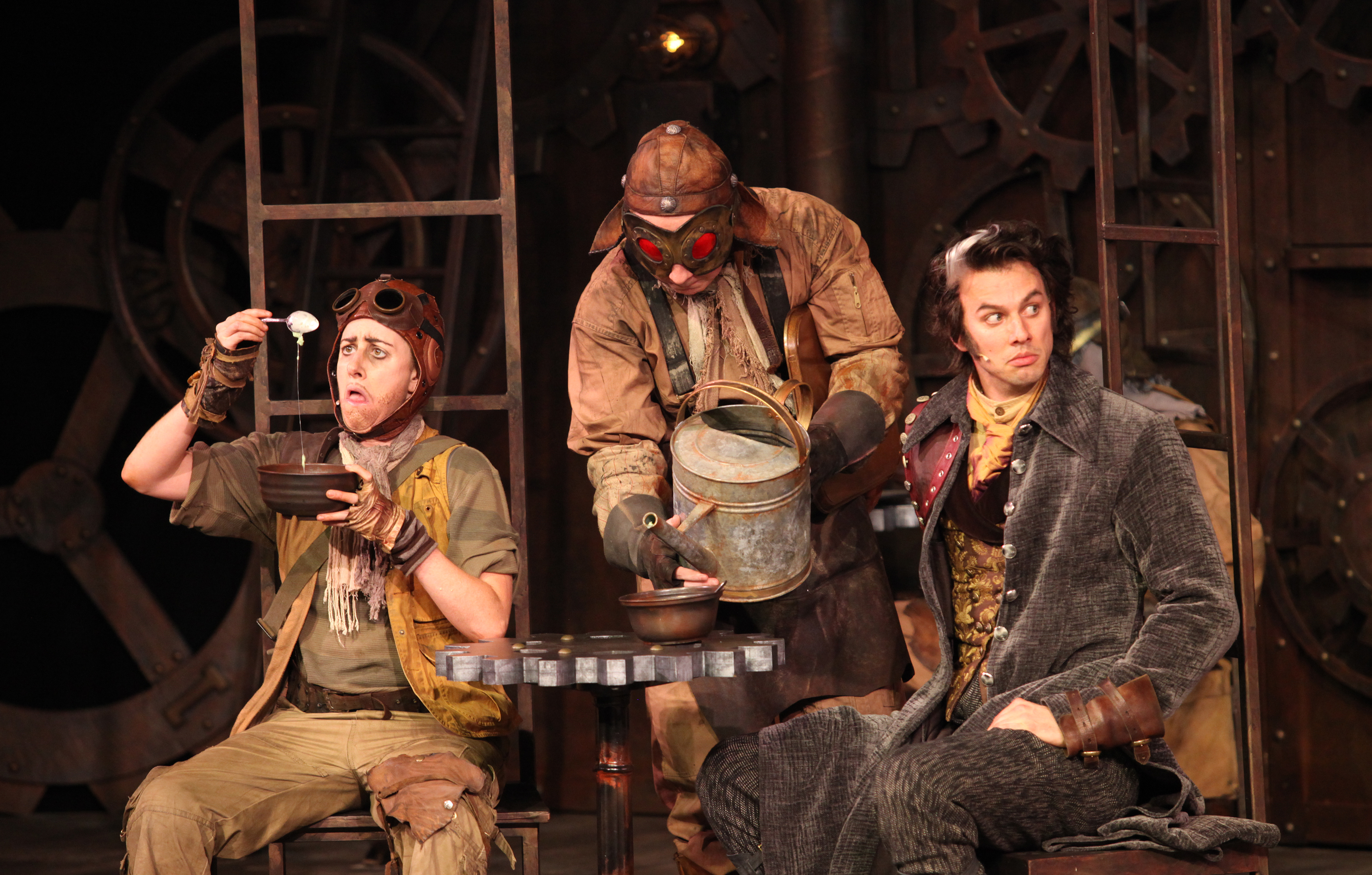
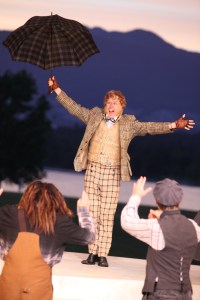
With Bard on the Beach in full swing during a sweltering Vancouver summer, Director Scott Bellis has taken Shakespeare’s The Comedy of Errors and given it the gears and gadgets of the Steampunk genre.
I know what you’re thinking, “Steampunk? Was that not a thing a decade ago? I mean, how can you add to the genre when Will Smith’s Wild Wild West filled the cup full?”
Well said and I did think the same going into the main stage on Vancouver’s beautiful Vanier Park looking out over English Bay. How many times have we seen a kind of kitschy genre played out once too many much to the audience’s chagrin?
Photo credits – David Blue
Yet Scott Bellis and the Bard on the Beach cast delivered a delightfully entertaining performance using the Steampunk back drop to add colourful characters behind the scenes and flashy special effects right in the audience’s faces.
The widgets, levers and wire-rimmed glasses worked in and around Shakespearean forms of love, hate, jealousy, misdirection and slap stick found in his comedies. The stage lighting tricks and quirky use of the monstrous Nurse, did nothing to take away from the fun of the mistaken identities and the foibles the followed. It was not a nauseating ride through the planet’s core filled with distracting gooberfish and the bigger fish that eat the gooberfish. It was a laugh fest coloured with smoke and lightening thanks to the design team including Pam Johnson (Scenery), Gerald King (Lighting), Malcolm Dow (Sound).
Antipholus and Dromio take centre stage.
The play begins with the aging Egeon (Scott Bellis) from Syracuse thrown before the Duke of Ephesus and sentenced to death simply for being a Syracusian. Sounds about right. Pleading for his life, Egeon tells his tragic tale of loss and how he came to be in Ephesus. Many years ago on a voyage at sea a terrible storm separated Egeon from his wife and son leaving him with his other twin son and twin servant. Yep. All believable so far. Both children were called Antipholus and the servants Dromio and when Egeon’s remaining son left for Ephesus and failed to return, he has been on a decade long search for him. The ever so generous Duke is moved by Egeon’s tale and grants a stay of execution granting him one day to come up with money for bail proving that all politicians are motivated by the promise of monetary reward (how can one not be cynical in these electoral times).
Antipholus berates his servant Dromio
Meanwhile across town, Antipholus of Syracuse (Ben Elliott) and his servant Dromio (Luisa Jojic) have come ashore unaware that they have stumbled upon the home town of their twin brothers Antipholus of Ephesus (Jay Hindle) and Dromio (Dawn Petten). In the ensuing confusion created by mistaken identity schtick that Shakespeare does so well, the antics of the Dromios and Antipholi drives the energy and comedy of the play right to the closing curtain. Hats off to Elliott and Hindle as they are thrown this way and that and even more so to Jojic and Petten who were spectacular in making the horrors of slave ownership and abuse quite funny as they were slap sticked around the stage. Hmmm. Feels wrong.
Costume designer Mara Gottler deserves kudos for capturing the feel of Steampunk especially with the minor characters nefarious Dr. Pinch, the mysterious Abbess and the monstrous Nurse Poppy. The iron gears and twisting metal made for a darker backdrop to the play and added a mysterious element juxtaposing the comedic performances in the foreground. Gottler does well by taking the darker science fiction/fantasy look and decorating the characters with horned rimmed glasses, old aviator helmets and trench coats.
When mixed with the sights and sounds of the stage crew, Bard on the Beach delivers a production of The Comedy of Errors that is a unique and wild and fun and a show that demonstrates how this company continues to keep Shakespeare alive in Vancouver.
Check out the amazing writers and artists in ‘Zounds!
Did she even know it was a Christmas play? Yeah, I’m sure she knows. She seems like a smart woman and she didn’t edit out Sir Toby Belch’s song in II.3. which starts, “[Sings] ‘O, the twelfth day of December.” She knows what she’s doing, and I think she’s pretty clever, too.
So how the hell does a Christmas play work for Midsummer weather?
Well, Twelfth Night is actually the name of a Christian holiday which corresponds to the 12 days following Christmas, ending on January 6th with the Feast of the Epiphany. And how do you celebrate Twelfth Night? You drink and eat a lot, make fun of your betters, and generally the social order gets turned upside down while everybody cuts loose. Like many Christian traditions that the Church would like to claim were wholly original, this one’s actually Roman.
Yep. The Romans had this thing called Saturnalia, which took place over several days in – you guessed it! – December! They even elected this King of the Saturnalia who could order people to make out with their boss, or to pirouette in Buckingham palace, or whatever.
It’s a good gig if you can get it.
(Little sidebar: Sir Toby’s song makes sense. Seems that there was a time when Twelfth Night started 13 days before Christmas and then ended on Christmas. Trust me.)
See how it makes sense now? It’s entirely in keeping with the spirit of misrule in Twelfth Night to turn Twelfth Night from a Christmas play into a Midsummer play.
And in that same spirit, we decided to stash our monogrammed copies of the Complete Works into our bags and just watch the show.
Now that this bit of business is done, what did I actually think of the play?
In contrast to last summer’s wild, over-the-top, gut-splitting history play mash-up Harry the King, Kelloc’s Twelfth Night is a much more traditional staging of Twelfth Night.
The whole play takes place on the same simple set representing Olivia’s garden where Sir Toby Belch, Andrew Aguecheek and Maria spy on Malvolio as he reads the letter he thinks is from Olivia and which will lead him to prance around on-stage wearing ridiculous cross-gartered yellow stockings.
And thank God. I’ve seen to many plays with spinning box sets that seems less about the drama and more like a platform for some set designer to show off just how many locations they can cram into a two hour play. Especially given the outdoor venue, I really appreciated that the set itself depicted an outdoor locale
The only set alteration – which not only makes a lot of sense but also recalls the trap door ‘pit’ built into Elizabethan playhouses – is a kind of barred dungeon window behind which Malvolio stands while everyone thinks he’s gone nuts.
A nice touch.
Performances were generally good, though those of the miscreant Belch and company by far eclipsed those of the play’s courtly characters like Orsino and Viola. In defence of Orsino and co., however, Shakespeare didn’t always give them a whole lot to work with in Twelfth Night.
Kabwe’s physicality and boundless energy really brought the character of Twelfth Night’s de facto Lord of Misrule to life. (Almost as good as our own Jay Reid, but I digress.)
The synergy between Belch and Aguecheek (Adam Capriolo) was excellent, as was the decision to represent Andrew Aguecheek as a kind of effeminate hipster poseur. Letitia Brooke‘s initially reluctant Maria fit right in with the two other pranksters.
Rainville’s Malvolio was equally memorable for his stern, quasi-Puritanical high-mindedness as well as his cocksure yellow-stocking prancing. As much as you wanted to hate Malvolio for being a killjoy, you really felt bad for him by the end of the play.
Viola (Emelia Hellman) as well was well-acted and well cast, though I felt that she did not stand out as much as Malvolio and Belch.
The character of Feste (Gitanjali Jain)was portrayed as a jack-of-all-trades entertainer: singer, musician, and acrobat. Jain accompanied herself on the guitar as she sang Feste’s many songs. While she sang and played well, and the live, acoustic musical performance lent an air of spontaneity to Feste’s fooling, I felt at times that the songs were just a little too long. Rather than feed the ribald energy of the scene, they sometimes took away from it.
To me, Olivia (Rachel Mutombo) seemed the weakest of the cast members. Olivia is a melancholy character, still in mourning over the death of her brother. However, none of this melancholy came through in her performance which was rather one-note.
Orsino (Mike Payette) delivered an honest performances though it was not particularly noteworthy. Jesse Nerenberg and Darragh Kilkenny-Mondoux, as Sebastian and Antonio, respectively, both did well in their supporting roles.
On the whole, Repercussion’s 2015 edition of Shakespeare in the Park is an enjoyable if relatively conservative staging of Twelfth Night. While not without its flaws, it nevertheless makes for an entertaining evening in the park. I recommend grabbing a blanket, a few drinks, and catching Twelfth Night while you have the chance.
Flashes of lightening crack, thunder roars and a stumbling madman emerges from the backdrop.
His shirt is un-tucked, his hair is full of static but, most telling, is the wild spark that fills his eyes, and the angry pitch with which he yells heavenward.
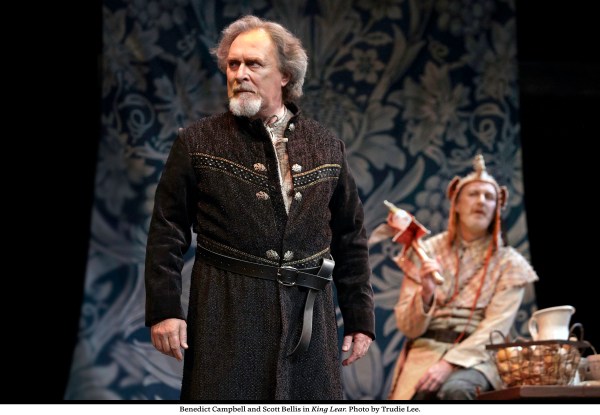
So enters the mad King Lear to the bittersweet pleasure of a rapt Calgary theatre audience. What the actor, Benedict Campbell, has successfully done, is to make you want to admonish the foolish king, and give him a comforting pat on the shoulder at the same time.
The scene described is the first we see after the intermission of Theatre Calgary’s production of King Lear, directed by Dennis Garnhum which runs from March 10 until April 12.
Where the first half is full on Shakespearean plotting, dialogue and pensive monologues, the second is pure action and includes gouged eyeballs, a ranting half naked madman, and assorted “deserved” and “undeserved” deaths.
Photo credit – Trudie Lee
King Lear is one of the “famous” Shakespeare plays, which brings to life the tale of a King of Britain’s descent into madness, and then his journey out of it, which ends in tragedy, great loss and ultimately his death.
Intrigue abounds as brothers clash, and sisters with sharp tongues and nasty streaks are backed into corners as Lear’s kingdom is divvied up among the royal family.
The play centres on Lear and his three daughters, Goneril (Colleen Wheeler), Regan (Jennifer Lines) and Cordelia (Andrea Rankin). The aged king loves his youngest the best (hey! I’m the youngest and best too), and this leads to complications, especially after his own self-serving game of ‘how much do you love me?’ causes him to banish Cordelia. The vultures in the royal family, who try to wrest away power from his feeble hands, then betray the proud Lear.
Which of you shall we say doth love us most? That we our largest bounty may extend,
Lear, I,i
The characters themselves feature some quirky and brooding additions in their mix. One in particular stands out among the rest: the fool, who is King Lear’s Court Jester, played by Bard on the Beach regular Scott Bellis.
*Garnhum’s Lear will follow at Bard on the Beach’s summer playbill.
The fool, imbues some much-needed levity into the first act. Wearing a coxcomb on his head, he spends a majority of his stage time leaping from place to place. Curiously, his mad interpretation of Lear’s confused reality does lend a bizarre sort of clarity to the king’s situation.
This is exemplified when the fool eerily jests to King Lear, “This cold night will turn us all to fools and madmen,” foreshadowing all the cacophonous events to come.
Heartbreaking is the excellent performance of the Earl of Gloucester, played by David Marr, who is the play’s one paternal character you can’t help but feel badly for as misfortune after misfortune befalls him.
Then there’s the scene that sticks out because of its unnecessary gore. Gloucester’s eyeballs are in stomach-churning fashion carved out his head and at one point even trodden upon. It did little to add to the production other then induce cringes and distraction at all the fake blood for a full two minutes afterward.
Lest it see more, prevent it. Out, vile jelly! Where is thy lustre now?
Cornwall, III, vii
Michael Blake performance of Edmund, the crafty bastard son of the Gloucester, is charmingly sinister. He plots for revenge by promoting multiple sibling entanglements making him both convincing as a villain, and likable.
While actor Andrea Rankin, as the young Cordelia, does play the doe-eyed daughter well, there is something a little grating about her over the top sweetness that came off as insincerity near the end. It seemed as though her tone and countenance changed little whether responding to a marriage proposal or being angry at her father’s mistreatment.
The Shakespearean world of King Lear, so artfully woven by the troupe of Theatre Calgary actors, doesn’t seem very far off from our own world, which is perhaps why the play still feels so relevant. These themes of undying devotion, betrayal and greed still saturate news media, television and movies because they are reflections of human reality and frailty.
Getting through the more slow-paced first half is well worth the wait. The explosion of passion, blood and revenge in the second half leaves you completely sated in a way only an excellent acting troupe and script can do.
The winds of fall were starting to cool, the leaves were in their final stages of clinging to the branches in Madison, New Jersey, and at long last, after years apart, the souls of Bard Brawl and Shakespeare Theatre of New Jersey met. Finally.
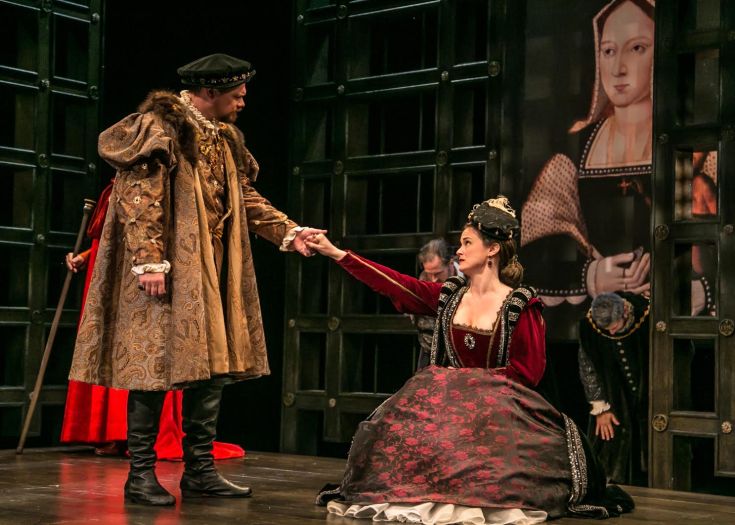
After a failed attempt to catch Pericles, Prince of Tyre last season thanks to a “snow storm” (come on New Jersey) we traveled to the quaint town of Madison and took in Henry VIII.
Let’s first give a big fits pump and major props to @ShakespeareNJ for putting on a play so rarely produced. Come to think of it, I don’t think I’ve ever seen Henry VIII on a playbill anywhere.
Alas, for those of you who didn’t catch it, we are sorry that you are too late. It was worth the fare.
As discussed often at the Bard Brawl (both podcast and blog), the play suffers from two facts that keep theatre companies from putting histories like Henry VIII on. (1) History plays are very complicated to those who aren’t familiar with the epoch and (2) the late plays where authorship may be questioned are sometimes avoided. It is what it is.
Fortunately for me, I went through a bit of a Henry VIII kick a while ago and have seen A Man For All Seasons, the incredibly addicting Tudors series, the unwatchable Other Boleyn Girl and David Starkey‘s two documentary series on the subject. I get obsessed sometimes.
To say familiarity with the characters helped in engaging Paul Mullins‘ production of Henry VIII would be an understatement, but that’s not a criticism of the play. Mullins’ direction is tight and on point and the story is followable if confusing. The confusion has nothing to do with the production. Shakespeare’s audience would have known the story well and would not have needed explanation on who was who and why that lord was important or not.
A friend that went with me admitted that she (a) understood nothing of what anyone was saying, but (b) really enjoyed the performance.
How did the paradox come to pass?
The characters’ words are hard to filter through at times and there is a lot of dialogue. The actors, however, emote and bounce off each other well and the audience can follow who is aligned with who, who is jealous, who is torn, who is tragic and so on.
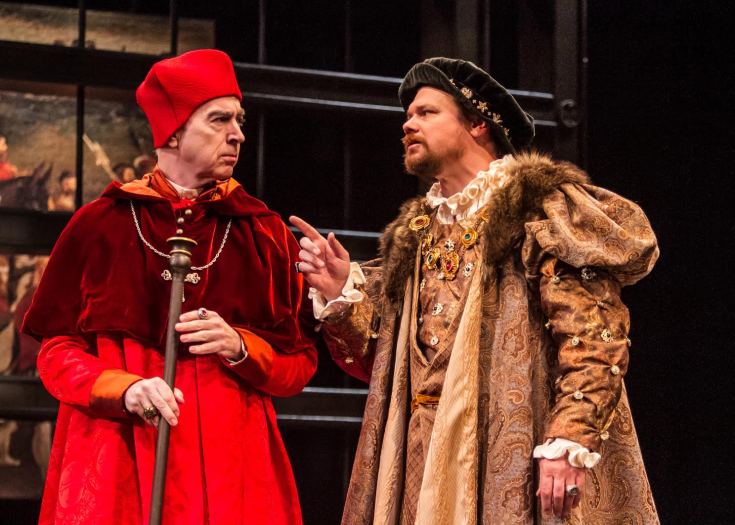
Cardinal Wolsey (Philip Goodwin), and the Duke of Buckingham (Thomas Michael Hammond) stand out in their respective roles, and leave memorable imprints. Both have great arcs that go from powerful and pompous to tragic and torn.
Two roles that really need to be amped up with intensity in the production were Anne Bullen (Katie Wieland) and Henry himself (David Foubert). Both actors are very good, but sometimes are overshadowed by those they share the stage with. The story and importance of these two requires that they be comets among asteroids. Something about Bullen (sometimes Boleyn) makes the king change everything. This is a big ask, but one that needs to be answered.
Queen Katherine (Jessica Wortham) is another that chews up the stage even if something in me wishes she played the part more Spanish. (Katherine is of Aragon after all).
At this point I’m nitpicking. The criticisms do not in any way take away from the joy in watching the performances.
Mullins is apt and on point with bringing characters in and out of the story, filling the stage with tension and drama and leaving theatregoers satisfied in the end. Particular points gained for keeping the set simple, costumes on point and not adding too much that shifts attention from the characters.
Having only caught the show in its last week, I feel it my duty to put a huge plug in for the upcoming Much Ado About Nothingthat hits the stage December 3. Let’s just hope there are no “snow storms.”
Take one part Tarantino classic Pulp Fiction, add in an equal measure of Shakespeare, and stir. What you get is Bard Fiction, a play which presents many iconic scenes of Tarantino’s classic film as if they had been written for the stage by Shakespeare.
Come to think of it, this would have made a great ‘Zounds! submission… Ennoble Marsellus, turn Vincent and Jules into household servants, swap out knives and halberds for guns…
Anyhow, the plot of the play follows the script of Pulp Fiction and the humour of Bard Fiction comes from watching these familiar scenes and seeing how they come out once they’re run through the Bardifier.
(The Bardifier is a complex series of linguistic algorithms codes and supervised by writers Aaron Greer, Ben Tallen & Brian Watson-Jones. It’s a complicated machine. We don’t really understand how it works, and maybe it’s just magic. But we can guarantee that it does work. Trust us!)
Out of the gate, the play is uproariously funny.
First, you get the scene where Ringo (Tim Roth) and Yolanda (Amanda Plummer) are planning to rob the patrons of the dinner. Plenty of foul language language most foul!
The effect of knowing exactly how the scene is going to play out but being surprised at every turn by Shakespearean turn of phrases tickles both the early 90s film freak and the Shakespeare nerd in you. In fact, it’s amazing how little impact the shift from Tarantino’s language to Shakespeare’s actually has on the pacing of the scenes. Did the writers discover the inherently Bardic soul at the heart of Pulp Fiction?
Next come Vincent and Jules (short for Vincenzio and Julius of course), riding in their horse-drawn cart. taking about the differences between England and France. Cue the bardifier! You put in Big Mac and Royalewith cheese and out comes Cottage pie or hachis parementier.
See? I told you it works!
This is damned funny stuff, at least at first.
As the novelty starts to wear off though, Bard Fiction becomes less uproariously funny and more, well, just plain funny. Thankfully, the writers realised this as well so instead of getting a recreation of the whole film, Bard Fiction presents a sort of greatest hits and runs a little over an hour.
It’s still really entertaining right up to the end but by the end of the play, that pony’s run about as far as this idea can take.
Still, is there anything more Bard brawl-tastic then the idea behind Bard Fiction? It’s definitely in the spirit of the Bard Brawl and ‘Zounds! which means that if you like either of these two things, you’ll have a great time with this play.
Bard Fiction isn’t a deep exploration of the state of Shakespeare in the 21st century or a thoroughly researched and cogent analysis of the construction of dialogue in the early 90s films of Quentin Tarantino.
It’s just a whole lot of fun and goes to show that the theatre, and Shakespeare’s theatre, doesn’t need to be elitist hard to get into.
In the final trip to the Bard on the Beach for the Bard Brawl the Tempestawaited. It is an entirely unique play in William Shakespeare’s cannon and has the potential to be one of the most entertaining, provoking and touching. It can fall flat or be incredibly moving.
To quote Omar from the Wire, ‘Indeed.’ (That was Shakespeare right?)
Meg Roe’s Tempest finds the balance between wonder and soliloquy at Bard on the Beach. Photo credit – David Blue
Roe’s Tempest executes the most difficult of things in live theatre: balance. The play bounces between incredible design, action, and intrigue and the subtle and powerful monologues of the play’s centre: Prospero (Allan Morgan).
Indeed the isle was full of noises, sounds and sweet airs that gave delight and did not hurt (wink), but first we have to get there.
Relinquishing solitude and embracing the brave new world is a wise model for theatre goers who should take in the Tempest. Photo credit – David Blue
The staging of the opening ship wreck was very clever, loud, and set the play perfectly as it destroyed the ship carrying the King of Naples and left him and his crew on the island inhabited by the exiled wizard, his naive daughter and a sprite name Ariel (no, not that Ariel. She’s a mermaid).
The balance between stylized action and solitary poetry is the Tempest at its best, and Roe does not miss an opportunity to exploit this juxtaposition (even if she spells her last name wrong. Shouldn’t it be R-O-W-E?).
Morgan is great as the aging Shakespeare getting ready to say goodbye to theatre. Er I mean Prospero saying goodbye to the island and his daughter. He is lucky (or unlucky depending on your style), as he gets a handful of the most famous of Shakespeare monologues. You can bet there were a few nights when a few theatre grads had copies of the text in hand and mouthed along to:
Our revels now are ended.
These our actors, as I fortold you, were all spirits and
are melted into air, into thin air.
Gotta love theatre grads. Wait a second. Most of the cast is theatre grads. Forget I said anything.
The only thing I can ask for is what Morgan was able to give me. Even though the lines were familiar and I knew they were coming they still had that sad melancholy of an artist hanging up his quill. He made them memorable and meaningful. It’s especially difficult to draw and audience in to that level of intimacy after some of the spectacle scenes that preceded and followed the lines.
And the spectacle can’t be understated. Roe’s Tempest is full of some really incredible design and style that added as much magic to the island as any Puck infested forest.
Speaking of whimsy and wonder, Ariel (Jennifer Lines) has a dramatic and powerful presence throughout the play. She pulls a little Galadriel out in one of the most impressive scenes of the whole production. Shivers.
Go see the play. You’ll get it.
Props has to also go to the Miranda (Lili Beaudoin) as Prospero’s naive daughter flitting around the island after love of her life (you know, the third guy she’s met in her life) Ferdinand (Daniel Doheny), while having her eyes opened to the brave new world (wink) that awaits her. Oh that world is a bunch of conniving, back-stabbing, flaky aristocrats Miranda. Sorry. Welcome to reality. Have a wonderful wedding.
Trincula (Luisa Jojic) and Stephana (Naomi Wright) threw me off a bit, but showed their quality in the end; just like Faramir. The jester and drunkard were great at playing off Caliban (Todd Thomson), and gave the audience a more than a few laughs even if they were of the ‘ha ha she’s drunk’ variety. For me, I could have taken a little less from the scenes, but, hey, who am I to criticize what everyone else is enjoying? More poop jokes!
Ariel pulls out a little Galadriel in the midst of the Tempest, no complaints here. Photo credit – David Blue
Sitting waiting for the play to start both myself and my brother noted the set. The design was perfect. Not too much, not too bare. The players worked their way through the set with ease, and were able to shine and wind their way through the design. The trap door was used sparingly and to great effect.
On a side note I would like to congratulate myself for not geeking out when I saw sound designer Alessandro Juliani walk by before the play. It’s hard to resist bringing it up, and insist on going over some of the decisions Felix Gaeta made in season four of Battlestar Galactica. He used to come into a restaurant I managed in Vancouver about seven years ago. Very nice guy. What a great show.
The Tempest is one of those plays Shakespeare theatre troupes can’t resist adding to the bill especially in the summer. The play can be very entertaining or mind-numbingly boring based on choices the director makes and the performances that accompany. Bard on the Beach pulled this one off not adding too many overly clever bits and adding just enough style for the wow factor. Props to the cast and crew.
Do yourself a favour if you’re in Vancouver between now and the end of September and check it out.
(Read in honest trailer voice) An attempt on the king’s life has been made, a plot is unveiled, the traitors are captured and the kingdom must be calmed. The hopes of all England ride one one man, a man who can sway the public and restore order.
He is…
A playwright?
William Shakespeare goes from writer to character at Bard on the Beach’s production of Equivocation by Bill Cain. Photo credit – David Blue
Vancouver, BC’s Bard on the Beach sole non-Shakespeare written play for 2014 is Bill Cain‘s Equivocation, a perfect fit to the season even if the play is not a curtain-t0-curtain masterpiece. Director Michael Shamata puts on a thoroughly enjoyable and energetic piece on the Bard on the Beach studio stage.
Rather than the author of the play, William Shakespeare or Shagspeare (Bob Frazer) is the central character struggling late in his career to, well, write a play.
In Cain’s play, we have the dark and serious playwright reflecting on a career built on piling up bodies on stage, rewriting courtly love, changing the nature of the theatre forever, and altering history with a hump here and there. He is under pressure to equivocate from political pressures in King James I’s court that want him doing more of what they want. They get it. The play is the thing. It can change things.
Shagspear (Bob Frazer) given lessons on the shady grey area of truth by Sir Robert Cecil (Anousha Alamian). Photo Credit – David Blue
The machiavell of the the play is Sir Robert Cecil (Anousha Alamian) who would like Shagspeare and his players to write the very current history of the gun powder plot of December 1605 in which a group of Catholics most notably Guy Fawkes (yes, the guy from V for Vendetta) sought to destroy parliament complete with the intolerant Scottish king in it. Can the greatest playwright in all of English history pull the play out, or is his quest for the capital ‘T’ truth to much of a barrier?
Who’s telling who lies? Who is really behind the plot? What are the characters’ motivations, and why are they motivated to act them out?
Consider the question central in the play:
The Spanish army invades England and a soldier is at your door asking if the king is hiding within. He is. Do you remain loyal to the crown and lie to save the king or do you tell the truth and betray he you swore to protect?
You may want to use the subtle art of equivocation.
equiv·o·cate
verb\i-ˈkwi-və-ˌkāt\
: to use unclear language especially to deceive or mislead someone
Thank you Merriam-Webster.
Cain, a Jesuit himself, is incredibly clever for the most part, weaving Shagspear’s crew of actors, King James’ politicians, clerics, and the playwright himself together to tell the incredibly complicated, but thoroughly enjoyable plot.
Actors, like in Bard on the Beach’s Cymbeline, play multiple roles sometimes swapping costumes onstage. On the whole the players pull off the swaps with accuracy and style, and rarely do the roles blend into each other.
A chink that stood out in the armour of Cain’s play is the side plot involving Shagspeare’s daughter Judith (Rachel Cairns), whose scenes lack the energy and pop of the rest of the play. Cairns is a fine actress and it’s unclear whether the 21st century sarcasm her character broods the stage with is the fault of the script or the performance. I want to say it’s the former. The “I hate soliloquies” lines are a little weird as they’re typically uttered while she delivers her various soliloquies. There’s also an odd line near the end where she says that after “the Scottish Play” (ha, ha. Theatre people are superstitious about saying ‘Macbeth), her father only wrote six more plays. Six more? Those plays were Antony and Cleopatra, Coriolanus, Timon of Athens, Cymbeline, Winter’s Tale and the Tempest (maybe Pericles). King Lear’s also around that time. Just those six? I can think of a playwright or two that wouldn’t mind if that list was their complete canon. She is meant to be the Debby Downer to the Bard, and winds up being the same for the audience.
Judith (Rachel Cairns) struggles to keep the energy left on the stage by her fellow players. Photo credit – David Blue
The Judith scenes might have been a bit more forgivable if the rest of the play wasn’t so intriguing, full of fine pace, and entertaining. The scenes between Shagspeare and Cecil are very strong and bursting with wit, as is the theological back and forth between Shagspeare and Father Henry Garnet (Gerry Mackay). Mackay pulls double duty as Shagspeare’s forever partner and friend Richard Burbage, and is great in both roles.
Oh and there’s a few heads that get cut off on stage. Always dramatic.
Bard on the Beach was wise to chose Cain’s play for 2014. Having one play that addresses the man rather than the work is always a treat. Those in Vancouver who sit in the ‘I don’t really get Shakespeare’ lawn chair would do well to check this one out, as well as those who sit on the ‘what was it really like in Shakespeare’s time’ hardback chairs.
It gives a great glimpse into a vision of what the time may have been like, and the struggles of an author to produce work that is both true, poetic and will have lasting appeal.
You know, unlike a few parts of the Henry VI trilogy.
Would you equivocate for your king? Photo credit – David Blue
Steam punk, Chuck Taylors, umbrellas, a lion and Daft Punk’s “Get Lucky,” and you’ve got yourself the ideal play by English Renaissance playwright William Shakespeare.
Wait. What?
Bard on the Beach, like almost every theatre company, just can’t resist the midsummer allure of a certain play. Photo – David Blue
The Bard on the Beach started its successful run as Vancouver, BC’s premier Shakespeare performance troupe with A Midsummer Night’s Dream, so it’s no surprise that in celebrating its 25th year, the players were at it again.
Actually, it’s no surprise that any troupe is doing the play during the summer; it gets put on a lot.
It’s glaringly obvious why. Midsummer has fairies, love triangles, wacky actors, and invites a style directors like Dean Paul Gibson can push and play with. Bard on the Beach has done the play six times now. Gibson’s done it twice. This one’s got a marionette.
A certain Brawler who may or may not be me, and another who may or may not be the other c0-creator of the brawl often gripe about the fact the play gets put on way too much. However, every time either of them read or see the play, they admit that it’s a pretty fun play. Gibson’s is no exception.
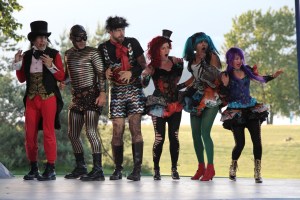
The Bard on the Beach production amps up the pop music, goes all-in on a melange of styles for the costumes, and misses no opportunity to push the whimsy and fun of the play. My dad and sister, who admitted to never liking Shakespeare, and who would rather pay for a six pack than a ticket to a play, both LOVED the production. My sister couldn’t believe how funny it was.
Purists poring over heavily dogeared and highlighted copies of the play probably will complain about Gibson’s use of Top 40 songs and some of the style choices. They complain about most things. Can’t please everyone. So it goes. Back to the library with you.
One critical friend of mine thought the choices bad, and suggested the director added the music to draw a bigger audience. Maybe. Then again, Midsummer always draws an audience.
Founding Bard on the Beach member Scott Bellis steals every scene his has in Midsummer. Photo – David Blue
Bottom (Scott Bellis) and Puck (Kyle Rideout) steal the show. Both actors chew up the scenery when onstage, and act head-to-toe with the energy that must make all directors feel warm at night.
Bellis, as ‘lead’ in the theatre troupe rehearsing for the wedding of Duke Theseus (John Voth) and Queen Hippolyta (Adele Noronha), is a standout missing no chance to push his farcical talents. His hair, makeup and costume only add to the character.
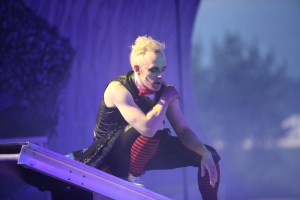
Rideout, as the fan favourite Puck, wears that tutu and pair of Chuck Taylors like a pro. Though purists will not appreciate the selfie he takes when accidentally self-medicating with a love potion herb, the audience loved it. In a particularly clever scene as the play is coming to a close that even the ultimate purist will appreciate, Puck mimics walking a tightrope down the middle of the stage cleverly highlighting the fine line between chaos and normalcy, love and hate, reality and fantasy, theatre and the real world: brilliant.
Eyeshadow, check; striped tights, check; tutu, check; time to play Puck. Photo – David Blue
The official program describes the plot as such:
Oberon, King of the Fairies, is upset with Queen Titania. He commands his servant Puck to produce a magical nectar that will cause love at first sight. The mischievous sprite arranges for Queen Titania to fall for Bottom, a simple weaver (now transformed into an ass) while hilariously misdirecting the affections of four runaway lovers.
Nothing is untrue in the description, but the more experience one has with the play, the more one gravitates to Bottom and Puck, and whatever they’re doing. The Lysander, Demetrius, Hermia, and Helena cat-and-mouse/love potion stuff is fun, but is upstaged by Bottom and Titania (Naomi Wright), and their wierd fairy-loves-donkey, Puck orchestrated subplot. I won’t lie. Writing that sentence was fun.
Gibson also chose to stage the “Indian boy” as a marionette puppet, which was a very clever touch even if it was a little confusing to some in the audience like my dad and sister, who hadn’t read the play. The choice added to that blurred line between reality and fantasy the play is always treading.
The purist in me (yes he is there scowling and shaking his head all the time) did have a touch of pshah at the opening scene when Theseus delivers the following line as if he’s Romeo:
Hippolyta, I woo’d thee with my sword,
And won thy love doing thee injuries;
But I will wed thee in another key,
With pomp, with triumph, and with revelling.
I tried this line on a girl once. Big mistake. Not a ton of romance there.
Bard Brawl Sonneteer and ‘Zounds! contributor Maya Pankalla told me the other day the play was her favourite.
‘It’s just so me,’ she said.
Those that know this particularly talented recently married brawler/zoundser (sorry boys) will get it right way.
For those that don’t: Midsummer is a must see for all who like the bard, fairies, whimsy, comedy, romance, and donkeys whenever it is produced. The Bard on the Beach production adds marionette aficionados to the list, and pulls the whole thing off with style.
Anita Rochon took on Cymbeline in all its facets from comedy to drama to action to romance and all else in between. Photo Credits: Rachel Cairns as Imogen Photo & Image Design by David Cooper & Emily Cooper
The 2014 Bard on the Beach run included the not done often play Cymbeline. It’s a dramatic and exciting play that bounces between comedy, drama and sometimes shocking plot turns, and is one of the Bard Brawl’s favourites.
Director Anita Rochon discussed the production with the Bard Brawl.
Bard Brawl: Why did you pitch Cymbeline (to Bard on the Beach)?
Anita Rochon: It was a couple of things. It was a play that was really interesting to me and also interesting why it isn’t done very often… The last time it was done at Bard on the Beach was 2002, so I also saw that it wasn’t done in a long time, and with the particular casting breakdown I was working with, which was one women and five men (I asked for a sixth) because we were paired with Equivocation, I had to work within a particular cast breakdown, and I saw that Cymbeline had this women who was at the axis point of all these different narratives, so she really was the centre. That was a play that I could imagine staging with a smaller cast and having a women at the centre of it all.
BB: What was the direction you were trying to lead this play?
AR: One of the motifs and themes that was very strong for me in reading it was the idea that one can change. The idea that you may get forgiveness, that you may get a second chance. So the idea of changing, and changing identity, and not just going in disguise – as happens in a lot of Shakespeare’s plays – but even the idea that you sometimes have to change your idea of who you are in order to keep living in a way that’s satisfying, but also to receive forgiveness is something that I really emphasized, and took it quite literally to this idea of people changing identities right before our eyes.
BB: The one thing that I was surprised with was in the first half of the play, it was a lot lighter. Cloten and his mother, there were a lot of laughs where you or they pushed the humour. Was the difficult to rectify seeing as how dark it (the play) gets at the end?
The ensemble guides the performance of Cymbeline. Photo credit – David Blue
AR: I think what every director does is just try and do what the playwrite is telling us to do, and so that’s what I was trying to do. I didn’t feel like I was attempting to push any humour. Shakespeare has written those weird scenes between Cloten and the lords where you get such a clear dynamic of how the whole kingdom thinks of Cloten, and the queen has those fantastic asides to the audience. She’s really written like an evil stepmother in fairytale tradition.
So many speak about how it’s such a crazy play, and has so many things: comedy, romance, drama, tragedy. The only way that I could understand dealing with that was just playing everything for what it’s worth. Just playing everything for how it’s written. We can’t squeeze the whole thing into being a comedy; why would we try?
I think there is a precedent for that now, we’re used to that now with shows like Game of Thrones or probably better example would be Breaking Bad where sometimes you have these scenes that are almost clown-like and then you have high drama, and then you have a stylized scene. A show like Breaking Bad has all of those things, and so I just tried to commit to each scene from what I understood from each scene and put them all together with a container of this ensemble telling us this story.
We see the ensemble coming out presenting themselves, presenting the narrative they’re about to tell us, and then, at the end, with that little button where Rachel Cairns (Imogen) takes centre stage again and finishes up the play, and then throughout with the ensemble sometimes sitting upstage, I just had to believe that the ensemble telling us the story that contained comedy, contained tragedy, contained drama, that if I played each scene for what it’s worth and asked the actors to do the same that we’d be okay.
BB: Everything in the production is almost monotone, greys and beiges, as far as the design goes, but the tempo is very fast. They move quickly. How did you get all of these elements to work together.
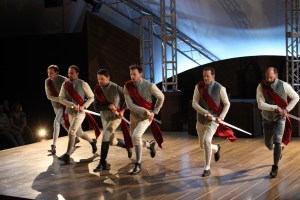
AR: I think I took it similar to how I was saying I took the scenes scene-by-scene. I probably took all the elements element-by-element. The costumes for instance, we based them off of fencing uniforms, for three reasons. I wanted the ensemble to feel like a team. I wanted them to feel athletic. I wanted the production from the very beginning to feel athletic and muscular and fast-paced, and sometimes masculine, but with a feminine presence in there. Certainly the Rome scenes I wanted them to feel masculine, so that kind of athletic, nimble feeling was a priority for me. I began to think, we need a base costume because they’re switching between all of these different characters, so what can I have as a base costume? The worst idea would be a black turtleneck and black pants.
I was scouring all these books, and I came across this amazing image of a fencing uniform from 100 years ago, and I thought, ‘this is really interesting’ because we immediately associate it with a particular time. It feels a little bit old timey without it feeling specifically old timey. It references a period without it saying, ‘this takes place in 1409.’ Yet it encapsulates a little bit of that team feeling, that play fighting feeling, that we’re going to play at something in front of you. Of course, fencing is in preparation for a real fight. Like this play is a representation of a reality or a true story.
In terms of colour, we just wanted a fairly neutral palate, so that those other costumes could live off of there, but also be complimented by it, and of course, fencing uniforms are in those light grey tones.
In terms of the set, I was really interested in highlighting the theatre in its raw form, so the stage really nice and bare, and we used similar material…
I kind of just went element-by-element, and then try to keep the look of it all similar. Keep it all clean and always ask myself, what is the essential here. Let’s try and boil everything down to its essential and not have a lot of extra props and extra props and extra sets.
Anita Rochon artistic co-directs The Chop in Vancouver with Emelia Symington Fedy, which has produced numerous new works including KISMET one to one hundred and How to Disappear Completely which continues to tour internationally. She frequently collaborates with some of the city’s most celebrated companies including Theatre Replacement, Théâtre la Seizième, Vancouver Opera and Electric Company Theatre. She is a graduate of Studio 58 (Acting) and the National Theatre School of Canada (Directing). Anita is the recipient of a Siminovitch Protégé Prize and a Mayor’s Arts Award.
Like bust-your-gut, pop-a-button, get-dirty-looks-on-the-Metro-because-you’re-laughing-so-damn-hard funny. And, as my wife Rachelle “The Butcherette” can testify, that’s if you don’t understand a word of Shakespeare besides ‘Zounds!
See, here’s the deal with this summer’s edition of Shakespeare in the Park: Harry the King is actually a play adapted from Henry IV parts 1 and 2 and Henry V. Specifically, it grabs up a bunch of the bits involving prince Harry’s rise from being a good-for-nothing lay-about who spends all of his time in Eastcheap’s taverns drinking with his buddies to his ascension of the throne and eventual conquest of France.
At least that’s what it looks like at first but the whole thing never actually makes it out of the tavern.
The entire play takes place inside the tavern with Hal, Falstaff, Mistress Quickly, and company playing out all of the roles in Hal’s story. As such, you’ll see actors doubling up on roles in the same scene, frivolous funny voices and accents, whimsical posturing and funny walks, criticism and praise of the actors performances and of course off-the-cuff comments about what’s happening to the audience who is a stand-in for the other tavern patrons.
So really, the whole thing is like an epic and uproarious Bard Brawl on stage if the Bard Brawl had a budget, some sound and lighting equipment, a stage and a live audience!
On an unrelated note, we still have a donate button and plenty of copies of ‘Zounds! for sale.
If you’re a purist who likes their Shakespearean histories untouched, their iambic speechifying solemn and formal, and their Salic law needlessly obscured and overly complicated to all except for those 2 guys in the front row who have been involved in 15th century Renaissance re-enactment for 20 years, maybe this won’t be the production for you.
But if you’re a person with a pulse and at least a few friends, particularly if you are a person subscribed to the Bard Brawl, there’s a good chance you’ll be thinking to yourself as you fold up your lawn chair or picnic blanket: “Well that was well worth the price of admission.”
Shakespeare in the Park is free so that was a free joke. (You’re welcome.)
But don’t be like that guy who refuses to tip: Repercussion Theatre lives on donations so when the actor who just made you pee your pants at the end of the first half of the play comes by with a hat during the intermission, hide your shame and drop a few bucks in please. (Or you can click here and donate.)
Pack up your cooler with a few snacks and a couple of drinks, bring a blanket and go see Repercussion Theatre’s Harry the King in a park near you before it’s too late! I won’t come to your house and force you to go see this (because I don’t know where you live, mostly), but I’ll just leave this last remark here for you to do with as you please.
This is the one play that made my wife say, for the first time ever since I have known her: “I want to go back and see it again!”
The Harry the King tour ends on August 3rd. You can check out Repercussion Theatre’s website for dates and locations of upcoming performances.




















 The Bard Brawl