Talking About the Weather – Man vs. Wild… er, Nature?

Artwork - Leigh MacRae
Artwork – Leigh MacRae

Listen to or download the podcast.

Welcome Brawlers, to a special episode of the Bard Brawl!

I promised you a post on the weather, astrology and nature in King Lear. However, we’ve done one better: Daniel and I got together yesterday for a short discussion of the play – and yes, we did talk about the weather.

There are a lot of different themes in Lear, a bunch of which we list and touch upon in this episode. However, King Lear is really a play about “Nature”.

Notice the scare quotes and the capital ‘N’? Yeah, there’s a good reason for that.

When we think of nature, we tend to think of birds, trees, hiking, national parks, Bear Grylls, whatever. And yes, nature could mean that to Shakespeare and his contemporaries, too. However, Shakespeare is much more interested in Nature, as in human nature.

The idea of Nature, what is it, and whether it is in fact good or bad, is very much up for grabs in this play. One of the (many) reasons Lear is still so popular is that even in the present, we haven’t managed to agree on the character of “Human Nature”. Is there even such a thing?

While this is grossly oversimplifying things, there tends to to be two models of Nature in the play.

On the one hand, we have the model which Lear and Gloucester subscribe to. In their view, daughters and sons are ‘by nature’ inclined to love their parents. That natural bond is supposed to ensure that children and parents get along and that children will take care of their parents when they are no longer able to care for themselves.

Also, Gloucester is very much interested in astrology and celestial events which he sees as portents of things to come in the realm of human affairs. It is entirely natural to him to see a comet streak across the sky and to associate that with some impending disaster in society. Why? because it suggests that some part of this well-oiled system is out of balance. When everything is working naturally, the natural world is sympathetic to and connected with humanity – and has humanity’s best interests at heart.

Another way of saying this is that Nature programs these behaviours into us in order to prevent society from crumbling into chaos. As a result, Lear and Gloucester place a tremendous amount of trust in this system.

What does Lear call Goneril and Regan after he is refused admittance with his knights: “You unnatural hags!” That is, their behaviour runs contrary to the natural model of the parent-child relationship.

And then there’s Edmond.

Clearly, he’s got no interest in his daily horoscope.

And why would he? According to his father’s model of the universe, he’s supposed to be the reject, the one left out, somehow less important or valued because of a simple accident of birth.

In his first speech, Edmond days; “Thou, nature, art my goddess; to thy law / My services are bound.” Clearly, he’s not talking about the same ‘Nature’ which Lear and Gloucester are referring to. His understanding of nature is the complete opposite of Lear and Gloucester’s.

Yet it is perhaps much closer to what we might think of when we consider human nature.

Lear and Gloucester live in a world where Nature runs everything, where your successes and failures are the result of the world working for or against you. However, Edmund sees human nature as self-directed and he’s pretty straight-forward with us: You think I’m ruthless and conniving because I was born out of wedlock?

My
father compounded with my mother under the
dragon’s tail; and my nativity was under Ursa
major; so that it follows, I am rough and
lecherous. Tut, I should have been that I am,
had the maidenliest star in the firmament
twinkled on my bastardizing.

Edmond admits that he chose to act this way. He wasn’t born this way, and the planets had nothing to do with it.

Can’t get enough of the Lear? Check out Melvyn Bragg’s In Our Time podcast on the fated king.

Enjoy your holidays and we’ll be here again next week for act IV of King Lear.

Bonus sonnet 22 read by Hannah Dorozio.

(Podcast recorded and edited by Daniel J. Rowe, Show notes by Eric Jean, music by Jack Konorska)

Stay in touch, brawlers!

Follow @TheBardBrawl on Twitter.

Like our Facebook page.

Email the Bard Brawl at bardbrawl@gmail.com

Subscribe to the podcast on iTunes

BB: King Lear, Act III

Artwork - Leigh MacRae
Artwork – Leigh MacRae

Blow, winds, and crack your cheeks! rage! blow!
You cataracts and hurricanoes, spout
Till you have drench’d our steeples, drown’d the cocks!
You sulphurous and thought-executing fires,
Vaunt-couriers to oak-cleaving thunderbolts,
Singe my white head! And thou, all-shaking thunder,
mite flat the thick rotundity o’ the world!
Crack nature’s moulds, an germens spill at once,
That make ingrateful man!

— King Lear, Act III, scene 2

The storm is upon us!

Welcome Brawlers to Act III of King Lear!

Listen to or download the podcast.

A lot of ground to cover today!

The gates of Gloucester’s castle have been shut by Cornwall and Regan and Lear and his followers have been cast into the stormy wilderness. Edgar has fled into the woods as well, disguised as a a mad beggar. In fact, as act III, scene 1 opens, Kent is presently searching for his king. He enlists the help of a gentleman to find him. It seems that Kent has been able to send a message to Cordelia in France, in which he tells her what her sisters have done to Lear. She and the King of France are preparing an army to march on England and they need to keep Lear safe.

While Kent has yet to find Lear, we see him right from the start of scene 2. He is shouting at the storm, accusing the weather of conspiring with his two daughters, Regan and Goneril, to ruin him. The fool is trying to plead with him to seek out shelter but Lear refuses. Finally Kent arrives and describes the storm as the worse he has ever seen. He mentions that he has found a hovel nearby where they can seek shelter. For his part, Lear seems to have no interest but then, seemingly moved to compassion at the sight of his suffering fool, agrees to take shelter. Then the fool pronounces a prophecy which he mentions comes from Merlin even though Merlin will only show up after Lear’s gone. Strange stuff.

Scene 3 is a short exchange between Edmund and Gloucester. Gloucester complains to Edmund that he does not at all approve of Regan and Cornwall’s exiling of King Lear. He also confides in Edmund – who Gloucester still believes has his best interest at heart – that he has received some news that Cordelia and the king of France are sending troops to England. Conveniently (for Edmund, at least), Gloucester has left this ridiculously incriminating letter in his ‘closet…’ No way anyone will find it, right? Oh, wait – Edmund is a lying scumbag. That won’t end well.

Kent leads Lear and the fool to the nearby hovel but Lear seems hesitant to enter. As he stands in front of the house, he seems to be arguing with himself and trying to keep his madness at bay. He talks about how the tempest which is going on around them is nothing compared to the storm in his mind. While Lear initially refuses to enter, he is again moved by pity for the fool and asks the fool to enter into the house. However, the house is already occupied: Edgar is hiding inside this same house. What an unbelievable coincidence! All of these Good Guys™ in the same place! There’s some discussion between the Fool and Edgar who is clearly interested in showing-up Lear and the Fool in crazy factor. You<ll want to listen to the podcast to get the full effect: Zoey was totally method with Edgar. Many of the brawlers were channelling Stanislavsky, actually.

Anyhow. So, Gloucester seems to have left his totally super-incriminating evidence carefully guarded by Edmund and has managed to find Lear and the other in the hovel. Of course, he does not recognise his son Edgar, who is walking around in his underwear, nor Kent, who is probably only wearing a different coloured shirt. Whatever. He does manage to get Lear indoors.

Edmund brings Gloucester’s letter to Cornwall in scene 5, who pronounces Edmund’s father a traitor. Edmund feigns regret over having to do his duty in this way. I guess the Duke of Cornwall ‘outranks’ the Duke of Gloucester, who is also his father? Cornwall tells him his father’s sa good as gone and that Edmund’s going to be the new Duke of Gloucester soon. Will Cornwall and Regan finally move out of his castle when he does become Gloucester?

Lear and his party have finally all taken shelter in the hovel and a maddened Lear decides to put his daughters on trial in scene 6. He conscripts Edgar, the Fool and a stool and sets up a mock court. While he is playing out his fantasy of justice, Edgar seems about to drop his disguise but manages to hold back his tears. He will have plenty to cry about later, though. Meanwhile, Gloucester tells Kent about Cordelia and France who are sending troops to support Lear. He tells him to make sure to lead Lear to Dover, which is where France’s forces will be landing.

And then, in scene 7, Gloucester makes the mistake of going back his castle where Regan and Cornwall are waiting for him. They are making preparations for war. They learn from Oswald that Lear is headed for Dover. Cornwall and Regan capture Gloucester and accuse him of treason. Of course, Gloucester denies that it is treasonous to help the old king but he does admit to them that Lear is on his way to Dover. They decide that the right penalty is for Cornwall to poke out one of his eyes with his boot!

Regan isn’t satisfied and tells him to take out the other eye as well!

WHAT?!?

Thankfully, one of the servants seems disgusted and tries to stop them. It doesn’t really amount to much, though: Regan stabs him and kills him.

And as if that was not enough, they then thrown Gloucester out of the castle. Reminder: this is going on in Gloucester’s own castle, and is being done to him by his ‘guests.’ Youch!

On the show, we talked a bit about the source texts for King Lear. Two of the more prominent and likely sources include a section on Leir of Britain from the medieval ‘historian’ Geoffrey of Monmouth. He’s the same guy who wrote about Merlin and who made the claims that the Tudor monarchs were descended from King Arthur and connected to the Roman Empire. Basically, King Arthur is a descendant of Aeneas’s son Brutus who managed to escape the destruction of Troy. Which means that England is like a second Troy. Which means that it is a glorious empire with a manifest destiny just waiting around the corner.

But you wouldn’t be able to guess that from the end of this play.

FYI, the ending of Leir’s story in both Monmouth and the play are nowhere near as bleak as Shakespeare’s ending.

A few more things we mentioned on the show and that you will want to check out:

Watch the full version of King Lear Daniel J. Rowe mentioned staring Darth Vader. I mean James Earl Jones. It’s free. Really. And you won’t be tested on it.

Make an effort and be sure to check out Stephanie’s show Monstrosities running until March 23, 2013.

Crap. At the end and I didn’t get to the weather. That calls for a special post, right?

So, stay tuned for that, as well as act IV of King Lear and my review of Kurosawa’s Ran, coming up in the next week!

(Podcast recorded and edited by Daniel J. Rowe, Show notes by Eric Jean, music by Jack Konorska)

Stay in touch, brawlers!

Follow @TheBardBrawl on Twitter.

Like our Facebook page.

Email the Bard Brawl at bardbrawl@gmail.com

Subscribe to the podcast on iTunes
BB: King Lear, Act II

Artwork - Leigh MacRae
Artwork – Leigh MacRae

Listen to or download the podcast. (Thank you to Jack Konorska for the intro music.)

Welcome Brawlers to act II of the absolutely awesome King Lear!

When we stopped at the end of act I, a whole whack of crazy stuff had already happened.

King Lear had disowned his daughter Cordelia and divided his kingdom between his two other daughters. He’d also banished his most trusted advisor, Kent – so trusted in fact that he comes back to Lear in disguise to continue to serve his king. Lear tried staying with Goneril but she wouldn’t let his friends sleep over so he picked up and left, hoping Regan would be okay with he and his buddies hanging around for a bit. We also saw how Gloucester’s bastard son, Edmund, had managed to implicate his older bother Edgar in a fictitious plot to kill their father. (If you missed it, you’ll want to go back and read up on act I.)

Well, that’s nothing compared to what’s just over the horizon by the time we get to the end of act II.

In act II, scene 1 we spy Edmond in his father Gloucester’s castle. He has just been told the news that his father is going to be at the caste that night. He sees a perfect opportunity to further implicate Edgar in this made-up conspiracy. Edmund convinces Edgar to flee and Edmund pretends to be trying to stop him. He even cuts his own arm to make his attempted arrest more convincing. After Edgar flees, Gloucester arrives and Edmond paints a not-so-pretty picture of his Edgar tried to convince him to join in the conspiracy and that they fought when Edmund refused. Gloucester promises to give Edmund all of his lands if he hunts down Edgar. Cornwall and Regan arrive (apparently they’re staying at Gloucester’s castle now) and Gloucester whines to them about his recent troubles with his son. They don’t seem too interested; they’re trying to figure out how to manage dad.

Kent was sent on ahead to Gloucester’s castle in act I, scene 5 and in act II, scene 2 Kent arrives at the gates and runs into Oswald. Kent seems to know that Oswald is nothing more than the two daughters’ glorified lackey and tells him what he thinks of him in his typical well-considered and reasoned way:

A knave; a rascal; an eater of broken meats; a
base, proud, shallow, beggarly, three-suited,
hundred-pound, filthy, worsted-stocking knave; a
lily-livered, action-taking knave, a whoreson,
glass-gazing, super-serviceable finical rogue;
one-trunk-inheriting slave; one that wouldst be a
bawd, in way of good service, and art nothing but
the composition of a knave, beggar, coward, pandar,
and the son and heir of a mongrel bitch: one whom I
will beat into clamorous whining, if thou deniest
the least syllable of thy addition.

(Translation: “Oswald, you are a worthless sack of s__t!”)

Kent draws his sword and threatens to kill Oswald who yells out for help. Edmond, Cornwall, Regan and Gloucester show up and find a still-defiant Kent. They exchange a few words – which Cornwall and Regan clearly do not appreciate – and Kent is placed in the stocks. Gloucester protests but no one’s really been listening to him since the beginning of the play anyhow so why would anyone care now?

Scene 3 is actually just a soliloquy, the first spoken by Edgar. Whether he knows yet that he has been set up or not, he knows he’s a dead man if anybody finds him. So, in true Shakespearean fashion he decides to don a disguise. He decides to play Tom o’Bedlam which is actually less of a real character and more of a character type. The name Tom o’Bedlam refers to a rather famous ‘hospital’ in London, founded in the 13th century: the Bethlem Royal Hospital. essentially, he’s playing an escaped mental patient who thinks he is being pursued by the devil.

Small detail: King Lear is set several centuries prior to the foundation of Bedlam. Oh well. Shakespeare never was one for being slowed down by fact-checking. (Best example: the infamous sea-shores of Bohemia in The Winter’s Tale.)

The final scene of act II is a lengthy one which starts with Lear arriving at Gloucester’s castle and ends with him banished into the wilderness. When he arrives he first finds his messenger Kent (in disguise) locked in the stocks. Of course, he’s pissed that his messenger was treated this way but powerless to do anything about it. Gloucester meets with him outside the caster and tells them that Regan and Cornwall are sick and won’t meet with him. Sound familiar?

Gloucester does manage to return with them in tow. He’s happy to see her but that quickly changes when she sides with Goneril. In fact, she tries to send him back but Goneril herself shows up. He pleads with them and after a little back and forth they both agree: “why do you even need a single follower when our entire household stands ready to serve you, dad?” They mutually agree to take him in only if he comes alone, without his buddies.

I have to admit, in some ways, that doesn’t sound unreasonable. Too bad they then order their servants not to invite Lear to stay. Cornwall gives the order to lock the doors. Of course, throughout the scene there’s plenty more of the Fool’s “I told you so, nuncle” wisdom.

King Lear is all very Game of Thrones. Or so Daniel, Zoey, Stephanie, Jay and just about anybody else over the age of 12 with access to the internet or TV has told me.

I do know that Sean Bean dies in season 1. I would apologize for ruining it but I’m sure any one of these memes has beat me to it.

I also know you can buy a replica of the throne itself for the modest sum of $30 000… plus a negligible shipping fee of $1 800 dollars. Why is it so expensive? Because it’s made with real fiber-glass resin. Or, you could choose to buy any one of several of these 1967 Ford Mustangs for the same price. They’re made of metal.

Bard Brawl consensus is that Game of Thrones has more boobs, shlongs, dongs and dragons than Lear but, a comparable amount of heartless treachery and back-stabbing.

Not so fast! King Lear has already told us that he’s a dragon, right? “Peace Kent / Come not between the dragon and his wrath.” (I’m totally going to write that in my thesis for big bonus points!) That’s at least one.

And when the Bard Brawl finally convinces to get HBO to do a complete works of William Shakespeare à la BBC Television Shakespeare, I’m sure that we can slip in more than enough dongs and boobs to keep everyone happy. Edmund does woo both Goneril and Regan. Knowing Edmund, I’m sure they haven’t just been talking on the phone all night and holding hands when they go to the movies. If nothing else, Cordelia must sleep with the King of France on their wedding night.

I’m sure they’ll return our emails any day now!

Join us next week when we will see crazy Lear conducts the weather, a disappearing fool who seems to be friends with Merlin for some reason, Edgar trying way hard to out-crazy Lear, and poor clueless Gloucester who gets it worse than Sean Bean in any of these death scenes.

And if I can find the time, we’ll talk about the planets, the stars and the weather.

Sonnet 28 read by Erin Marie Byrnes.

(Podcast recorded and edited by Daniel J. Rowe, Show notes by Eric Jean)

Stay in touch, brawlers!

Follow @TheBardBrawl on Twitter.

Like our Facebook page.

Email the Bard Brawl at bardbrawl@gmail.com

BB: King Lear, Act I

Artwork - Leigh MacRaeArtwork – Leigh MacRae

Listen to or download the podcast.

Welcome Brawlers to the Bard Brawl’s recording of the first act of this, our fifth play.

And what a play it is! This is no Taming of the Shrew or Henry VI, part 1, scrappy dramatic undercards who hang in there on pure grit and desire despite their faulty technique and poor conditioning.

No. This is the main event, ladies and gentlemen.

Along with such plays as Hamlet, Julius Caesar and Othello, this one is a serious contender to the title of best play ever written, folks.

Get ready for King Lear!

Without further ado, then, let’s ring the bell!

The play opens in act I, scene 1 with Gloucester and Kent – two nobles of Lear’s court – talking about Kent’s son Edmond. There’s a lot of wordplay centering on the fact that Edmond is Gloucester’s bastard son (and no one seems to care that he’s standing right there listening to the whole thing). More importantly, we learn that King Lear’s about to do something completely nuts: he’s going to abdicate the throne, turn over the lands to his daughters and ‘retire’ with a hundred knights, which the daughters will be responsible for upkeeping. This is already a little sketchy but here’s the really crazy part: he decides to give the biggest or best portion of his kingdom to the daughter who loves him most. And so he has them take part in a ‘sucking-up-to-dad’ competition. Goneril and Regan jump right into it but Lear’s youngest daughter Cordelia refuses to play the game. Despite being Lear’s favourite, the old man misinterprets her silence as ingratitude and decides to deny her any land at all. He redistributes that portion between his two other daughter. Kent, his most loyal retainer, tries to reason with him but he is banished for his honesty in a fit of range in which lear speaks on of the most famous line of the play: “Peace, Kent! / Come not between the dragon and his wrath.” (Sends shivers down my spine, that line. We should all start using it in daily speech. Just saying.) After Kent is banished, Lear calls in Cordelia’s suitors, the Duke of Burgundy and the King of France. After they learn that Cordelia has been stripped of her dowry (a third of Lear’s lands), Burgundy rejects her. The King of france, however, recognises the value of her honesty and agrees to marry her. Whew – it’s on!

Actually, does this remind you of anything a little more recent, too?

As the first and legitimate son, his brother Edgar is in line to inherent all of Gloucester<s lands and titles. Of course, Edmund is not about to just take that lying down and t the start of scene 2, we surprise Edmond musing to himself and plotting to get his brother out of the picture. The world think’s a bastard is a bastard? Well, then he’ll show them a bastard they won’t soon forget. He forges a letter which is supposed to be written by Edgar and which discusses a plot for the two brothers to team up and kill dad. Then, the letter adds, when dad’s out of the picture and Edgar inherits everything, he’ll cut Edmund in for half. He fakes hiding the letter which just makes it irresistible to Gloucester who buys into the whole thing. Part two of the plan involves getting rid of Edgar so he can<t go to dad and say his jerk of a bastard brother made the whole thing up. So, Edmund takes Edgar aside and makes up some story that their father wants him dead because he suspects that Edgar is trying to kill him. Edmund tells him to run the hell away and that he’ll try to dead with Gloucester for him. Edgar runs off.

See how all this talk of bastards and inheritance is mirrored in the two main plotlines? Shakespeare gets to be really good at this stuff by this point in his career. Moving right along.

Act I, scene 3 is short but vital. Lear mentioned earlier that not only would he have a hundred knights in his entourage at all times but that he would split his time living with each of his daughters in turn. However, when Goneril hears that Lear has apparently hit her servant, she decides that she’s had enough of Lear and his rowdy knights. When she hears that they are making their way to her castle, she instructs her servant Oswald to be negligent in serving Lear. this way, she can trick Lear into giving her justification for reducing the number of his entourage. Lot of clever people in this play.

Despite being banished by Lear earlier, it’s clear from the start of scene 4 that he has no intention of abandoning the old king now. He disguises himself and offers his services to Lear who accepts. Oswald arrives and informs lear that Goneril and her husband Albany will not be greeting him because they are sick. One of Lear’s knights points out that they’ve totally been dissed. Lear hits Oswald who takes issue with that but Kent steps in and shows Oswald out of Lear’s presence. Lear calls his fool to him and as soon as he arrives on the scene, the fool lays into Lear. All of his arguments basically come down to this: “You crazy old coot! By splitting your crown and kingdom into pieces, you’ve left yourself with nothing. Even I’m better off than you are because while you’re not a king anymore I’m still a fool.” Something like that. After quite of bit of this between Lear, Kent and the fool, Goneril shows up and she’s pissed. She asks Lear to reign in his entourage and to wisen up. He of course refuses and gets insulted, but of course there’s nothing he can do about it now. She tells him he;ll have to downsize his entourage to fifty knights. Not happy at all about any of this, he says ‘the hell with this’ and decides to go see Regan who he hopes will treat him with a bit more respect. Goneril, however, has already sent off a letter to her sister and they’ve both agreed that they’ve had enough of their father and his buddies watching the Habs game and getting drunk on their dollar. I think we can see where this is going.

In the final scene of the act, Lear sends Kent to Gloucester with a letter explaining what has happened at Goneril’s and telling him to expect Lear shortly. (Seems that Regan and her husband Cornwall are staying at Gloucester’s castle at the moment.) The rest of the scene is an exchange between Lear and his fool. While Lear hopes that Regan will give him a warmer welcome, the fool predicts that she’ll be just like Goneril. Then, for a brief moment, Lear seems to realize how much he has wronged Cordelia when he stripped her of her share of his lands and banished her to France. The fool interrupts him and rubs a little salt in the wound by reminding Lear that it was a really dumb move to give up his house as now he has to live at the mercy of merciless daughters.

We’ll get into the succulent barbecued meat of King Lear in our next post but in the mean time, as always, here’s a list of some of the main characters appearing in King Lear:

  • King Lear: The aging King of England. He has no sons so decides instead to retire and split the kingdom between his three daughters.
  • Goneril: Lear’s eldest daughter. She is married to the Duke of Albany.
  • Albany: Goneril’s husband. A bit of a pushover with a good heart. Nowhere near the ruthlessness of Cornwall.
  • Regan: Lear’s second daughter and arguably the meanest of the bunch. She is married to the Duke of Cornwall.
  • Cornwall: Regan’s husband. Like her, he’s a ruthless and sadistic.
  • Cordelia: Lear’s youngest daughter. While she loves him the most, she is disowned by her father because she refuses to indulge in flattering him.
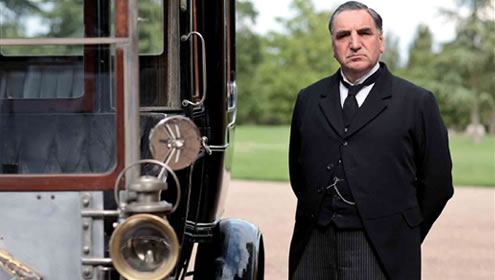
  • Kent: One of Lear’s oldest and most loyal advisors, he continues to serve Lear in disguise after he is banished. Stephanie points out in the show that Kent’s kind of like a Mr. Carson from Downton Abbey. You know, this guy – Mr. Carson as Kent?
  • Fool: This is Lear’s fool or court jester. One of Shakespeare’s best fools.
  • Oswald: A servant to Goneril and Regan.
  • Gloucester: A nobleman of Lear’s court, and the father of Edgar and Edmund. While loyal to Lear, he’s unable to help him and pays a high price for trying to do so.
  • Edgar: Gloucester’s legitimate son who is being framed by Edmund. He is loyal to his father and like Kent with Lear, he disguises himself to stay near Gloucester.
  • Edmund: Gloucester’s bastard son. He plots to overthrow his father and eventually tries to play the two sisters against each other in the hopes of being king.

You might have noticed that a crap ton of stuff happens in this act? Well, get used to that pace because the intensity’s about to get ramped way up for act II.

Check out Jessica Winter’s article on Lear for Slate Magazine that was mentioned in the podcast.

Bonus sonnet 19 read by Kayla Cross.

IMG_2902

Stay in Touch Brawlers!

Follow @TheBardBrawl on Twitter.

Like our Facebook page.

Email the Bard Brawl at bardbrawl@gmail.com

Subscribe to the podcast on iTunes

King Lear (1987), Jean-Luc Godard (director)

Zoey Baldwin

An Attempt to Wade Through Jean-Luc Godard’s King Lear

Before watching Jean-Luc Godard’s King Lear, I was a bit wary of the film’s length. How on earth did Godard manage to condense Shakespeare’s seventh-longest play into 90 minutes?

In short: he didn’t. Godard’s 1987 adaptation hardly resembles the Bard’s original work. But I don’t think that was the director’s intention. French cinema’s most revered, revolutionary (and occasionally reviled) filmmaker turned a tragic piece of theatre into an exploration of art as a whole. Which works in theory, but in execution is dense and bewildering.

Godard’s rendition is set in a post-Chernobyl world. All traces of art have been destroyed. Peter Sellars (not to be confused with the Peter Sellers of Dr. Strangelove fame) plays William Shakesper Junior the Fifth, a Bard descendant who has been charged with restoring the work of his ancestor. (Yes, the spelling of Shakespeare is off, but I looked it up on IMDb and apparently this is what the director intended.)

In a parallel and occasionally overlapping storyline, a woman named Cordelia (Molly Ringwald) and her father, a Russian mobster named Mr. Learo (Norman Mailer) are at a coastal resort. Shakesper appears to be in and out of the same resort, and Cordelia’s relationship with her father inspires him. Shakesper borrows words from their conversations (which he creeps on in cafés) to craft the lines in his restored King Lear. After a while, however, we are not sure whether Cordelia exists, or if Shakesper has invented her.

He sums up Cordelia’s relationship with her father in a way that mirrors my own confusion about the film: “Obviously this man was power. Obviously this girl was virtue. They’re fighting. I don’t know what the issue is.”\

Most of what has been preserved of Shakespeare’s Lear exists in the film in the form of voiceover. Many lines are uttered in the film, sometimes simultaneously, often behind unmatching images. Lear’s “You must bear with me, I am old and foolish” (Act IV, sc. vii) and the fool’s “Have more than thou showest, / Speak less than thou knowest, / Lend less than thou owest, / Ride more than thou goest, / Learn more than thou trowest, / Set less than thou throwest” (Act I, sc. iv) make eerie appearances. The words are often presented in an ominous fashion, whispering behind images of flickering candles and medieval paintings of angels.

Another aspect of the film that must be addressed is the narrative device of tableaus. Occasionally, words will flash across the screen: “King Lear : A Study,” “3 Journeys into King Lear,” “King Lear: Fear and Loathing,” “Nothing”  and “No Thing” are a few that we see.  These devices are used to mimic the human thought process of rediscovery, perhaps.

The idea of “nothing” and silence is a major concept throughout the film. At the beginning of Shakespeare’s King Lear, the king is old and has decided to divide up his kingdom amongst his three daughters. He will give the largest portion of the kingdom to the daughter who most convincingly swears her love. Goneril and Regan sing their father’s praises, but Cordelia, the youngest daughter, says nothing. The Godard film focuses largely on this notion.

The Shakesper character sums up the weight of Cordelia’s refusal to suck up to her father quite nicely. He describes her silence as “a violent silence”: “But Cordelia is not mute. It’s not that she hasn’t said anything. She has said nothing. No thing. Everything that conspires and organizes itself around her silence, that wants to silence her silence, this produces violence.”

There is also a segment of the movie (which is not in any kind of logical order) where Shakesper journeys into the woods and meets a man named Edgar (Leos Carax), another Lear character, sitting by the water. Edgar and his girlfriend Virginia (Julie Delpy) aid Shakesper on his path to discovery. It seems like these two people are meant to represent the simple minds we would all have if no art existed in the world.

Art makes us think and explore levels of reality. I feel like Godard is trying to make his audiences see the value of interpreting art in your own way and not just swallowing one artist’s vision.

But talk about avant-garde—yikes.

Godard’s King Lear is not suited for impatient viewers. I spent most of the 90 minutes scratching my head and struggling with the overwhelming cacophony of sound. The entirety of the film is punctuated by the sound of screeching seagulls, car horns and violent string music. This is only addressed at one moment, where Shakesper happens upon a crazy professor, played by Godard himself, and asks: “There’s a lot of noise around here, huh? What’s it for? What’s it all for, professor? Please!”

In case you hadn’t guessed, the professor never answers. Godard never tells us what any of it is for.

And, of course, like any deep film, King Lear closes with Woody Allen as a character named Dr. Alien, who edits all of Shakesper’s film that materialized out of nowhere on the ground in the woods a few minutes earlier.

Oh, and SPOILER ALERT, Cordelia dies.

There’s a repeated shot of her splayed out like Jesus on the beach in a white gown. Her father sits holding a large stick and looking out over the ocean.

“King Lear: a cLEARing” flashes across the screen. A seagull squawks in an attempt to pierce my eardrums.

Shakespeare would have been proud…?

<object width=”410″ height=”341″ id=”veohFlashPlayer” name=”veohFlashPlayer”><param name=”movie”

Zoey Baldwin is an unabashed grammar nazi, procrastibaker and television addict. She attended Shakespeare camp for five summers in her native California because she is allergic to mosquitoes. She’s in her last semester of the journalism graduate diploma program at Concordia University.

Stay in touch, Brawlers!

Follow @TheBardBrawl on Twitter.

Like our Facebook page.

Email the Bard Brawl at bardbrawl@gmail.com

Artwork - Leigh MacRae
Artwork – Leigh MacRae

Scotland, Pa. (2001), Billy Morrisette (writer/director)

Jay Reid

“We’re not bad people, Mac.  We’re just underachievers that need to make up for lost time.” – Pat McBeth.

If Maura Tierney said that to me, I’d probably be okay with killing my jerk of a boss too.  Tierney plays Pat McBeth, writer/director Billy Morrisette’s Lady MacBeth in Scotland, PA, his unusual adaptation of the Bard’s Scottish classic Macbeth.

A lot of guys will do crazy things for love, but James LeGros’s “Mac” (Macbeth) certainly takes it the extra mile.  Tierney is the type of hot, cool chick with a wicked streak that a lot of guys would probably do unspeakable things for (not that I ever did).  Sure she can be a bit crazy and mean, but she’s got a certain appeal for men looking for something more than the typical girly chick.  She’s the type of girl who could chug more beers than your pals.  The type of girl who doesn’t mind having sex in the back room of a fast food joint.  The type of girl that brightens up your life and you’d do anything for because you want to keep her happy and you don’t want to screw it up. Mac, poor hapless schmuck that he is, gets sucked into her scheme to move up the fast food chain at the local burger joint where they both work.

Morrisette relocates the play from the castles and moors of Scotland to a thriving restaurant in a sleepy Pennsylvanian suburb in the 70s, which means the soundtrack is going to be chock full of classic rock hits.  Unfortunately, most of the tracks are from Bad Company, but despite the lack of variety, it’s still appreciated. If you don’t like the movie, you’ll probably enjoy the music at least.

The burger joint is run by Norm Duncan (James Rebhorn).  He’s a bit of dorky dad, trying to push his sons into taking over the family business, although they seem more interested in being rock stars or exploring their sexuality than managing their father’s legacy.  Norm steals good ideas from the underappreciated Mac, who actually works hard at his job and does have an interest in taking over the restaurant.  Norm is about to take Mac’s best idea, a drive-through window, and make a huge profit.  Does he thank Mac?  Apparently not enough or there would be no movie.  He makes one of his disinterested sons into a manager instead of Mac, which is really the last straw for this struggling burger flipper and his wife.  Tired of getting passed over, Mac and Pat take matters into their own hands, leading to one of the most ridiculous and hilarious ways to dispatch a character in Shakespeare’s history.  Without giving too much away, it involves a deep fryer.

The film’s most interesting characters are Mac and Pat, while the others are broadly drawn spins on Shakespeare’s characters.  They will make you laugh, but it’s hard to invest in any of them.  So when they start getting killed off as Mac slaughters his way to the top, you just kind of shrug.  So it goes.

Christopher Walken has an interesting turn as Lieutenant MacDuff who investigates Norm’s death after Mac and Pat take over the restaurant and turn it into McDonalds style fast-food joint.  Walken plays typical Walken, amusing and menacing at the same time.  While he puts some pressure on the main characters with his presence, he isn’t really much of a foil.  The last battle between him and Mac lacks drama, and while I wasn’t expecting an epic sword fight, it seems a bit anticlimactic.

There are plenty of clever spins on scenes and characters in the original story in Scotland, PA, and each of the changes fit the setting in the film.   Yes, Lady Macbeth/Pat has something that won’t come off her hands, but it isn’t blood.  And the three witches are in there, but they’ve been transformed into three stoners who hang around an amusement park.  One of them (Amy Smart), dresses like a fortune teller, promising Mac future glory in the restaurant business.

Scotland, PA is more of a dark comedy than anything else, but it’s perhaps only funny for the serious Shakespeare fan.  Other than that, aside from a few fun scenes, it’s fairly unremarkable, which is why it might be hard to find on DVD.  It lacks the drama and tragedy of the original story, which makes it difficult to invest in the outcome of events.  You can invest in the love story between Mac and Pat, who strive to achieve success as underachievers.

It’s a Macbeth adaptation that is about more than ruthless ambition.  Mac may be interested in becoming a big shot, but he does everything because he loves Pat and wants to make her happy.  While Pat may come across as manipulative, she sees her husband struggling and wants more for him and for herself.  She wants to live the good suburban life, full of big houses, flashy cars and swimming pools.

It seems odd to set Macbeth in a burger joint, since killing your way to owning a restaurant pales in comparison to becoming King of Scotland, but it works within the setting of 1970s America – the Me Decade.  The characters in the film are so well established that you understand that taking over this restaurant and making it into a successful business means as much to them as becoming King.  They are down and out, slaving away in their menial jobs and drinking themselves into a stupor in some suburb like every other poor sap and for a brief moment, they see a chance to take their piece of the American Dream.  Would you really blame them for trying?

Jay Reid is the Bard Brawl social media co-ordinator and contributor to its blog and podcast. His short film Byline is in post-production and due out later this year.

Looking for Richard (1996), Director Al Pacino

Laura MacDonald

Prologue

Was ever woman in this humour wooed?
Was ever woman in this humour won?
                        Richard III, 1. 2

As anyone who has lived with me can attest, I am a notoriously grumpy movie watcher and as this video was popped into the DVD player I muttered, “There better not be any special features.  This movie is, like, all special features.  All behind the scenes stuff…grumble, grumble…”

To which my much better half replied, “That’s pretty much what a documentary is, sweetie.”

I responded with silence (silence and the sound of a chip bag being opened).

Looking for Richard and Finding Al

It’s a docu-drama type thing.

Al Pacino

Spot on, Al.  Spot on.

Touted as a behind-the-scenes look at the production of an American film version of Richard the III, featuring one of Shakespeare’s most villainous of villains, we watch the tension, the struggle and the efforts to understand Shakespeare from a modern day perspective and yet, here’s the catch: there is no movie being filmed.

This is the movie.  Richard the III is not.

Looking for Richard is a movie about Al Pacino playing Richard.  Cultivating the perfect scenario where he can rule the Shakespearean landscape as he sees fit, cutting and pasting the text to meet his aim, charming famous actors into joining him in his ill-defined endeavour, ruling the silver-screen…his way.

Sound familiar?  Richard as King, Al as director.

Hmmmm…

Now, after tactlessly implying that Al Pacino is an amoral, murderous, covetous scoundrel, I will follow up by saying that I really did enjoy some of his directorial choices.   The aim, as stated early in the film, is to make Shakespeare accessible to an American audience.  I believe that they have achieved this in Looking for Richard – that by the end of the movie we, the audience, do find him.

By allowing us to sit in on the table readings and the discussions and debates that ensue, we learn about the play along with all the famous players in this film (Hey! That’s the premise for the Bard Brawl).  As audience members, we aren’t intimidated because we can see that we are not the only ones who are confused.  Even the seasoned actors are more than a little bit muddled. We are merely joining the ranks of centuries of confused Shakespeare-o-phobes.

We are also given a glimpse at the common-folk as Pacino and co. take a casual walk down a New York street falling into lockstep with locals who give their two cents on Shakespeare.  They meet resistance (“It sucked”).  They meet clichés (“To be, or not to be”). They meet pragmatic Brits (“He’s a great export”).  They also meet a wise-beyond-his-toothless-grin man who believes that Shakespearean language gives us access to our feelings and that, “if we felt what we said we’d say less and mean more.”

Yeah, what that guy said.

Pacino also does a beautiful (albeit an overt) job of juxtaposing the urban New York landscape with the opening lines from Richard the III and we start to see how that Shakespeare can thrive in modernity.  Thrive but not without obstacles.  We watch as Pacino and his gregarious cohort Frederick Kimball try to seek inspiration by travelling to England to visit the actual birth room of Shakespeare only to be interrupted by the sound of sirens.  Alternatively, there is a lovely brief moment when Pacino is walking down some city street and we can hear the sound of horse hooves clopping by.

It gives a whole new meaning to the word timeless.

Another shining moment in the film is when Kimball is explaining iambic pentameter by comparing an iamb to an anteater:

And five of them: Da-da da-da da-da da-da da-da.  Make a pentameter line, five iambs.  An iamb is like an anteater. Very high in the back and very short, little front legs: da-DA!

You just can’t beat a solid anteater analogy.

What falls short in Looking for Richard are the scenes from the “movie they are filming”; all the characters seem considerably more believable with their backwards baseball caps, messy hair and civvies.  Their Elizabethan garb becomes a distraction and actually goes against their effort to make Shakespeare accessible to an audience that is not familiar with the plays.  This is not to say that it never works but, in the context of this film, when we are being thrown from rehearsal to table work and back, from in-costume to baseball cap to in-costume again; from trendy Ray Bans to bejeweled crowns, it is a lot to take in .  Pacino, speaking about the language of Shakespeare, asserts that it is not difficult.  He just says, “you have to tune up”.  I would suggest that he take his own advice when it comes to the costume as well – our eyes need to get accustomed to the floppy hats, over-sized crowns and Alec Baldwin in a puffy Seinfeldian shirt.

Truth be told, I started getting anxiety while watching Looking for Richard but was too scared to ask if the movie version of Richard III was ever really produced because if it was, I might have to watch it.  One of the scholars in the film stated that “The action of the play, the sense of exciting movement is Richard’s finding out the point beyond which people won’t go.” I believe that sentiment holds true for this film as well.

Epilogue

An honest tale speeds best, being plainly told.
                        Richard III, 4. 4

In terms of introducing an unfamiliar play to the general masses, Pacino was on the right track by stacking the deck with so many familiar faces: Alec Baldwin, Derek Jacobi, Sir Arthur John Gielgud, Winona Ryder, Kenneth Branagh, the principal from The Breakfast Club (though he has no lines, let alone a gem like “Don’t mess with the bull, young man.  You’ll get the horns”) and Kevin Spacey, to name a few.  We get a peek at the struggle and discovery involved in putting up Shakespeare for a modern day audience.  Or at least the struggle involved with thinking of putting it up.  And since struggle and discovery are the ingredients to every good quest, I say it’s worth embarking on the journey…as long as you have plenty of chips.

Laura Macdonald

Richard III (1955), Laurence Olivier (director)

Daniel J. Rowe

Though in a certain sense dated, Olivier’s Richard III is a great piece of film largely thanks to the director/star’s scene chewing greatness.

When looking at William Shakespeare’s work on film, one will, in a very short time, collide with “cinema’s first great Shakespearean artist“, the godfather of them all, Sir Laurence Olivier.

Richard III is the final of his three directorial efforts (he acted in eight); the other two being Hamlet (1948) and Henry V (1944). He began what Orson Welles and Kenneth Branagh continued. Branagh, like Olivier, started his bard-on-film odyssey with Henry V. Sir Kenneth followed that promise by bumbling through roles he had no business playing (Hamlet, Iago), and hasn’t done much for a while. Here’s hoping he doesn’t decide to cast himself as R III.

Olivier’s Richard III suffers from one thing: age. It is hard for a contemporary viewer to appreciate the film when Richard Loncraine’s 1995 adaptation is staring us in the face. Sir Ian McKellen’s Richard is just so sexy. The ascetic of Olivier’s R III suffers datedness in three respects: costumes, set and music. Oh the music. So bad.

By the way, are we a little fast and loose with the knighthoods Windsors? I guess all it takes is making a few Shakespeare movies and you’re in.

The “it’s dated” criticism, even with the billowy tights and static sets, misses the forest for the trees however (ask Macbeth the consequences of that). Richard III is always about the title character. If Richard is good, so goes the production. Olivier is, surprise, surprise, very good. He bounces through his manipulation of the Yorkish court with the cheshire cat grin of a true sadist. He loves what he’s doing, and dreads it in the same scene at times. His soliloques to camera are chilling, as are his “friendly” moments with his nephews. Olivier, as per normal, chews up the scenery.

His directorial choices, as well, work. He splits speeches and changes the order or scenes to make the very confusing plot of the play make a little more sense. He opens with the court, so we can at least see the characters of Richard’s opening soliloquy. Of course the opening, “Now is the winter of our discontent,” loses a little power if not performed loud and proud on fade in.

The use of shadows is a little obvious. Yes we get it, Richard is a shadowy figure whose only pleasure is to “spy my shadow in the sun and descant on mine own deformity.” The director’s choice is understandable, as is the Edward court brightly lit, Richard court gloomy lit decision.

A particularly good scene is Richard’s coronation. Lady Anne (Claire Bloom) plays torture victim off Richard’s Machiavel creating a gut wrenching balance of hell that is the last York king’s court. The murder of Clarence (Sir John Gielgud) is harsh, hard to watch and perfect in its callousness. Gielgud, another knight, it should be noted, was called the greatest Shakespearean actor of the 20th century; he was in Branagh’s Hamlet and died in 2000. He directed his own version of Hamlet in 1964.

The historical Richard III has recently found his way into the headlines with the discovery of a skeleton thought to be his under a carpark. His historical footprint has been as much outlined by Shakespeare as any scholar, and thus the play remains important.

Olivier’s Richard III is worth the watch. Richard ranks with Hamlet, Macbeth, Lear and Othello as Shakespeare’s finest and most difficult characters. Any bard brawler must appreciate the role, and catch a master knee deep in the guck. Olivier is a master.

Note to Queen Elizabeth II: We bard brawlers are part of the commonwealth and waiting for our knighthoods.

Daniel J. Rowe is c0-creator of the Bard Brawl.DSC_0180

The Merchant of Venice (2004), Michael Radford (director)

Andre Simoneau

The Merchant of Venice is a tragicomic tale of hypocrisy, pride and revenge, and Michael Radford’s beautiful production is a subtle and faithful interpretation of Shakespeare’s ambiguous and highly controversial play.

——-

Though ultimately it serves as a compelling case for mercy and the value of love, The Merchant of Venice has, over the centuries, come to be seen as one of Shakespeare’s most controversial plays, thanks in no small part to the cruel and complex depiction of the Jew Shylock, portrayed by Al Pacino.

While he acknowledges the inherent judeophobia of the time, Radford (1984, Il Postino) takes great care in bookending the piece with scenes that help impart a deeper context than may have been evident to modern audiences in the original text.

In a written prologue added by Radford, we are told of the pitiful conditions in which the Jewish community lived in 16th century Venice, confined to guarded ‘gettos’ and forbidden from owning land. Shylock himself describes in detail the pains which he has suffered at the hands – and feet – of the Christian bourgeoisie. In fact, there are several passages in the play which point to the hypocrisies of the ruling class and which highlight the humanity of the oppressed. All this only serves to amplify the ambiguity of Shakespeare’s villain and to further the case for Shylock as a tragic figure.

The infamous debt at the heart of the story involves Antonio, a nobleman who has agreed to take out a loan from Shylock on behalf of his bankrupt young friend Bassanio, to help him in the pursuit of the beautiful Portia. Though highly sought after, Portia may only select a suitor by means set out to her by her late father, and Bassanio wants to make a worthy impression. Meanwhile, Shylock’s daughter Jessica runs off with one of Bassanio’s men, never to return, and they all sail to Portia’s court. As Bassanio wins Portia’s hand in marriage, Shylock slips into a depression. When Antonio is unable to repay his debt, Shylock vows to avenge the injury dealt to him by exacting the horrific – though lawful – execution of his bond.

In his portrayal of Shylock, Pacino is at the top of his game, delivering the famous ‘hath not a jew eyes?’ speech with empathy and his trademark unrestrained passion. He is aptly matched by, the sexually ambiguous Jeremy Irons as frail Antonio, the title merchant who is sworn by bond to deliver a pound of flesh to his creditor. The cast is rounded out by the excellent Lynn Collins as Portia, who delivers an equally well-known speech on the ‘quality of mercy’, and Joseph Fiennes as her suitor Bassanio (Antonio’s lover?). There is also a number of highly skilled comic actors who step in to fill the play’s many clown parts.

Add to that an exquisite production design by the late Bruno Robeo and costume design by Sammy Sheldon to imbue the story with texture and atmosphere. Venice’s inimitable canals and unique architecture are on full display here, and lend an authenticity to the film which enhances the moral and historical undertones of the source material.

The Merchant of Venice is a problematic play for a variety of reasons, and poses many challenges to would-be performers. Little wonder then that it had never been filmed (with sound) before this. With his production, Radford and co. succeed in delivering a nuanced and intelligent reading of Shakespeare’s text, while managing to create a detailed visual palette to serve as its backdrop.

Andre Simoneau is a first line bard brawler and regularly reads for the Bard Brawl podcasts.

Andre Simoneau

Coriolanus (2011), Ralph Fiennes (director)

Jay Reid     

The tragedy of Coriolanus is that a brutish man, prone to burst of violence can be undone by an act of compassion towards those he loves.

Director Ralph Fiennes and screenwriter John Logan make the choice to trim down Shakespeare’s text, conveying that tragedy visually, while creating a film adaptation of the play that is not restrained by absolute faithfulness to the source material.

Fiennes stars at Gaius Martius Coriolanus, a Roman general, whose skills as a warrior makes him something of an anti-hero among the people whom he has open contempt for.  They love and hate him within the same scene at times. The scowl on Fiennes face makes his every word seem like it comes from pure rage.  His performance gives the film an intensity that would otherwise be lost on stage.  He doesn’t even need to spit out the Bard’s words or stab an enemy for the viewer to know that he is a man fueled by anger.  A simple glare conveys all we need to know about him.

Early in the film, Coriolanus, after brutally killing an enemy, emerges victorious, walking towards a group of soldiers, his face streaked with blood, almost like war paint.  There is no doubt that this is a man who will fight to his last breath, and that makes him a compelling character to watch.  Fiennes’ performance can evoke sympathy from the viewer, even when he is at his most monstrous.

His mother, Volumnia, played by Vanessa Redgrave and his wife Virgilia, played by Jessica Chastain, allow Fiennes tender moments in between his bursts of violence and anger.  They are his Achilles heel, and yet the only thing that really makes the character anything else than a single-minded warrior.

Redgrave steals most scenes. She gives a tender and powerful performance, showing the strength of a determined, politically minded woman and the compassion of a mother at the same time, while Chastain does her best, but is rarely captivating.  Chastain is usually a solid actress, but her performance seems underwhelming when compared to heavy hitters such as Fiennes, Redgrave and Brian Cox as the Roman Senator Menenius.  She seems to drop the ball on more than one occasion and often fades into the background.

Performances make or break any Shakespeare film and there can be very little room for weak links in the chain.

Although the film is set in some place called Rome, Coriolanus was shot in Belgrade, Serbia, and the location works well, especially after Coriolanus’ exile. He is shown walking through the cold, gray towns, conveying the harshness of his expulsion in a way only an Eastern European shooting location provides.

The film is transposed into modern day times, where swords become automatic weapons, and discussions between citizens in the play become television news panels.  This modernizing of the play gives the film modern day significance, especially when exploring the idea of a patriot exploited by politicians for their own gain, and what happens when they can no longer control that patriot.  Coriolanus is a wild guard dog that can never be made to behave, and it’s no wonder that as soon as he develops political aspirations, the politicians turn against him because they are afraid he is going to bite them.  They are soon faced with the choice of putting the dog to sleep or casting him out into the wilderness.

Coriolanus is especially strong when we see the titular character unleashed.  The film is bloody, as any Shakespearean tragedy should be, but not gratuitous.  The violence is never artsy, but brutal in a way that a dogfight can be.  The handheld shots of Fiennes stabbing enemies give the brutal scenes of violence a frenetic energy that conveys Fiennes rage.  The most effective fight scene is the first between Martius and Tullus Aufidius, played by Gerard Butler.  Close, tight shots of Martius and Aufidius, wrapped around each other, almost in a bear hug, are reminiscent of a UFC fight at its bloodiest, and if they were given knives.  With bombs going off in the background, the fight scene makes it seem like the entire war is being fought by two men.

Although Fiennes’ film takes certain liberties with the source material, it is loyal to Shakespeare’s vision, capturing the tragedy of a man that has become a killing machine, manipulated by the politicians, lauded as a hero and loved by his family, but lost in his own hate.

It is the Shakespeare film for the person who doesn’t usually like Shakespeare.  It’s a compelling piece of work that tries to stand apart from typical film adaptations of Shakespeare’s work, and succeeds as a film by being quiet, relying on the performances of the actors rather than the words of the immortal Bard.

Jay Reid is a Bard Brawler, writer and director. 

Up ↑