BB: Romeo and Juliet, Act II

Artwork - Stephanie E.M. Coleman
Artwork – Stephanie E.M. Coleman

(Podcast recorded and produced by Daniel J. Rowe, blog written and edited by Eric Jean)

Welcome back to the Bard Brawl and act II of Romeo and Juliet. I hope your Valentine’s Day story worked out a little better than theirs. Although, really, I guess they did have a pretty bangin’ first date.

Listen to or download the podcast.

Like the first act, act II opens up with a Prologue. Don’t remember this prologue? That’s probably because no one stages it. And why would you? You just finished this blockbuster first act of death threats and teenage lovemaking and Shakespeare wants you to stop to listen to someone tell you about how they need to figure out a way to meet in secret.

Yeah, we figured that since their two families are at war, they might not be so keen to announce they started dating. Thankfully, Shakespeare seems to figure this out because that’s the last of the prologues for this play.

Mercutio and Benvolio spot Romeo sneaking out of Juliet’s house in scene 1 but they must not have realised who’s bedroom he’s sneaking off to because Mercutio tries to get his attention by invoking his ‘love,’ Rosaline. You’d almost get the impression this wasn’t the first time they spotted him sneaking into some girl’s bedroom in the middle of the night. Romeo clearly doesn’t want to be found out and they would much rather make fun of him behind his back so after doing that for a minute or two, they head home to bed.

So here’s the set-up for act II, scene 2, one of the most famous (and totally made up) love scenes in the world:

Having sneaked into the Capulet orchard by jumping the fence, Romeo makes his way to Juliet’s window, which is a little unsettling because he seems to know exactly where that is despite the fact that she lives in a huge estate. While he’s hiding in the bushes (trying to catch a glimpse of her undressing) Juliet walks out onto the balcony. Romeo goes on and on like he’s a hockey announcer providing some sort of play by play for some imagined audience.

Juliet, like Romeo, seems to have a habit of speaking her thoughts aloud which, in this case, happens to work in her favour because Romeo hears her and announces his presence. She’s a little creeped out that he’s here at first but after some blah blah back and forth they agree that the best course of action – and the thing they most want in the world – is to get married.

Tomorrow.

No problem. Romeo tells her to get in touch by 9am and he’ll have worked out a plan.

At the start of scene 3, Friar Laurence is quietly pruning his plants when Romeo barges in, out of breath and babbling on about how he’s in love and that he needs the Friar’s help. The friar’s a little surprised that Romeo so quickly forgot Rosaline, his one true love, and now wants to marry Juliet. He doesn’t seem to have much faith in Romeo’s constancy but he agrees to marry them only because he thinks that this might put an end to the Montague and Capulet feud.

Wait, what? Does he even realize what he’s saying? When has two people marrying ever made warring in-laws kiss and make up? Maybe it will work out this one and only time though.

Romeo’s friends Mercutio and Benvolio as hanging out in the street making fun of Romeo (again) and Tybalt when Romeo runs into them in scene 4. They mock him for ditching them last night and make a bunch of jokes involving penises such as: “then is my pump well flowered.” Juliet’s nurse arrives to meet with Romeo where they discuss the plan to sneak Juliet out of her house: she just needs to tell her folks that she’s stepping out for a quick confession at father Laurence’s. The Elizabethan equivalent of “I’m going to the library to study.” No mother or father would ever doubt that excuse. Brilliant!

Meanwhile, Juliet’s been waiting impatiently for her nurse (who is starting to come off as more of a pimp, really) to come back with news from Romeo. Back and forth between the two of them which seems designed to torture poor Juliet but eventually the nurse spills the beans: head to Friar Laurence’s place where he’ll marry you and you’ll finally get to have sex! And then you’ll get pregnant which is exactly what every 13-year-old wants, right?

In the final scene, Romeo is waiting for Juliet to show up. Friar Laurence tries to get him to chill out a bit, to slow this love train down a little, but when he sees Juliet, he seems ready to get on it himself. (He also wins the creepiest line of the play award for this gem: “Romeo shall thank thee, daughter, for us both.”)

Off they go to get married in secret, like two totally responsible adults who have carefully weighed the pros and cons of their decision and are in no way whatsoever rushing into the mistake of a lifetime.

Can we expect a honeymoon scene in act 3? I sure hope so!

And hey. Buy ‘Zounds! You’ll never regret or forget it.

Enjoy sonnet 43 by the legend, David Kandestin.
Artwork - Stephanie E.M. Coleman
Artwork – Stephanie E.M. Coleman

Stay in Touch Brawlers!

Follow @TheBardBrawl on Twitter.

Like our Facebook page.

Email the Bard Brawl at bardbrawl@gmail.com

Subscribe to the podcast on iTunes

Or leave us a comment right here!

Go back

Your message has been sent

Warning
Warning
Warning
Warning

Warning.

‘Zounds! Launch Party!

[sennet trumpet within]
[sennet trumpet within]

That’s right, it’s party time!

‘Zounds! is on its way to the printers and just about to be unleashed onto its adoring and expectant public. That would be you, all of the wonderful and amazing people who helped make ‘Zounds! happen by donating to our IndieGoGo campaign, by submitting articles and artwork for the journal, or simply by being nice enough not to mock our epic nerdiness to our faces. (“No, babe. I do not bite my thumb at you but I do bite my thumb. But not at you. Really.”)

To thank every one – and because we feel strongly that Bard without Brawl is a sad affair – we’re throwing a launch party!

Come join us for an evening of Bard and Brews at Brutopia, on Thursday, February 20th, starting at 8pm!

Brutopia Brew Pub - 1219 rue Crescent, Montreal, Quebec H3G 2B1.
Brutopia Brew Pub – 1219 rue Crescent, Montreal, Quebec H3G 2B1.

For all of our faithful podcast listeners, now’s your chance to meet the people behind your favourite voices, such as servant number one, or second senator! And how often do you get to take over this amazing downstairs lounge space and pack it with awesome Shakespeare nerds?

A party space Falstaff would be proud to get drunk in!

Of course, we’ll have some copies of ‘Zounds! for sale as well as some other Bard Brawl loot which will no doubt make you the envy of all of your bardic brothers and sisters. There will also be plenty of beer on tap and even some door prizes!

While the journal will normally be selling for $12 an issue, copies will be available for only $10 at the launch party, so you won’t want to miss it.

Hope we’ll see you there!

Hey, while you’re at it, why not let us know you’re coming by visiting our ‘Zounds Launch party Facebook event?

Stay in Touch Brawlers!

Follow @TheBardBrawl on Twitter.

Like our Facebook page.

Email the Bard Brawl at bardbrawl@gmail.com

Subscribe to the podcast on iTunes

Or leave us a comment right here!

Go back

Your message has been sent

Warning
Warning
Warning
Warning

Warning.

BB: Romeo and Juliet, Act I

You'll have to wait for Bar Scrawler art - they're busy with 'Zounds! right now.
You’ll have to wait for Bar Scrawler art – they’re busy with ‘Zounds! right now.

(Podcast recorded and produced by Daniel J. Rowe, blog written and edited by Eric Jean)

This is one of the big ones, Brawlers: Romeo and Juliet.

Listen to or download the podcast.

Ah, good ol’ “R&J.”

You think you know this play because you read it in Mrs. MacDonald’s grade nine English class and had to write a 500 word essay on ‘why do we have to read Shakespeare.’ You wrote something like:

“We have to read Romeo and Juliet because it’s the greatest love story every written. […] It shows us how my parents are ruining my life with TJ/Cindi because they hate my boyfriend/girlfriend. They should just accept that we are in love and will spend the rest of our lives together living in their basement.”

The end.

After a week and a half of torturing (and being tortured by) the Shakespearean language about ‘Prince of Cats,’ ‘Queen Mab,’ ‘plagues on households’ and ‘purple fountains,” Mrs. MacDonald – because she just wants her suffering to end – gave you your ‘A’ and you moved on to Catcher in the Rye.

But admit it. Deep down, you feel ridiculous for writing those words. I mean, you were 14 or 15 years old. Of course you were naive and stupid. Just like a certain Juliet (almost 14 years old) or a certain Romeo (15 years old) everybody thinks they know. The only decision I could be trusted to make when I was that age was which Nintendo game to rent with my allowance money.

Try this synopsis instead, Mrs. MacDonald: two teenagers with more sexuality than sense are married in secret (and sacrificed on the altar) in order to try to put a stop to the constant feuds and vendettas of the Montagues and Capulets which have been tearing Verona apart for who knows how long. They die, feud ends, mission accomplished.

Don’t believe it? Too cynical? Well, let’s have a look.

Romeo and Juliet opens with a Prologue which tells us that isn’t going to end well. Two kids born from feuding families are going to need to die on order to put the feud to rest. Additional information provided: this play will last approximately 2 hours.

In scene one, Sampson and Gregory, two Capulets, are wandering the streets looking to pick a fight. They spot Abraham and Balthazar, two Montagues, and decide to start swapping insults. Eventually they draw swords but Benvolio (a Montague and Romeo’s friend) shows up and tells them to sheath their sword. Moments later, Tybalt (a Capulet and Juliet’s cousin) arrives. Benvolio asks him to help break up the fight but Tybalt attacks Benvolio and they fight. Soon Lord Capulet and Lord Montague show up and all hell breaks loose until the Prince shows up threatens to kill anybody who doesn’t immediately stop fighting. He asks for the Capulets to follow him and asks the Montagues to come see him later about this brawl. (ding!)

Benvolio fills the lord in on what’s going on and then Lady Montague asks about Romeo. Seems he’s been locking himself up in his room and crying a whole bunch, which we all know never happens with teenagers so something must be up. Eventually Romeo comes on stage. Seems he’s in love with a girl who doesn’t love him back, whatever that feels like. Benvolio, like a good friend, tell him that what he needs to do is to forget about Rosaline. (That’s the name of his one true love, the type of love that there’s no way he will ever have for anyone else, ever, in his lifetime!)

How to forget about Rosaline? Easy. Chase after other girls to sleep with love.

After his meeting with the Prince, Lord Capulet meets up with Paris in scene 2, a young man who’s really interested in marrying Juliet. Dad thinks she’s a little too young and that marrying to early is not a good thing. But, he’s willing to give his blessing is Paris can win her over. Lord Capulet is throwing a big party tonight and he thinks that would be a good opportunity for Juliet and Paris to meet. He gives a list of guests to his illiterate servant and asks him to go invite his other guests.

Coincidentally, Romeo and Benvolio are walking by and the servant asks them to help him read the letter. After the servant leaves, Benvolio gets a great idea: why not crash the party at the house of their mortal enemy?

We finally get to see Juliet in scene 3. She’s with her nurse who is still responsible for helping her get dressed and otherwise taking care of her while mom and dad get plastered with their friends. Lady Capulet comes and asks her daughter about Paris. She seems to like him so she hopes that Juliet will too. Juliet doesn’t seem very interested in the prospect of getting married but mom insists that it’s happening sooner or later so she better get used to the idea.

Benvolio and Romeo have met up with their buddy Mercutio and are headed to the Capulet party in scene 4. Benvolio and Mercutio alternate making fun of their love-sick and depressed friend. Romeo then tells them of a dream he’s had which he thinks is prophetic. Of course, Mercutio mocks him to no end. Romeo insists that he’s got a bad feeling about tonight but on they go to the party.

The final scene of the act takes place in the Capulet mansion. Lord Capulet walks in a makes a bunch of bad jokes about ladies’ corns and dancing – which I am sure they are thought was totally hilarious and tasteful. Of course, Romeo’s here and this is where he first spots Juliet, without realising that she’s a Capulet. He babbles on about beauty and Tybalt over hears him and realises that he’s a Montague. He’s a bout to storm off after him but Lord Capulet stops him: “he’s not a bad kid and he’s not causing any trouble. I don’t want you starting a fight with him in my house.”

Romeo, who doesn’t seem to care one little bit that he came here to see Rosaline (Rosaline who?), starts sweet-talking Juliet and manages to score a couple of kisses from her before she is called away by her mother. Romeo then learns that Juliet is the daughter of Lord Capulet. Time for the Montagues to leave.

As soon as they disappear, Juliet is asking the nurse about Romeo and learns the bad news: he’s a Montague.

I’ll say this for R&J: that’s a hell of an opening act!

While I suspect that many of you Brawlers know this play already, here are some of the key characters who show up in this act:

  • Benvolio: He’s one of Romeo’s buddies and, at least at first, is trying to keep the peace between the Capulets and Montagues.
  • Tybalt: One of Juliet’s cousins, he’s only too happy to look for reasons to fight Montagues.
  • Romeo Montague: Lovesick Romeo starts the play madly ‘in love’ with Rosaline and then, after spotting Juliet once, swears that he’s never loved anyone before. I’m sure he’ll make a great husband.
  • Juliet Capulet: She seems like a level-headed young girl at first but that goes out the window when she meets Romeo. She just can’t get married quickly enough.
  • Lord and Lady Capulet: The rulers of the Capulet family and Juliet’s parents.
  • Lord and Lady Montague: The rulers of the Montague family and Romeo’s parents.
  • Paris: A young, eligible bachelor looking to marry into the Capulet family. The parents like him but he didn’t stand a chance with Juliet.
  • Mercutio: A friend of Romeo’s who has no patience for Romeo’s melancholic self-pity and who sees what Romeo calls love as lust.

Next week: more bad, life-altering decisions made by horny teenagers.

Oh, and happy valentine’s day.

Also, get ready for a big upcoming announcement about ‘Zounds!

Stay in Touch Brawlers!

Follow @TheBardBrawl on Twitter.

Like our Facebook page.

Email the Bard Brawl at bardbrawl@gmail.com

Subscribe to the podcast on iTunes

Or leave us a comment right here!

Go back

Your message has been sent

Warning
Warning
Warning
Warning

Warning.

BB: Short Poems, Sonnets 24-29

Sonnets Brown

Happy New Year!

Welcome Brawlers to our first podcast of 2014 and the start of our third year of doing the show!

How awesome is that? Very.

We’re ready to help you out with your New Year’s resolution to increase your bardic intake! To start the year off right, today we’re sending a recording your way of sonnets 24 through 29, read by some of our amazing Sonnetters.

Listen to or download the podcast.

Sonnet 24 (Episode: Henry VI, part 1: Speeches, Read by: Erin Marie Byrnes)

Erin Byrnes
Erin Byrnes

Mine eye hath play’d the painter and hath stell’d
Thy beauty’s form in table of my heart;
My body is the frame wherein ’tis held,
And perspective it is the painter’s art.
For through the painter must you see his skill,
To find where your true image pictured lies;
Which in my bosom’s shop is hanging still,
That hath his windows glazed with thine eyes.
Now see what good turns eyes for eyes have done:
Mine eyes have drawn thy shape, and thine for me
Are windows to my breast, where-through the sun
Delights to peep, to gaze therein on thee;
Yet eyes this cunning want to grace their art;
They draw but what they see, know not the heart.

Argument: Picture this: my heart is a canvas, my body is an art gallery and my eyes are a painter. With me so far? My eyes then painted picture of you and put it on display in my body. When you look into my eyes, it’s like you’re looking in through the gallery windows. When the sun shines on the painting it makes it appear lifelike but here’s the problem: perspective is only a two-dimensional illusion that give the impression of three dimensions, it’s not the real thing.

(FYI/Helpful knowledge: Perspective in painting was the artistic discovery of the Renaissance. Kind of like 3-D television or printing.)

Sonnet 25 (Episode: King Lear, Act III, Read by: Zoey Baldwin)

Let those who are in favour with their stars
Of public honour and proud titles boast,
Whilst I, whom fortune of such triumph bars,
Unlook’d for joy in that I honour most.
Great princes’ favourites their fair leaves spread
But as the marigold at the sun’s eye,
And in themselves their pride lies buried,
For at a frown they in their glory die.
The painful warrior famoused for fight,
After a thousand victories once foil’d,
Is from the book of honour razed quite,
And all the rest forgot for which he toil’d:
Then happy I, that love and am beloved
Where I may not remove nor be removed.

Argument: Let the people who are lucky today gloat about what they have while I talk about what I’m lucky enough to have. People who are famous are subject to public opinion: it only takes one loss to ruin a fighter’s career or turn someone from a hero into a nobody. I’m happy then that my love isn’t subject to the whims of rulers and can’t be ruined by a change of fortune.

Sonnet 26 (Episode: Taming of the Shrew: Speeches, Read by: Laura Pellicer)

Laura Pellicer
Laura Pellicer

Lord of my love, to whom in vassalage
Thy merit hath my duty strongly knit,
To thee I send this written embassage,
To witness duty, not to show my wit:
Duty so great, which wit so poor as mine
May make seem bare, in wanting words to show it,
But that I hope some good conceit of thine
In thy soul’s thought, all naked, will bestow it;
Till whatsoever star that guides my moving
Points on me graciously with fair aspect
And puts apparel on my tatter’d loving,
To show me worthy of thy sweet respect:
Then may I dare to boast how I do love thee;
Till then not show my head where thou mayst prove me.

Argument: The point of this message isn’t to show you how clever I am but rather it is to show you how committed I am to serve you. I can’t really find the words to describe the extent of my loyalty but I hope that you’ll get the picture from my actions. I’ll keep working at in until I get lucky enough to catch your eye. Then, and only then, will I risk revealing my feelings for you.

Sonnet 27 (Episode: Twelfth Night, Act V, Read by: Hannah Dorozio)

Hannah Dorozio
Hannah Dorozio

Weary with toil, I haste me to my bed,
The dear repose for limbs with travel tired;
But then begins a journey in my head,
To work my mind, when body’s work’s expired:
For then my thoughts, from far where I abide,
Intend a zealous pilgrimage to thee,
And keep my drooping eyelids open wide,
Looking on darkness which the blind do see
Save that my soul’s imaginary sight
Presents thy shadow to my sightless view,
Which, like a jewel hung in ghastly night,
Makes black night beauteous and her old face new.
Lo! thus, by day my limbs, by night my mind,
For thee and for myself no quiet find.

Argument: After a long day of work, I can’t wait to get to bed to rest my tired body. But as soon as I fall asleep my mind starts racing after you. Even though my eyes are looking into the back of my eyelids, they can still make out your shape. So even though night is ugly, you’re like a shining gem which makes it beautiful. Basically, I can’t win: I just can’t seem to get any rest or peace at all.

Sonnet 28 (Episode: King Lear, Act II, Read by: Erin Marie Byrnes)

How can I then return in happy plight,
That am debarr’d the benefit of rest?
When day’s oppression is not eased by night,
But day by night, and night by day, oppress’d?
And each, though enemies to either’s reign,
Do in consent shake hands to torture me;
The one by toil, the other to complain
How far I toil, still farther off from thee.
I tell the day, to please them thou art bright
And dost him grace when clouds do blot the heaven:
So flatter I the swart-complexion’d night,
When sparkling stars twire not thou gild’st the even.
But day doth daily draw my sorrows longer
And night doth nightly make grief’s strength
seem stronger.

Argument: How can I be happy if day and night each make me tired? Though they’re supposed to be enemies, day and night have allied to make my life miserable. I try flattering the day by telling it that you’re like the sun. I tell the night that you’re like a bright star. But it’s not working: they both just keep making me more and more miserable.

Sonnet 29 (Episode: Twelfth Night, Act IV, Read by: Zoey Baldwin)

When, in disgrace with fortune and men’s eyes,
I all alone beweep my outcast state
And trouble deaf heaven with my bootless cries
And look upon myself and curse my fate,
Wishing me like to one more rich in hope,
Featured like him, like him with friends possess’d,
Desiring this man’s art and that man’s scope,
With what I most enjoy contented least;
Yet in these thoughts myself almost despising,
Haply I think on thee, and then my state,
Like to the lark at break of day arising
From sullen earth, sings hymns at heaven’s gate;
For thy sweet love remember’d such wealth brings
That then I scorn to change my state with kings.

Argument: At times I feel isolated and alone, unlucky and rejected by society. I get envious of other people’s success, good looks, friends or even their abilities or fame, and I no longer enjoy the things I’ve always liked. I almost end up hating myself. When that happens, I think about you and then I feel my spirits rise up. I feel so good about my life when I think about your love that I wouldn’t trade places with kings.

Next week, we start on a new play. Which play will be the Bard Brawl’s 9th play?

Send us your comments and suggestions or we’re just going to let the cats – Wako and Desdemona – decide.

Wako
Wako
Desdemona ("Dezzie")
Desdemona (“Dezzie”)

If you would like to lend your voice to the Bard Brawl and contribute a sonnet, or even a monologue or soliloquy, to the Bard Brawl, feel free to get in touch. We’d love to hear from you.

Stay in Touch Brawlers!

Follow @TheBardBrawl on Twitter.

Like our Facebook page.

Email the Bard Brawl at bardbrawl@gmail.com

Subscribe to the podcast on iTunes

Or leave us a comment right here!

Go back

Your message has been sent

Warning
Warning
Warning
Warning

Warning.

Exit James Avery

Actor James Avery as Uncle Phil in Fresh Prince of Bel-Air

In honour of the late James Avery, who passed away this past Tuesday, we’re re-posting this episode of the Bard Brawl in which Mr. Nicholas MacMahon gives us his insight into The Fresh Prince of Bel-Air.

Rest in peace, Uncle Phil!

_________

Welcome back to the Bard Brawl and act II of Timon of Athens.

Listen to or download the podcast.

What did you think of act I? Kind of makes you want to have a good look at your own friends, doesn’t it?

Nonsense! You are rich in your friends, aren’t you? 😉

While the party’s in full swing within, a Senator arrives at Timon’s gate at the start of act II, scene 1. He’s disgusted that Timon should spend so much money on parties with his friends while he has outstanding debts to this senator. The Senator commands his servant Caphis to take debt bonds to Timon and not return until Timon pays up. The senator suspects that, when the money runs out, so will Timon’s friendships.

Flavius is just complaining about Timon’s careless spending when Caphis walking in to scene 2, speaking with Varro and Isidore’s servants. These men are also looking to collect on some outstanding debts. They intercept Timon as he returns from hunting. Timon tried to talk his way out of it but Caphis reminds him that his money was due six weeks ago and won’t take no for an answer. Flavius promises to deal with it for them right after supper and ushers Timon away.

The servants hang back to be made fun of by the Fool and Apemantus who, as Daniel points out, seem to be competing for the job of “guy who gets to say whatever he wants to Timon’s ‘friends’.”

After hearing about the current state of his finances, Timon tries to blame Favius for not mentioning any of this sooner. Flavius of course tell him that he tried to but that Timon wouldn’t hear it before. And now, even if Timon were to sell everything he has, that would only be enough to pay back about half the debt. While Falvius freaks out Timon calms him down and reminds him that as he has so many friends in good financial situations surely a few of them will be willing to help bail him out of this. But, turns out that Flavius has already approached some of these friends who gave him a bunch of excuses as to why they couldn’t help Timon. No big deal though: Timon’s buddy Ventidius – who he bailed out of jail in act 1 – just struck a rich inheritance so he’s sure that he’ll be more than happy to help out Timon.

Here are some of the characters introduced in this act:

  • Senator: This senator has lent money to Timon who does not appear to be in any hurry to pay him back. He comes armed with his legal documents to collect his debt.
  • Caphis: A servant to the Senator who comes knocking at Timon’s door to get the money he is owned.
  • TBD: _description_

Excited for act III?

A special shout out to Emily Murphy who wrote this article for CBC’s Canada Writes site.

Different Timon.
Different Timon.

Join us by contributing to the Bard Brawl journal volume I at our Indiegogo page.

Stay in Touch Brawlers!

Follow @TheBardBrawl on Twitter.

Like our Facebook page.

Email the Bard Brawl at bardbrawl@gmail.com

Subscribe to the podcast on iTunes

Or leave us a comment right here!

Go back

Your message has been sent

Warning
Warning
Warning
Warning

Warning.

BB: Timon of Athens, the Speeches

Artwork - Leigh MacRae
Artwork – Leigh MacRae

(Podcast recorded and produced by Daniel J. Rowe, blog written and edited byEric Jean)

Welcome back Brawlers to Timon of AthensStephanie E.M. Coleman‘s favourite Shakespeare play.

What better way to wrap up the year than with a Timon of Athens speeches podcast? Just in time for your New Year’s Eve party. (You know, the one where you are serving rocks and warm water to your ungrateful entourage)

Listen to or download the podcast.


“Good morrow to thee, gentle Apemantus!” Act I, Scene 1
Speakers: Timon, Apemantus, Painter
Why is Apemantus even at Timon’s house if he’s just going to talk smack at him the entire time? And why does Timon put up with it? Our best guess is that Timon’s house is like the king’s court – anybody and everybody in society is invited and not showing up is like relegating yourself to civic obscurity. Here he is, calling our Timon’s guests for their brown-nosing… and calling out Timon for lapping it up.

“You make me marvel: wherefore ere this time” Act II, Scene 2
Speakers: Flavius, Timon
Timon’s creditors are at his door and he’s just learned the bad news: as a result of his lavish and generous lifestyle, he’s completely broke and can’t afford to pay his debts. He tries to blame his servant/bookkeeper Flavius for not telling him about this sooner but Flavius makes it clear that this is not the first time he’s tried to discuss finances with Timon. Even if Timon sold all of his lands, he would not have enough to pay back his creditors.

“Each man to his stool, with that spur as he would to” Act III, Scene 6
Speakers: Timon, various lords
The lords of Athens believe that Timon has miraculously managed to pay his debts. While they all refused to help him when he asked them for help, they’re all right back at his place for this special feast in their honour. Wouldn’t you be a little suspicious? Even after he’s spelled out why he did this, the lords still don’t quite get it and just think he’s gone crazy.

“How came the noble Timon to this change?” Act IV, Scene 3
Speakers: Alcibiades, Timon, Timandra
Alcibiades and Timon should technically be on the same side; they were both taken advantage of or treated poorly by Athens and are now living in the wilderness. Big difference between the two? Alcibiades is travelling with two prostitutes and it seems to have worked wonders on his mood. In this scene, Alcibiades is trying to understand what drove Timon nuts; Timon is trying to convince Alcibiades to kill everybody.

“By all description this should be the place.” and “‘Here lies a
wretched corse, of wretched soul bereft”
Act V, Scene 3 and Act V, Scene 4
Speakers: Solider, Alcibiades
We’ve actually spliced together two scenes. Act V, scene 3 is just a short scene of an illiterate soldier coming across Timon’s grave. As he can’t read the whole inscription on the gravestone, so he makes a copy of it and brings it to his general, Alcibiades. (My best guess as to how the gravestone gets set up? Flavius must have done it. Unless Timon buried alive by summoning the animals of the forest to do his bidding. Whichever one seems more plausible to you, I guess.) The rest of the ‘speech’ picks up at the end of the play where Alcibiades reads the rest of the inscription and decides that he won’t kill everybody – just the people who the senators of Athens will have decided are guilty of his exile.

That’s it for the Bard Brawl’s eighth play!

We want to thank everybody who helped spread the word and who donated to ‘Zounds!, our upcoming Bard brawl journal! Our campaign raised a total of $1020 thanks to your efforts!

Stay tuned for updates about ‘Zounds! in the coming days and weeks!

And Happy New Year Brawlers!

Artwork - Stephanie E.M. Coleman
Artwork – Stephanie E.M. Coleman

Stay in Touch Brawlers!

Follow @TheBardBrawl on Twitter.

Like our Facebook page.

Email the Bard Brawl at bardbrawl@gmail.com

Subscribe to the podcast on iTunes

Or leave us a comment right here!

Go back

Your message has been sent

Warning
Warning
Warning
Warning

Warning.

BB: Timon of Athens, Act V

Artwork - Leigh MacRae
Artwork – Leigh MacRae

(Podcast recorded and produced by Daniel J. Rowe, blog written and edited by Eric Jean)

Welcome back Brawlers to Timon of Athens, act V, Stephanie E.M. Coleman‘s favourite Shakespeare play.

Listen to or download the podcast.

The rumours of Timon’s gold have reached the ears of our Painter and our Poet who, at the start of act V, are camped outside Timon’s cave discussing how they plan on separating Timon from more of his money. Having nothing to actually offer him, they instead decide that they will ask for money in exchange for a promise to deliver on a project in the future. How nice.

They are unaware that Timon has over heard their whole conversation. After letting them squirm and grovel a bit, Timon asks them if they have come to get gold, like the others. They admit that they heard he had money again but that this had nothing to do with why they are at his doorstep. He plays long for a little bit and messes with them before finally chasing them off.

Moments later, Flavius arrives, leading two Athenian senators. It would seem now that they are willing to welcome Timon home. And coincidentally, they need his help to try to talk Alcibiades out of razing the city to the ground. Once again Timon pretends to play along only to flip everything around into some variation of “&@!# off and die!” (Look for some of the choice insults and curses in the upcoming speeches podcast!)

The senators eventually get the message but as they go to leave Timon in peace, he tells them not to return and that this sea-shore shall be his eternal resting place.

The news of Timon’s refusal is relayed to the city of Athens in scene 2 before turning to a lone soldier by Timon’s cave in scene 3. He expected to find Timon but instead he sees only a tomb. The illiterate soldier cannot reads the inscription so he uses some wax to make of copy of the writing and heads back to his captain, Alcibiades.

The final scene takes place just outside Athens, with Alcibiades’ army ready to besiege and conquer the city. The senators begin to plead with the general. They make the case that while he has just cause to seek retribution against some people in the city, that not everybody is equally guilty of his exile, that they just wanted to give him some time to cool his temper. In fact, it would seem that those people who did him wrong have died of an excess of cunning.

They invite him not to kill everyone but, if he really wants vengeance, to decimate the town instead, as in to kill one in every 10 people. They will not even oppose him. Timon relents and accepts instead to put to the sword whoever the senators will identify as the guilty parties and spare every one else.

At the very end, Alcibiades reads Timon’s epitaph and then enters the city, promising to help sets things right in Athens.

Is there a moral to this story? Was anything accomplished by Timon’s death? I’ll leave that up to you to decide.

Legendary sonneteer Maya Pankalla returns for sonnet 53.

This wraps up our eighth play and our final play of 2013!

Stay tuned for the upcoming speeches podcast. And send us your suggestions for which play you would like us to tackle next!


Join us by contributing to the Bard Brawl journal volume I at our Indiegogo page.

Stay in Touch Brawlers!

Follow @TheBardBrawl on Twitter.

Like our Facebook page.

Email the Bard Brawl at bardbrawl@gmail.com

Subscribe to the podcast on iTunes

Or leave us a comment right here!

Go back

Your message has been sent

Warning
Warning
Warning
Warning

Warning.

BB: Timon of Athens, Act IV

T-carrick-stamp

(Podcast recorded and produced by Daniel J. Rowe, blog written and edited by Eric Jean)

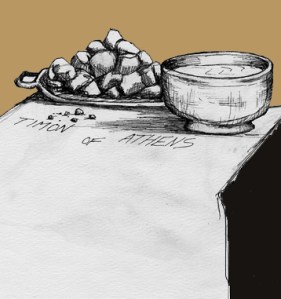
The table is set, the guests drenched in lukewarm water and the flatterers pelted with rocks. It time for act IV of Shakespeare’s tragedy, Timon of Athens!

Listen to or download the podcast.

Welcome back Brawlers. Last show Timon’s ‘friends’ were “touched and found base metal” by his servants so that Timon finally figured out that he was penniless and friendless and that pretty much no one but his servants cared that he was totally bankrupt.

With nothing left for him in Athens by the start of act IV, he decides that all human beings are disgusting, two-faced scumbags and so he does the only sensible thing and runs off to live in the wilderness by himself. Insert litany of curses and well-wishes: may your prostitutes be considered virgins, may the young steal from and beat up the old, may your state be a lawless cesspool fueled by avarice and lust.

So, it turns out that the only friends Timon has are his servants, with Flavius being particularly vocal about how it falls to the servants to try to help Timon out however they can. “Flavour’ Flavious runs off to find and continue to serve Timon at the end of scene 2.

Remind you of a certain Kent from act I of King Lear?

Seems that by scene 3, Timon has moved into a cave with a view, at the edge of some woods, right by the seashore. Seems like things might be looking up for this foraging caveman misanthrope.

As he’s digging for some roots to eat, Timon finds some gold. Timon’s about to bury all of it again when he hears some marching music in the distance. He buries most of the gold but keeps some of it, so he can torment the other humans with it, very likely. Alcibiades, who has been banished from Athens and now gathers up an army to assault the city, wanders by Timon and his cave.

Alcibiades figures out who this is but has no idea what happened back in Athens and why Timon is out here in the woods. Just like we have no idea why Alcibiades is leading an army flanked by two prostitutes. But, seeing as they are there, Timon sees an opportunity to use them in the war effort: he gives them gold and asks them to infect every in Athens with the STDs they are undoubtedly carrying. Timon also gives Alcibiades gold to make sure that he slaughters everyone in Athens. Lovely.

As soon a Alcibiades leaves, Apemantus shows up. They swap insult and wish one another a long and painful life, full of suffering, before they quickly part ways.

When Apemantus exits, some bandits, having heard that Timon found gold, show up to steal it. Timon gives them the gold and sends them off to Athens to rob all of the lying thieves in Athens blind. And maybe slit a few throats while they’re at it.

Finally, Flavius shows up and offers his continued service to Timon. His former master is about to turn him away but Flavius manages to convince him that maybe not every human being is a totally reprehensible entity entirely bereft of honestly and worth. So, Timon amends his position: all of humanity needs to die, except for Flavius.So Timon gives him some money and chases him off.

What’s left now that Timon’s given all of his money away. Again?

Tune in to the next episode to find out.

Sonnet 33 read by first-time sonneteer David Kandestin.


Join us by contributing to the Bard Brawl journal volume I at our Indiegogo page.

Stay in Touch Brawlers!

Follow @TheBardBrawl on Twitter.

Like our Facebook page.

Email the Bard Brawl at bardbrawl@gmail.com

Subscribe to the podcast on iTunes

Or leave us a comment right here!

Go back

Your message has been sent

Warning
Warning
Warning
Warning

Warning.

BB: Timon of Athens, Act III

artwork - Stephanie E.M. Coleman
artwork – Stephanie E.M. Coleman

(Podcast recorded and produced by Daniel J. Rowe, blog written and edited by Eric Jean)

Welcome back to the Bard Brawl! This week, Daniel J Rowe, ‘Mister’ Nicholas MacMahon and myself are back for act III of Shakespeare’s tragedy, Timon of Athens.

Listen to or download the podcast.

With creditors knocking at his door, Timon turns to his friends to lend him a little money so he can avoid bankruptcy. He sends his servants out to see the three lords who he feels pretty confident will be able to bail him out.

Flaminius arrives at lord Lucullus’ house in act III, scene 1. Lucullus greets Timon’s servant warmly as he expects that he is here to deliver some sort of gift. When he discovers that Flaminius is there to ask for money, Lucullus puts on his best ‘I told him not to be so generous’ act and then tries to bribe Flaminius so he’ll pretend he wasn’t able to find Lucullus. Flaminius tosses the cash back at Lucullus then curses him (and all other selfish jerks like him) to be boiled in a vat of molten coins.

The next lord to be visited is Lucilius. By the start of this scene, he has apparently heard that Lucullus refused to bail Timon out. He finds it deplorable and says that of Timon had turned to him instead, he would have been happy to help him. And on that cue, Servilius enters. Lucilius also seems to think that Timon’s servant is here offering gifts at first. When he finds out that Servilius is here to beg some cash for Timon, Lucilius replies that he would love to be able to help Timon out but – wouldn’t you know? – he just spent the last of his available funds this very morning, just before Servilius arrived. What an unfortunate coincidence.

Are all of Timon’s friends flattering jerks? Surely Sempronius isn’t like Lucius, Ventidius, or Lucullus? At the start of scene 3, Sempronius seems disgusted by the fact that the others lords have refused to help Timon. Even worse, Sempronius is disgusted that he wasn’t asked first, as this might suggest that maybe Timon doesn’t like him as well as the other lords. So, if Timon doesn’t care for him as much and his close friends refused to bail him out, why should Sempronius have to help him out? He proclaims to Timon’s servant that any man who would dishonour him in this way won’t get any help from him.

With no one left to ask for money, Timon has locked himself up in his house in scene 4. In a hall in his house, his creditor’s servants want to be paid. Seems that the servants aren’t too keen to be collecting from Timon when they know full well that their masters walk around with the jewellery that Timon once gave them. As they wait, Timon’s messengers return to announce that they have failed to get any money for Timon’s debts.

Timon eventually enters the hall in a rage and is greeted by the collectors’ bills. He offers to pay with his blood and flesh and chases the servants out of his house. Once they are gone, he asks his servants to invite all of his former friends back to his estate for one final banquet.

We leave Timon behind for a moment as scene 5 takes place in the Athenian senate-house and features the general Alcibiades. It appears that one of Alcibiades’ soldiers was involved in the violent crime in Athens. The law calls from his execution but Alcibiades, as his commanding officer, is here to beg the senate for leniency. The senate refuses. When Alcibiades is a little too insistent in his critique of the thanklessness of the Athenian senate, they banish him from the city despite all of the wars he fought for them. This should remind you of another general who was forced to turn his back on his city.

The last scene of the act takes place in Timon’s house. The lords have all arrived for the feats and are commenting that clearly Timon’s need for money must not have been so great as they have heard. Timon greet them all and escorts them into the dining room where for each guest is layed out a covered dish. The lords sit down, Timon curses all of Athens’ flattering lords, and once the covers are removed, each guest sees that their meal is warm water and rocks. Timon slashes the water in their ungrateful faces and then drives them out in a hail of stones.

The craziest part of the whole thing is that none of the lords seems to have a clue as to why Timon would be pissed at them…

Penniless and friendless, What’s next for Timon? Find out next week!

Sonnet 56 read from afar by Zoey Baldwin.

Shout out to the Segal Centre’s production of Othello in its last weekend and the Shakespeare Theatre of New Jersey’s upcoming Pericles from Dec. 4 – 29.


Join us by contributing to the Bard Brawl journal volume I at our Indiegogo page.

Stay in Touch Brawlers!

Follow @TheBardBrawl on Twitter.

Like our Facebook page.

Email the Bard Brawl at bardbrawl@gmail.com

Subscribe to the podcast on iTunes

Or leave us a comment right here!

Go back

Your message has been sent

Warning
Warning
Warning
Warning

Warning.

BB: Timon of Athens, Act 2

Act II, ii; Flavius
Act II, ii; Flavius

(Podcast recorded and produced by Daniel J. Rowe, blog written and edited by Eric Jean)

Welcome back to the Bard Brawl and act II of Timon of Athens.

Listen to or download the podcast.

What did you think of act I? Kind of makes you want to have a good look at your own friends, doesn’t it?

Nonsense! You are rich in your friends, aren’t you? 😉

While the party’s in full swing within, a Senator arrives at Timon’s gate at the start of act II, scene 1. He’s disgusted that Timon should spend so much money on parties with his friends while he has outstanding debts to this senator. The Senator commands his servant Caphis to take debt bonds to Timon and not return until Timon pays up. The senator suspects that, when the money runs out, so will Timon’s friendships.

Flavius is just complaining about Timon’s careless spending when Caphis walking in to scene 2, speaking with Varro and Isidore’s servants. These men are also looking to collect on some outstanding debts. They intercept Timon as he returns from hunting. Timon tried to talk his way out of it but Caphis reminds him that his money was due six weeks ago and won’t take no for an answer. Flavius promises to deal with it for them right after supper and ushers Timon away.

The servants hang back to be made fun of by the Fool and Apemantus who, as Daniel points out, seem to be competing for the job of “guy who gets to say whatever he wants to Timon’s ‘friends’.”

After hearing about the current state of his finances, Timon tries to blame Favius for not mentioning any of this sooner. Flavius of course tell him that he tried to but that Timon wouldn’t hear it before. And now, even if Timon were to sell everything he has, that would only be enough to pay back about half the debt. While Falvius freaks out Timon calms him down and reminds him that as he has so many friends in good financial situations surely a few of them will be willing to help bail him out of this. But, turns out that Flavius has already approached some of these friends who gave him a bunch of excuses as to why they couldn’t help Timon. No big deal though: Timon’s buddy Ventidius – who he bailed out of jail in act 1 – just struck a rich inheritance so he’s sure that he’ll be more than happy to help out Timon.

Here are some of the characters introduced in this act:

  • Senator: This senator has lent money to Timon who does not appear to be in any hurry to pay him back. He comes armed with his legal documents to collect his debt.
  • Caphis: A servant to the Senator who comes knocking at Timon’s door to get the money he is owned.
  • TBD: _description_

Excited for act III?

A special shout out to Emily Murphy who wrote this article for CBC’s Canada Writes site.

Different Timon.
Different Timon.

Join us by contributing to the Bard Brawl journal volume I at our Indiegogo page.

Stay in Touch Brawlers!

Follow @TheBardBrawl on Twitter.

Like our Facebook page.

Email the Bard Brawl at bardbrawl@gmail.com

Subscribe to the podcast on iTunes

Or leave us a comment right here!

Go back

Your message has been sent

Warning
Warning
Warning
Warning

Warning.

Up ↑