Sorry Bill I just Don’t Get It!

Troy Clements

So I’m not sure about you guys but Shakespeare is F ing hard to understand right?! I mean I just can’t seem to get my head around some of it. Especially if you are a fella coming from the maritime provinces where ya got lots of different kinds of fish spears but no Shakespeares unless you’re just trying to get the fish off your spear. I suppose you could call that shake spear?

I mean com’on, did people really talk like this??

A man may, if he were of a fearful heart,
stagger in this attempt; for here we have no temple
but the wood, no assembly but horn-beasts. But what
though? Courage! As horns are odious, they are
necessary. It is said, ‘many a man knows no end of
his goods:’ right; many a man has good horns, and
knows no end of them. Well, that is the dowry of
his wife; ‘tis none of his own getting. Horns?
Even so. Poor men alone? No, no; the noblest deer
hath them as huge as the rascal. Is the single man
therefore blessed? No: as a walled town is more
worthier than a village, so is the forehead of a
married man more honourable than the bare brow of a
bachelor; and by how much defence is better than no
skill, by so much is a horn more precious than to want.

– As You Like It, Act3, Scene 3

Haha ahh insert WTF emoticon here…I mean, Christ, feels like I’m talking to Steven Hawking about the origin of the universe. Isn’t this stuff supposed to be about like love, lust and other normal people shit?

I mean I get it. Everybody likes to show off and use “smart words” but cut us some slack Bill: either ease back on the drugs or come down off your pedestal and drop the “smart words.”

We get it, you talk good!

So if you feel the same way as I do, but still wanna get to the most outta Shakespeare… fuck it, just cheat!

I found a simple audio book app that has many Shakespeare ditties.

There are a few that break down entire plays in 15min, written in a way even children can understand. Well, to be honest, its still a little complicated at times as it was written for children who lived in the early 1900’s…I guess kids were smarter then? Makes me wonder what happened to the baby boomers?

What did I learn from ole Nesbit’s approach that I didn’t learn from Eric Jean you ask?  An example would be from Two Gentleman of Verona, a play of platonic love and fidelity where the character Speed – who I really enjoy – says,

O jest unseen, inscrutable, invisible,
As a nose on a man’s face, or a weathercock on a steeple!
My master sues to her, and she hath
taught her suitor,
He being her pupil, to become her tutor.
O excellent device! was there ever heard a better,
That my master, being scribe, to himself should write
the letter?

Two Gentlemen of Verona, Act 2, Scene 1

This scene is about Silvia asking Valentine to write a sort of love letter to a friend of hers cause she doesn’t have time to do it herself.  But in truth she wants Valentine to actually write the letter to her…(big communication issues if you ask me).  Valentine, who is smitten with love and not thinking clearly, doesn’t pick up on her obvious nuances and writes some half-ass letter that falls short and Silvia kinda gets pissed off.  When Silvia leaves the room Speed pipes up, poking fun at Valentine, pointing out that she clearly wanted him to write the letter to her.

Nesbit doesn’t really explain the entire scene but does bring Speed’s lines down to earth a bit.  She references the weathercock on a steeple jab, meaning that its very obvious as to what Silvia is up too.  This is what made things clearer for me, allowing for the entire scene to make sense.

https://itunes.apple.com/ca/app/audiobooks/id311507490?mt=8

Anyway…if you are looking for the easy way out check out the app Audiobooks and download Edith Nesbit’s Beautiful Stories from Shakespeare  (or buy the real, live printed book form. Remember those?) and if you still don’t understand…well, blame your parents.
A certain kind of madness

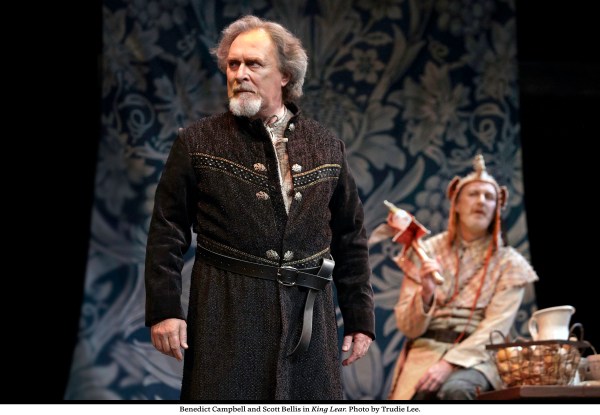
Theatre Calgary’s production of King Lear was a good crazy.

Jennifer Dorozio

Flashes of lightening crack, thunder roars and a stumbling madman emerges from the backdrop.

His shirt is un-tucked, his hair is full of static but, most telling, is the wild spark that fills his eyes, and the angry pitch with which he yells heavenward.

So enters the mad King Lear to the bittersweet pleasure of a rapt Calgary theatre audience. What the actor, Benedict Campbell, has successfully done, is to make you want to admonish the foolish king, and give him a comforting pat on the shoulder at the same time.

The scene described is the first we see after the intermission of Theatre Calgary’s production of King Lear, directed by Dennis Garnhum which runs from March 10 until April 12.

Where the first half is full on Shakespearean plotting, dialogue and pensive monologues, the second is pure action and includes gouged eyeballs, a ranting half naked madman, and assorted “deserved” and “undeserved” deaths.

Photo credit - Trudie Lee
Photo credit – Trudie Lee

King Lear is one of the “famous” Shakespeare plays, which brings to life the tale of a King of Britain’s descent into madness, and then his journey out of it, which ends in tragedy, great loss and ultimately his death.

Intrigue abounds as brothers clash, and sisters with sharp tongues and nasty streaks are backed into corners as Lear’s kingdom is divvied up among the royal family.

The play centres on Lear and his three daughters, Goneril (Colleen Wheeler), Regan (Jennifer Lines) and Cordelia (Andrea Rankin). The aged king loves his youngest the best (hey! I’m the youngest and best too), and this leads to complications, especially after his own self-serving game of ‘how much do you love me?’ causes him to banish Cordelia. The vultures in the royal family, who try to wrest away power from his feeble hands, then betray the proud Lear.

Which of you shall we say doth love us most?
That we our largest bounty may extend,

Lear, I,i

The characters themselves feature some quirky and brooding additions in their mix. One in particular stands out among the rest: the fool, who is King Lear’s Court Jester, played by Bard on the Beach regular Scott Bellis.

*Garnhum’s Lear will follow at Bard on the Beach’s summer playbill.

The fool, imbues some much-needed levity into the first act. Wearing a coxcomb on his head, he spends a majority of his stage time leaping from place to place. Curiously, his mad interpretation of Lear’s confused reality does lend a bizarre sort of clarity to the king’s situation.

This is exemplified when the fool eerily jests to King Lear, “This cold night will turn us all to fools and madmen,” foreshadowing all the cacophonous events to come.

Heartbreaking is the excellent performance of the Earl of Gloucester, played by David Marr, who is the play’s one paternal character you can’t help but feel badly for as misfortune after misfortune befalls him.

Then there’s the scene that sticks out because of its unnecessary gore. Gloucester’s eyeballs are in stomach-churning fashion carved out his head and at one point even trodden upon. It did little to add to the production other then induce cringes and distraction at all the fake blood for a full two minutes afterward.

Lest it see more, prevent it. Out, vile jelly!
Where is thy lustre now?

Cornwall, III, vii

Michael Blake performance of Edmund, the crafty bastard son of the Gloucester, is charmingly sinister. He plots for revenge by promoting multiple sibling entanglements making him both convincing as a villain, and likable.

While actor Andrea Rankin, as the young Cordelia, does play the doe-eyed daughter well, there is something a little grating about her over the top sweetness that came off as insincerity near the end. It seemed as though her tone and countenance changed little whether responding to a marriage proposal or being angry at her father’s mistreatment.

The Shakespearean world of King Lear, so artfully woven by the troupe of Theatre Calgary actors, doesn’t seem very far off from our own world, which is perhaps why the play still feels so relevant. These themes of undying devotion, betrayal and greed still saturate news media, television and movies because they are reflections of human reality and frailty.

Getting through the more slow-paced first half is well worth the wait. The explosion of passion, blood and revenge in the second half leaves you completely sated in a way only an excellent acting troupe and script can do.

Here’s a scene.

Waving the boat of gender constructs goodbye courtesy of Shakespeare

Troy Clements

So I grew up in a very rural area of Prince Edward Island, Canada. And when I say rural I mean friggin rural! With a population of 75 people in my village (well it’s actually defined as an unincorporated area, but village is just easier to say), it gives you an idea of what I mean when I say small.

Not like… “Hey I’m from a rural place too” “oh yah, where’s that” I ask…”oh just outside of Kingston, Ontario.” Yah buddy that’s not what I mean by small…small like, shooting rats at the dump with your dad’s 22cal riffle. Or waking up at the crack of dawn to head to the wharf on setting day, sending the lobster fisherman off with a friendly wave…

There ain’t nothing like waving at boats!

I made the big move in 2010. Not the one where you go to Alberta and make lotsa money in the oil biz so you can buy a big truck, the one where you move to Montreal and make no money but yet discover a bit more of yourself.

When I arrived I realized Montreal has lotsa boats leaving the harbour, but nobody really finds waving at them as fun for some reason. And there are rats but they won’t let ya shoot em’….even if your gun is registered…go figure eh?  So as you can imagin’ my horizons were broadening quickly. One example would be Bard Brawl.

Back home you would never have an opportunity to join a group that got together once a week, had a couple of beers and read Shakespeare…and out loud, like in front of people, not just by yourself hiding in your room in fear of being seen as something different. I mean we would brawl back home, but it usually involved more than a couple of beers and few broken noses in the end.   So yah, Montreal…here I am, discovering something new everyday.

So now that you have an idea of where I came from and who I am, I will get to the point…I found an episode of CBC Ideas, “Not With the Eyes,” that struck a chord with me. It was about gender identity as it is in our contemporary culture compared to how it was when Shakespeare was observing and writing about his time.

Being from where I’m from I was always pushed to be male, to be a man. Like be a man…suck it up, you shouldn’t respond that way to a given situation, you should respond this way because…”you’re a man!” And I mean I followed that. I didn’t push back or anything, I really thought that’s how it was.

Don’t get me wrong. Despite where I grew up, I was a little bit more open-minded than others in the community. I accepted anyone who identified as gay or transgendered for example, but I never thought about where I was in that spectrum, and this episode of Ideas really allowed room for me to question my gender. Not my sexual identity but my gender.

You know like…what is gender really?

I mean physically there is a difference but how one perceives oneself is not so obvious. For example, as mentioned in the episode, race was a created construct. Sure we have similarities to a certain group in comparison to others but nowadays, for the most part, race is slowly ceasing to exist.

We don’t see one race compared to another as much any more. There are still differences but we are realizing more and more that we are all just Homo sapiens, and we are getting away from separation of people because their skin is a different colour or because they cook with different spices. And so like race, gender (when looked at in a certain light) was a created construct as well… and one that is slowly moving away from a “you’re a man” and “you’re a woman” type thing.

When we truly ask ourselves who we are, it’s not easy to say. Like personally, I have been questioning if I am male or female…or if either really exist. And I tell you what…it feels so liberating to question that.

Especially coming from rural PEI. Let’s talk about washer tossing some time.

So does gender exist and how did it exist when ole Shakespeare was writing? I mean when you read between the lines Shakespeare was writing about what he seen among the population, usually the upper class of citizens, and poking fun or at least making a comment about how people perceived themselves and the world around them. And so, as mentioned in the broadcast…in his plays he had men playing women roles/parts and these women would then dress up as a young boys. In turn you would have male characters in the play attracted to these ‘young boys’ who were actually women who just looked like young boys. So you have a sort of taboo issue being discussed through a form entertainment.

That’s crucial. As long as it is in some form of theatre, poetry, song writing, etc., one is less likely to get his or her head cut off for it. Sorry Patricia Jannuzzi but Facebook doesn’t cut it!

Helena (in A Midsummer Night’s Dream, adds this nerdy editor) says, “Love looks not with the eyes but with the mind,” and so the question is what are the eyes actually seeing? If you fall in love with the mind, what are the male characters physically seeing in these women who resemble young boys?

When we discuss a similar situation nowadays we see the same thing more or less. We have people who consider themselves sapiosexual.

sapiosexual: (adj) a form of sexual orientation characterized by a strong attraction to intelligence in others, often regardless of gender and/or conventional attractiveness.

So once again falling in love through the mind.

This still leaves the question, what is it that the eyes actually see then?

And so this speaks to the fluidity of gender and sexuality, that nothing is fixed, that there can be many forms of gender and many forms of attractiveness toward that gender and that they are in a constant state of change and flux. And this fluidity is part of a continuum that exists where people exist, that it’s not just fixed to one time or another.

Shakespeare saw it and now we see it. It will evolve but I’m not sure if we will ever know what the eyes actually see.


EDITOR’S NOTE: Troy’s essay is in response to the program “Not With The Eyes” produced for the CBC program Ideas. The link is here:

http://www.cbc.ca/i/caffeine/syndicate/?clipId=2648111044

She’s the Man (2006), Andy Fickman (director)

Twelfth Night is fast approaching, so now’s the time to approach Twelfth Night. (See what we did there? Of course you did!)

In order to celebrate along with Shakespeare – and buy us some time while we get our act together for 2105 –  we’ll be reposting our Twelfth Night podcasts starting tomorrow.

Want to get back into the swing of things before our sweet voices hit your ears again?

We got you covered.

Check out Zoey Baldwin’s review of the film She’s The Man (an adaptation of Twelfth Night). And once you’re read that, watch the full film which we have so helpfully linked at the bottom of the page!

Enjoy and see you next time!

Zoey Baldwin

High school soccer movie She’s the Man’s hardly a match for Twelfth Night.

Twelfth Night, or What You Will—Shakespeare’s hilarious tale of mistaken identity and unrequited love—begins with a shipwreck on the shores of Illyria.

Or, in the case of the 2006 film She’s the Man, on the soccer pitch at Illyria boarding school. No one is presumed dead in this case; Sebastian Hastings (James Kirk (not the captain of NCC-1701-A)) has gone to London to play with his band without his parents’ knowledge.

After the girls soccer team at her school gets cut, his twin sister, Viola (Amanda Bynes), takes this as an opportunity to play soccer on her level—with the boys. And a wig. And a rather unconvincing voice timbre.

Viola hatches the switcharoo idea after her mother, who is dying for a debutante daughter, says, “Sometimes I think you might as well be your brother.” And one gratuitous salon montage underscored with an uppity chick rock cover of “You’re Gonna Make it After All” and complete with stick-on Yosemite Sam moustaches later, Viola sets her plan in action.

She tells each of her conveniently divorced parents she’s at the other’s house, and sets off for Sebastian’s new school. (Of course, this only works because no one at Illyria has met Sebastian yet.)

When Viola starts posing as Sebastian, she suddenly dons an awkward, half-southern accent and saying things like “Word, g-money.” Problems arise when her dreamy roommate, Duke Orsino (Channing Tatum) spots her tampons. To get out of the awkward situation, Viola sticks a tampon up her nose, claiming she uses them for nosebleeds.

Much like the play, Viola and Duke work out an arrangement. Viola will help Duke woo the gorgeous blonde Olivia (Laura Ramsay), and Duke helps Viola improve her soccer skills so she can make first string and kick her ex-boyfriend’s butt in the season opener. Too bad Viola is falling for Duke the whole time, and he thinks she’s her brother. Ruh-roh! Drama, drama, drama, happy ending ensues. I won’t spoil it for you.

There are a number of components in the film that could leave you scratching your head. Tatum’s Duke never seems suspicious that he’s living with a co-ed. I’m willing to suspend disbelief a little bit, but she’s not remotely convincing. The wig isn’t bad, sure, but how do the heart-to-hearts and awkward moments in the locker room not tip Duke off? And how does Olivia not realize she’s flirting with a girl?

As is the case with the original play, there’s no use trying to make sense of how a set of fraternal twins (of opposite genders) would be confused for one another. Or how when Sebastian suddenly returns from London/his watery grave, Olivia has no idea she wasn’t crushing on him all along. And so on.

This is all well and good. The play is not meant to be deep. But though the Bard’s original version is a light romp, it is filled with genuine laughs, pranks and chaos. She’s the Man, on the other hand, relies on kissing booths, debutante balls and chemistry lab partner dynamics. (Yes, Olivia falls for Viola/Sebastian in chemistry. What are the odds of that?!)


In addition to a fair dose of cheesiness:

a number of my favorite characters aren’t done their full justice—namely the staff in Olivia’s court like Feste, Maria, and the perpetually drunk Sir Toby Belch and Sir Andrew Aguecheek. True, in She’s the Man Duke has two teammates named Toby and Andrew, but they are in high school and, sadly, never drunk. (Just kidding! Stay in school, kids.)

We do get a solid dose of Malvolio in Olivia’s obsessive sidekick Malcolm Festes, but we never get to see him in yellow, cross-gartered stockings, which is disappointing. He even has a pet tarantula named Malvolio, which he pretends to lose in an attempt to prevent Viola/Sebastian from hooking up with Olivia.


The most famous verses work their way into the film, as expected, but it’s actually the only one that does. “Be not afraid of greatness: some are born great, some achieve greatness, and some have greatness thrust upon them” is used as a cliché line from Duke after Viola’s true identity is revealed in the middle of their season opening soccer game. A bit out of context, if you ask me, considering that we see that line in Malvolio’s big speech when he reads the letter Maria writes to fool him into thinking Olivia holds a torch for him.

You might be asking yourself, why should I support a celebrity who’s spinning off the rails? But people, this is Amanda Bynes pre-bizarre Twitter habits. Whatever she claims has not snapped inside her head definitely hadn’t snapped yet, so this movie’s pretty easy watching.

She was cute once! I promise. Any All That fans out there?

If Bynes’ presence puts you off, perhaps your attention might be redeemed by Channing Tatum’s irresistible charm. Besides Tatum, the only other beacon in the movie is David Cross (Oops. I mean David Cross) as Illyria’s overly friendly headmaster, Horatio Gold. But even an Arrested Development alum can’t fully rescue this awkward, unconvincing adaptation.

Plus, let’s face it, no high school Shakespeare film will ever touch what 10 Things I Hate About You did for The Taming of the Shrew. (Heath Ledger’s adorable serenade of “Can’t Take My Eyes Off of You” is forever burned on my brain.)

She’s the Man is pretty bland. I’d recommend it for sick days, if it comes on TBS or Bravo or something. Don’t go out of your way.

Stay in Touch Brawlers!

Follow @TheBardBrawl on Twitter.

Like our Facebook page.

Email the Bard Brawl at bardbrawl@gmail.com

Subscribe to the podcast on iTunes


Two wives, two religions, one bombastic king in New Jersey

Daniel J. Rowe

The winds of fall were starting to cool, the leaves were in their final stages of clinging to the branches in Madison, New Jersey, and at long last, after years apart, the souls of Bard Brawl and Shakespeare Theatre of New Jersey met. Finally.

After a failed attempt to catch Pericles, Prince of Tyre last season thanks to a “snow storm” (come on New Jersey) we traveled to the quaint town of Madison and took in Henry VIII.

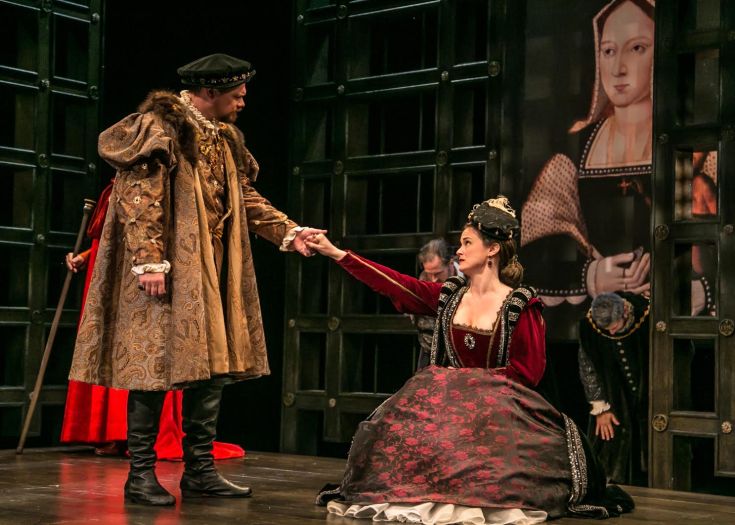
King Henry (David Foubert) greets his faithful wife, Queen Katherine (Jessica Wortham). Photo: © Jerry Dalia, The Shakespeare
King Henry (David Foubert) greets his faithful
wife, Queen Katherine (Jessica Wortham). Photo: © Jerry Dalia, The Shakespeare

Let’s first give a big fits pump and major props to @ShakespeareNJ for putting on a play so rarely produced. Come to think of it, I don’t think I’ve ever seen Henry VIII on a playbill anywhere.

Alas, for those of you who didn’t catch it, we are sorry that you are too late. It was worth the fare.

As discussed often at the Bard Brawl (both podcast and blog), the play suffers from two facts that keep theatre companies from putting histories like Henry VIII on. (1) History plays are very complicated to those who aren’t familiar with the epoch and (2) the late plays where authorship may be questioned are sometimes avoided. It is what it is.

Fortunately for me, I went through a bit of a Henry VIII kick a while ago and have seen A Man For All Seasons, the incredibly addicting Tudors series, the unwatchable Other Boleyn Girl and David Starkey‘s two documentary series on the subject. I get obsessed sometimes.

To say familiarity with the characters helped in engaging Paul Mullins‘ production of Henry VIII would be an understatement, but that’s not a criticism of the play. Mullins’ direction is tight and on point and the story is followable if confusing. The confusion has nothing to do with the production. Shakespeare’s audience would have known the story well and would not have needed explanation on who was who and why that lord was important or not.

A friend that went with me admitted that she (a) understood nothing of what anyone was saying, but (b) really enjoyed the performance.

How did the paradox come to pass?

The characters’ words are hard to filter through at times and there is a lot of dialogue. The actors, however, emote and bounce off each other well and the audience can follow who is aligned with who, who is jealous, who is torn, who is tragic and so on.

Cardinal Wolsey (Philip Goodwin), and the Duke of Buckingham (Thomas Michael Hammond) stand out in their respective roles, and leave memorable imprints. Both have great arcs that go from powerful and pompous to tragic and torn.

Two roles that really need to be amped up with intensity in the production were Anne Bullen (Katie Wieland) and Henry himself (David Foubert). Both actors are very good, but sometimes are overshadowed by those they share the stage with. The story and importance of these two requires that they be comets among asteroids. Something about Bullen (sometimes Boleyn) makes the king change everything. This is a big ask, but one that needs to be answered.

Queen Katherine (Jessica Wortham) is another that chews up the stage even if something in me wishes she played the part more Spanish. (Katherine is of Aragon after all).

At this point I’m nitpicking. The criticisms do not in any way take away from the joy in watching the performances.

Mullins is apt and on point with bringing characters in and out of the story, filling the stage with tension and drama and leaving theatregoers satisfied in the end. Particular points gained for keeping the set simple, costumes on point and not adding too much that shifts attention from the characters.

Having only caught the show in its last week, I feel it my duty to put a huge plug in for the upcoming Much Ado About Nothing that hits the stage December 3. Let’s just hope there are no “snow storms.”

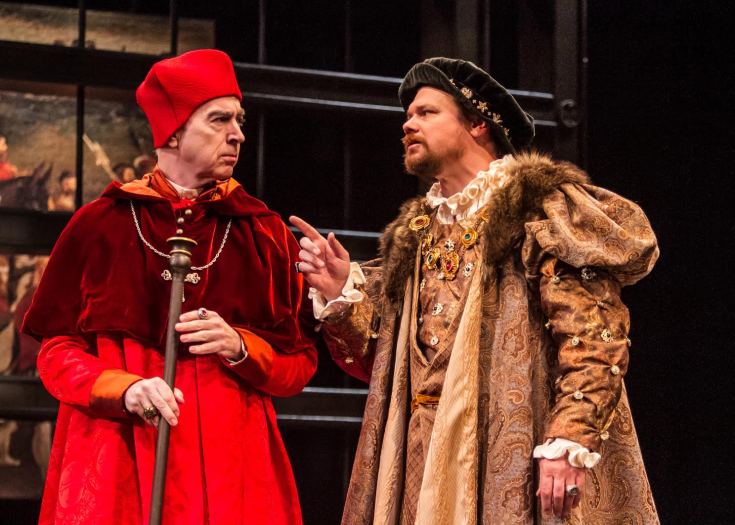
King Henry (right, David Foubert) consults with his trusted advisor, Cardinal Wolsey (Philip Goodwin). Photo: © Jerry Dalia,  The Shakespeare Theatre of New Jersey
King Henry (right, David Foubert) consults
with his trusted advisor, Cardinal Wolsey (Philip Goodwin). Photo: © Jerry Dalia,
The Shakespeare Theatre of New Jersey

Beyond the Mountain Productions’ Bard Fiction, Directed by Christopher Moore

Bard Fiction
Bard Fiction

Take one part Tarantino classic Pulp Fiction,  add in an equal measure of Shakespeare, and stir. What you get is Bard Fiction, a play which presents many iconic scenes of Tarantino’s classic film as if they had been written for the stage by Shakespeare.

Come to think of it, this would have made a great ‘Zounds! submission… Ennoble Marsellus, turn Vincent and Jules into household servants, swap out knives and halberds for guns…

Anyhow, the plot of the play follows the script of Pulp Fiction and the humour of Bard Fiction comes from watching these familiar scenes and seeing how they come out once they’re run through the Bardifier.

(The Bardifier is a complex series of linguistic algorithms codes and supervised by writers Aaron Greer, Ben Tallen & Brian Watson-Jones. It’s a complicated machine. We don’t really understand how it works, and maybe it’s just magic. But we can guarantee that it does work. Trust us!)

Out of the gate, the play is uproariously funny.

First, you get the scene where Ringo (Tim Roth) and Yolanda (Amanda Plummer) are planning to rob the patrons of the dinner. Plenty of foul language language most foul!

The effect of knowing exactly how the scene is going to play out but being surprised at every turn by Shakespearean turn of phrases tickles both the early 90s film freak and the Shakespeare nerd in you. In fact, it’s amazing how little impact the shift from Tarantino’s language to Shakespeare’s actually has on the pacing of the scenes. Did the writers discover the inherently Bardic soul at the heart of Pulp Fiction?

Next come Vincent and Jules (short for Vincenzio and Julius of course), riding in their horse-drawn cart. taking about the differences between England and France. Cue the bardifier! You put in Big Mac and Royale with cheese and out comes Cottage pie or hachis parementier.

See? I told you it works!

This is damned funny stuff, at least at first.

As the novelty starts to wear off though, Bard Fiction becomes less uproariously funny and more, well, just plain funny. Thankfully, the writers realised this as well so instead of getting a recreation of the whole film, Bard Fiction presents a sort of greatest hits and runs a little over an hour.

It’s still really entertaining right up to the end but by the end of the play, that pony’s run about as far as this idea can take.

Still, is there anything more Bard brawl-tastic then the idea behind Bard Fiction? It’s definitely in the spirit of the Bard Brawl and ‘Zounds! which means that if you like either of these two things, you’ll have a great time with this play.

Bard Fiction isn’t a deep exploration of the state of Shakespeare in the 21st century or a thoroughly researched and cogent analysis of the construction of dialogue in the early 90s films of Quentin Tarantino.

It’s just a whole lot of fun and goes to show that the theatre, and Shakespeare’s theatre, doesn’t need to be elitist hard to get into.

Today is the last day Bard Fiction is showing at the Mainline Theatre so head down there and get yourself a ticket,  or check out one of Beyond the Mountain Productions’ upcoming shows!

And hey! Buy ‘Zounds! You’ll never regret or forget it. Volume II is OUT NOW.brassknucklestshirt1.png

Stay in Touch Brawlers!

Follow @TheBardBrawl on Twitter.

Like our Facebook page.

Email the Bard Brawl at bardbrawl@gmail.com

Subscribe to the podcast on iTunes

Or leave us a comment right here!

Go back

Your message has been sent

Warning
Warning
Warning
Warning

Warning.

The fun of Serpents and Shylocks and Moors and Poe

Daniel J. Rowe

Christopher Moore’s menage of Othello, Merchant of Venice and the Cask of Amontillado  is so much dang fun that it would smite my place as a bard brawler not to recommend picking the book up and diving in. Just beware of sea monsters.

Christopher Moore gets from the Bard to Poe to a sea serpent in style in the Serpent of Venice

The story begins with three men waiting in Venice for a fool to arrive. The plot is laid for them to off the fool, so they can proceed to reap the bounteous fortunes that await them. They even took care of the monkey. One poisoning later, and the Fool is chained to a wall and being sealed in brick-by-brick by the father of the his sister-in-law. Ba-da-bing and we just got from William Shakespeare to Edgar Allen Poe and we’re only in the second chapter.

And the sea snake hasn’t even showed up!

Christopher Moore’s The Serpent of Venice is a great read that thumps from cover-to-cover with the funny, clever, sometimes really gross rhythm welcome on any Bard Brawler’s shelf.

The book follows the Fool (King Lear’s fool), as he wanders through a Venice haunted by a sea creature that does dirty things to the Fool and deadly things to those you want deadly things done to. The serpent is one of the few characters Shakespeare did not have in either of the plays the plot follows, but I’m sure the bard would have welcomed her presence. At least I hope he would.

Edgar Allen Poe’s short story kicks the story off, and the rest of the novel follows the plots of Othello and Merchant of Venice more or less with a cameo from Marco Polo.

Okay, now you’re showing off Moore.

The book is the ultimate response to the comment, “I want to read Shakespeare, but I don’t understand what’s going on.” The book is simple to follow, and incredibly fun. Iago, Othello, Antonio, Jessica, Shylock and Lorenzo are all there, and Moore is damn clever in twisting the plots together so it reads like one clear novel about a poor Fool trying to avenge the murder of his wife Cordelia? Yep, Lear’s youngest married the Fool in the end. Why not? The speeches are there, as is a general commentary on the plot lines complete with modern swears, sexiness and a bit with a monkey.

Moore also does what all who watch Shakespeare plays secretly want to do: scream at the characters and question their motivations. Why can’t enough be enough Macbeth? Why do you have to think so much Hamlet? Or as the Fool says to Othello in Moore’s book:

Fine. So you would accuse your lady of being untrue – your lady, who did throw all of Venice away for you, stood up to the most powerful men in the republic, for you, Moor,; she you would accuse, without any evidence but the comment of another, yet Iago, who you know to be a villain, a cutthroat, and a traitor – for him you need proof beyond my word? Respect my judgement in this, Othello, if in nothing else, or thou art a fool.

Yeah Othello. Think before you act.

The book also cleverly works in the soliloquies and famous lines from each play ad-libbing here and there, and adding reaction from other characters so that even those who don’t know a lick of Shakespeare will give that, ‘huh. I’ve heard that somewhere,’ or better yet, an ‘oh. I get it now.’

The Serpent of Venice was a joy to read. It adds the flare and seduction of the Bard with the page-turning joy of a clever modern fantasy tale. And how can you not be happy to read what happens to Lorenzo. I’m always sad when I hear sweet music indeed, Jessica. Boom.

The joy of reading Shakespeare is not always an easy sell, and so it’s a pleasure when someone like Moore comes along and makes it come off so easily.

I feel like Moore would be a great bard brawler, and thus could do nothing but commend him for his efforts with the Serpent of Venice. Those students struggling through either Merchant of Venice or Othello would do well to pick up a copy of Moore’s book, and you’ll be well on your way. Of course, you could always just listen to the Bard Brawl podcast, and that would do just as well. Either way.


Stay in Touch Brawlers!

Follow @TheBardBrawl on Twitter.

Like our Facebook page.

Email the Bard Brawl at bardbrawl@gmail.com

Subscribe to the podcast on iTunes

Or leave us a comment right here!

Go back

Your message has been sent

Warning
Warning
Warning
Warning

Warning.


The Hollow Crown S01E01; Richard II (2012), Rupert Goold (director)

Daniel J. Rowe 

The Hollow Crown series kicks off the tetralogy with a bang on the backs of incredible acting talent, savvy directing and an overall appreciation of just how great the histories of William Shakespeare can be.


It has long been a question tossed around in the vaunted halls of the Bard Brawl: Why doesn’t anyone produce Shakespeare’s histories?

It seems the only ones who appreciate the brilliance of the history plays are certain medieval re-creation societies, monarchy scholars or the basketball and hockey fans who mistake the Kings in the titles for the sports franchises in LA and Sacramento (though who in their right mind is supporting the Sacramento Kings these days? Am I right?)

The Hollow Crown series answers the question with an exclamation point that looks a lot like an bullet hole. The tetralogy of Richard II, Henry IV part I and II, and Henry V is produced with style, substance and power.

This humble brawler gives his official thank you to whoever pitched the idea first and second to those involved with the project.

Rupert Goold directs Richard II, the first episode in the series, and dang is it good.

Ben Whishaw plays the arrogant, naive, and ultimately tragic king, who first sits comfortable on the throne in glory and pomp, and then laments his kingdom’s passing into the hands of his cousin Henry Bolingbroke (Rory Kinnear).

I know many of you are asking, “why would we ever need more out of Richard II than what the Bard Brawl has already offered us?” To answer: I know, I know, but to watch simply adds to the overall genius of the Bard Brawl’s audio podcasts. That’s all.

Goold’s episode is fantastic.

The performances in the episode are fantastic.

The sets, scenery and style are all, yep, fantastic.

The actors from the leads all the way down to the Gardener (David Bradley), who for some reason gets lead billing, leave no opportunity to show their quality unchecked. The opening scenes between Richard, Bolingbroke and Thomas Mowbray (James Purefoy) can be really confusing and a little boring. It’s hard to understand what the offence is (CCCCEO Eric Jean explains the whole thing if you’re still confused). The three actors with subtle movements and clever reactions put the turmoil in the kingdom into such clear focus it makes those that miss some of the language and real politic of late 12th century England understand what’s going on. These are real people fighting for their honour in a system where the king is head and his subjects below.

There’s a beauty bit early where Mowbray is pleading his case before Richard, and Richard turns to his pet monkey and feeds it. Very nice.

Then there’s this scene:

Shivers. If I don’t meet Captain Picard before I or he dies, I will be sad.

Whishaw and Kinnear’s performances are brilliant. As one’s power crumbles and the other’s rises, their personas and gravitas do the opposite. For one actor to pull this effect off is great, for two in the same production is simply brilliant. Actors out there should study these two talents. I just watched Kinnear in Southcliffe, he was great. Whishaw is in one of my favourite series, the Hour.

Whishaw is tasked with three great soliloquies (never an easy task) starting with the following where the series gets its name:

For God’s sake, let us sit upon the ground
And tell sad stories of the death of kings;
How some have been deposed; some slain in war,
Some haunted by the ghosts they have deposed;
Some poison’d by their wives: some sleeping kill’d;
All murder’d: for within the hollow crown (BING!)
That rounds the mortal temples of a king
Keeps Death his court and there the antic sits,
Scoffing his state and grinning at his pomp,
Allowing him a breath, a little scene,
To monarchize, be fear’d and kill with looks,
Infusing him with self and vain conceit,
As if this flesh which walls about our life,
Were brass impregnable, and humour’d thus
Comes at the last and with a little pin
Bores through his castle wall, and farewell king!
– Act 3, Scene 2

A certain brawler I know loves this monologue and it’s not hard to see why.

Richard’s final scenes as king, and following where he’s forced into advocating the crown are incredible. Goold does not spare on the Christ imagery including a shot of the crownless Richard riding a white donkey to meet the new king Henry IV. It may border on heavy handed symbolism there, but it works (particularly because Whishaw seems destined to be cast as Jesus at some time in the future. It’s the all in the hair and beard).

Oh, and there are heads falling into rivers, and rolling all over the ground for all you gore fans.

As a side note: Al Gore fans might also appreciate the anointed king being supplanted storyline as well. No, tea party members, I am not suggesting your beloved U.S. president is in any way shape or form similar to a king or that dynastic rule full of courts dominated by powerful families is what the land of stars and stripes is destined for. Wait a second…

After watching the first episode of the Hollow Crown, the appetite for more is unavoidable.

Listening to, and reading the histories can be tough. The characters’ names are hard to follow and the plots can be very convoluted. However, that does not mean they are not as great as any of the big gun, seat filling tragedies or comedies.

Richard II is rarely done (although I found this trailer for one that looks crazy interesting). The Hollow Crown episode one was the first time I’d ever seen the play on film or stage, and Goold makes it utterly compelling, incredibly interesting and as powerful as Lear or Othello.

I have, gentle brawlers, become a fan of the Hollow Crown series.


Weather the Tempest and you will not regret the storm

Daniel J. Rowe

In the final trip to the Bard on the Beach for the Bard Brawl the Tempest awaited. It is an entirely unique play in William Shakespeare’s cannon and has the potential to be one of the most entertaining, provoking and touching. It can fall flat or be incredibly moving.

Did director Meg Roe pull it out under the tent?

To quote Omar from the Wire, ‘Indeed.’ (That was Shakespeare right?)

Meg Roe's Tempest finds the balance between wonder and soliloquy at Bard on the Beach. Photo credit - David Blue
Meg Roe’s Tempest finds the balance between wonder and soliloquy at Bard on the Beach.
Photo credit – David Blue

Roe’s Tempest executes the most difficult of things in live theatre: balance. The play bounces between incredible design, action, and intrigue and the subtle and powerful monologues of the play’s centre: Prospero (Allan Morgan).

Indeed the isle was full of noises, sounds and sweet airs that gave delight and did not hurt (wink), but first we have to get there.

Relinquishing solitude and embracing the brave new world is a wise model for theatre goers who should take in the Tempest. Photo credit - David Blue
Relinquishing solitude and embracing the brave new world is a wise model for theatre goers who should take in the Tempest.
Photo credit – David Blue

The staging of the opening ship wreck was very clever, loud, and set the play perfectly as it destroyed the ship carrying the King of Naples and left him and his crew on the island inhabited by the exiled wizard, his naive daughter and a sprite name Ariel (no, not that Ariel. She’s a mermaid).

The balance between stylized action and solitary poetry is the Tempest at its best, and Roe does not miss an opportunity to exploit this juxtaposition (even if she spells her last name wrong. Shouldn’t it be R-O-W-E?).

Morgan is great as the aging Shakespeare getting ready to say goodbye to theatre. Er I mean Prospero saying goodbye to the island and his daughter. He is lucky (or unlucky depending on your style), as he gets a handful of the most famous of Shakespeare monologues. You can bet there were a few nights when a few theatre grads had copies of the text in hand and mouthed along to:

Our revels now are ended.

These our actors, as I fortold you, were all spirits and

are melted into air, into thin air.

Gotta love theatre grads. Wait a second. Most of the cast is theatre grads. Forget I said anything.

The only thing I can ask for is what Morgan was able to give me. Even though the lines were familiar and I knew they were coming they still had that sad melancholy of an artist hanging up his quill. He made them memorable and meaningful. It’s especially difficult to draw and audience in to that level of intimacy after some of the spectacle scenes that preceded and followed the lines.

And the spectacle can’t be understated. Roe’s Tempest is full of some really incredible design and style that added as much magic to the island as any Puck infested forest.

Speaking of whimsy and wonder, Ariel (Jennifer Lines) has a dramatic and powerful presence throughout the play. She pulls a little Galadriel out in one of the most impressive scenes of the whole production. Shivers.

Go see the play. You’ll get it.

Props has to also go to the Miranda (Lili Beaudoin) as Prospero’s naive daughter flitting around the island after love of her life (you know, the third guy she’s met in her life) Ferdinand (Daniel Doheny), while having her eyes opened to the brave new world (wink) that awaits her. Oh that world is a bunch of conniving, back-stabbing, flaky aristocrats Miranda. Sorry. Welcome to reality. Have a wonderful wedding.

Trincula (Luisa Jojic) and Stephana (Naomi Wright) threw me off a bit, but showed their quality in the end; just like Faramir. The jester and drunkard were great at playing off Caliban (Todd Thomson), and gave the audience a more than a few laughs even if they were of the ‘ha ha she’s drunk’ variety. For me, I could have taken a little less from the scenes, but, hey, who am I to criticize what everyone else is enjoying? More poop jokes!

Ariel pulls out a little Galadriel in the midst of the Tempest, no complaints here. Photo credit - David Blue
Ariel pulls out a little Galadriel in the midst of the Tempest, no complaints here.
Photo credit – David Blue

Sitting waiting for the play to start both myself and my brother noted the set. The design was perfect. Not too much, not too bare. The players worked their way through the set with ease, and were able to shine and wind their way through the design. The trap door was used sparingly and to great effect.

On a side note I would like to congratulate myself for not geeking out when I saw sound designer Alessandro Juliani walk by before the play. It’s hard to resist bringing it up, and insist on going over some of the decisions Felix Gaeta made in season four of Battlestar Galactica. He used to come into a restaurant I managed in Vancouver about seven years ago. Very nice guy. What a great show.

The Tempest is one of those plays Shakespeare theatre troupes can’t resist adding to the bill especially in the summer. The play can be very entertaining or mind-numbingly boring based on choices the director makes and the performances that accompany. Bard on the Beach pulled this one off not adding too many overly clever bits and adding just enough style for the wow factor. Props to the cast and crew.

Do yourself a favour if you’re in Vancouver between now and the end of September and check it out.


Equivocation packed with energy and intrigue on the beach

Daniel J. Rowe

(Read in honest trailer voice) An attempt on the king’s life has been made, a plot is unveiled, the traitors are captured and the kingdom must be calmed. The hopes of all England ride one one man, a man who can sway the public and restore order.

He is…

A playwright?

William Shakespeare goes from writer to character at Bard on the Beach's production of Equivocation by Bill Cain. Photo credit - David Blue
William Shakespeare goes from writer to character at Bard on the Beach’s production of Equivocation by Bill Cain.
Photo credit – David Blue

Vancouver, BC’s Bard on the Beach sole non-Shakespeare written play for 2014 is Bill Cain‘s Equivocation, a perfect fit to the season even if the play is not a curtain-t0-curtain masterpiece. Director Michael Shamata puts on a thoroughly enjoyable and energetic piece on the Bard on the Beach studio stage.

Rather than the author of the play, William Shakespeare or Shagspeare (Bob Frazer) is the central character struggling late in his career to, well, write a play.

Think Shakespeare in Love, Jacobean Style.

In Cain’s play, we have the dark and serious playwright reflecting on a career built on piling up bodies on stage, rewriting courtly love, changing the nature of the theatre forever, and altering history with a hump here and there. He is under pressure to equivocate from political pressures in King James I’s court that want him doing more of what they want. They get it. The play is the thing. It can change things.

Shagspear (Bob Frazer) given lessons on the shady grey area of truth by Sir Robert Cecil (Anousha Alamian). Photo Credit - David Blue
Shagspear (Bob Frazer) given lessons on the shady grey area of truth by Sir Robert Cecil (Anousha Alamian).
Photo Credit – David Blue

The machiavell of the the play is Sir Robert Cecil (Anousha Alamian) who would like Shagspeare and his players to write the very current history of the gun powder plot of December 1605 in which a group of Catholics most notably Guy Fawkes (yes, the guy from V for Vendetta) sought to destroy parliament complete with the intolerant Scottish king in it. Can the greatest playwright in all of English history pull the play out, or is his quest for the capital ‘T’ truth to much of a barrier?

Who’s telling who lies? Who is really behind the plot? What are the characters’ motivations, and why are they motivated to act them out?

Consider the question central in the play:

The Spanish army invades England and a soldier is at your door asking if the king is hiding within. He is. Do you remain loyal to the crown and lie to save the king or do you tell the truth and betray he you swore to protect?

You may want to use the subtle art of equivocation.

equiv·o·cate

verb \i-ˈkwi-və-ˌkāt\

: to use unclear language especially to deceive or mislead someone

Thank you Merriam-Webster.

Cain, a Jesuit himself, is incredibly clever for the most part, weaving Shagspear’s crew of actors, King James’ politicians, clerics, and the playwright himself together to tell the incredibly complicated, but thoroughly enjoyable plot.

*Spoiler alert: he writes Macbeth.

Actors, like in Bard on the Beach’s Cymbeline, play multiple roles sometimes swapping costumes onstage. On the whole the players pull off the swaps with accuracy and style, and rarely do the roles blend into each other.

A chink that stood out in the armour of Cain’s play is the side plot involving Shagspeare’s daughter Judith (Rachel Cairns), whose scenes lack the energy and pop of the rest of the play. Cairns is a fine actress and it’s unclear whether the 21st century sarcasm her character broods the stage with is the fault of the script or the performance. I want to say it’s the former. The “I hate soliloquies” lines are a little weird as they’re typically uttered while she delivers her various soliloquies. There’s also an odd line near the end where she says that after “the Scottish Play” (ha, ha. Theatre people are superstitious about saying ‘Macbeth), her father only wrote six more plays. Six more? Those plays were Antony and Cleopatra, Coriolanus, Timon of Athens, Cymbeline, Winter’s Tale and the Tempest (maybe Pericles). King Lear’s also around that time. Just those six? I can think of a playwright or two that wouldn’t mind if that list was their complete canon. She is meant to be the Debby Downer to the Bard, and winds up being the same for the audience.

Judith (Rachel Cairns) struggles to keep the energy left on the stage by her fellow players. Photo credit - David Blue
Judith (Rachel Cairns) struggles to keep the energy left on the stage by her fellow players.
Photo credit – David Blue


The Judith scenes might have been a bit more forgivable if the rest of the play wasn’t so intriguing, full of fine pace, and entertaining. The scenes between Shagspeare and Cecil are very strong and bursting with wit, as is the theological back and forth between Shagspeare and Father Henry Garnet (Gerry Mackay). Mackay pulls double duty as Shagspeare’s forever partner and friend Richard Burbage, and is great in both roles.

Oh and there’s a few heads that get cut off on stage. Always dramatic.

Bard on the Beach was wise to chose Cain’s play for 2014. Having one play that addresses the man rather than the work is always a treat. Those in Vancouver who sit in the ‘I don’t really get Shakespeare’ lawn chair would do well to check this one out, as well as those who sit on the ‘what was it really like in Shakespeare’s time’ hardback chairs.

It gives a great glimpse into a vision of what the time may have been like, and the struggles of an author to produce work that is both true, poetic and will have lasting appeal.

You know, unlike a few parts of the Henry VI trilogy.


Would you equivocate for your king?  Photo credit - David Blue
Would you equivocate for your king?
Photo credit – David Blue

Up ↑