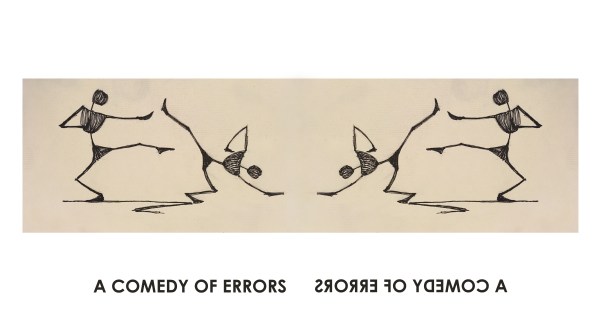
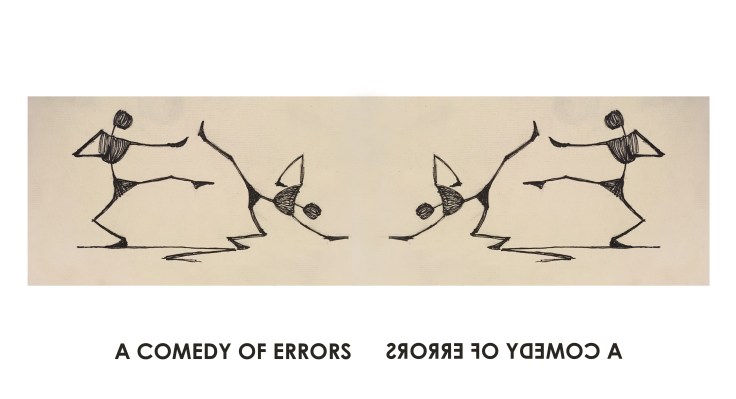
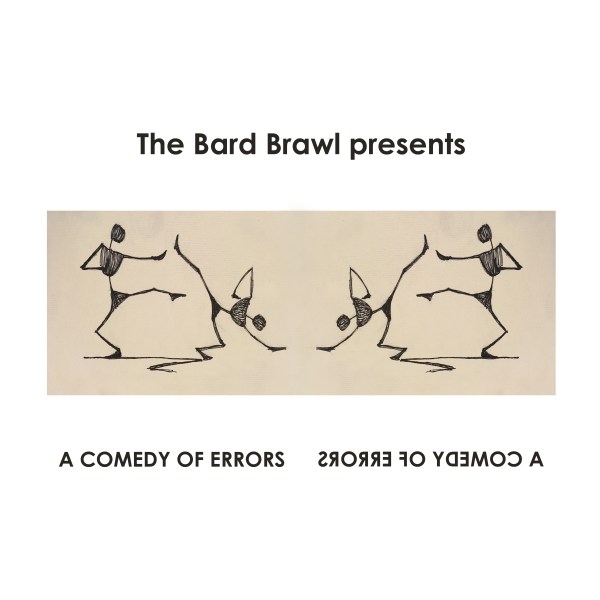
The feature logo for The Comedy of Errors is brought to you by Mezari designer Stephanie E.M. Coleman. We think it’s pretty rad. Check out her event this Thursday in Montreal.
The setting for the Comedy of Error – the city of Ephesus – was an ancient trading city whose power rested on the power of its merchant ships. In this way it’s pretty similar to England in the 17th century. It’s also very similar to some other Mediterranean settings like Venice where a certain merchant ends up indebted to Shylock for a pound of flesh.
Some of these mercantile themes crop up even in a early play like Comedy of Errors.
What’s the setup?
Egeon, father of Antipholus of Ephesus and Syracuse, was found trespassing in the city while searching for his lost son(s). The punishment for that crime is death. Egeon’s story moves the duke but he states that he cannot change the law. However, if Egeon can somehow find his son and come up with bail money then he can go free.
Antonio mentions basically the same thing in Merchant of Venice but explains that the reason the duke cannot overrule the law when confronted by a sad story is that mercantile societies rely on the supposed impartiality of the rule of law:
The duke cannot deny the course of law. For the commodity that strangers have With us in Venice, if it be denied, Will much impeach the justice of his state, Since that the trade and profit of the city Consisteth of all nations. (Merchant of Venice, III, iii, 26-30)
Money keeps changing hands in other way during the play. There’s the whole plot around a gold chain. The merchant keeps asking the wrong Antipholus for cash, the chain is given to the wrong one. The goldsmith needs the payment because he owes money to the merchant who is about to set off for Persia. Seeing as Antipholus doesn’t seem willing to pay, the goldsmith tries to have him arrested for not paying his debts.
The idea of bonds is paramount. It<s not just a matter of keeping one’s word and being honest. It’s also a matter of being good for it, of paying up when the time comes.
Here’s a link to the CBC article discussed in the pod about Indigenous authors trumping the bard in one teacher’s classroom.
And here’s a link to the Wikipedia article for Aimé Césaire’s re-write of The Tempest. (There’s a link on the Wikipedia page to an English translation of the play.)
See you next time!
Brooke Deer (and sister Jessica), brawling Comedy of Errors.
This week we talk proto-feminists, servitude and abuse. And yes, this is somehow still a comedy and this is all very funny, right?
First, we take a look at our twinned servants as they face off in a battle of words to gain access to Antipholus of Ephesus’ house. Dromio of Syracuse and his master are inside Antipholus of Ephesus’ house, but the rightful master has been locked outside while his wife thinks the wrong Antipholus is her husband.
Hilarious.
While this is happening, Antipholus of Syracuse is inside the house macking on ‘his’ wife’s sister, Luciana. She’s freaked out that he brother-in-law is creeping on her and keeps trying to get Antipholus of Syracuse to act like a proper husband. (In this case, like Antipholus of Ephesus.)
I guess it’s kind of reassuring to think that Antipholus of E. might be a pretty decent husband because Adriana deserves it. She and her sister certainly put up with a lot of crap throughout the play for the sake of these two Antipholuses. (Antipholii? Whatever.)
After being brushed off by Luciana, and being forced to play husband to Adriana, Antipholus of Syracuse again describes the city of Ephesus as some sort of dangerous magical place filled with witches and mermaids.
That’s some pretty strongly gendered language for a play in which two sets of men spend all of their time confusing the hell out of all the women around them.
Because we know you’re just too shy to ask but are dying to know, here’s a famous line from this act to memorize:
“How many fond fools serve mad jealousy” – Luciana.
You’re welcome. There may be a quiz in a few weeks. Just saying.
Here’s a link to Shakespeare Kelowna, a company that will be putting on Comedy of Errors May 17-28. If you’re in the area, you should go check it out. If you know of any other companies staging Comedy of Errors, let us know. We’d love to get the work out!
Catch us next week as we continue to get lost in the side-streets of Ephesus with our Dromios and Antopholi! (Antipholuses? Whatever.)
The feature logo for The Comedy of Errors is brought to you by Mezari designer Stephanie E.M. Coleman. We think it’s pretty rad.
Stephanie E.M. Coleman, The Bard Brawl
Welcome to Act I of The Comedy of Errors brought to you by the Bard Brawl. And happy birthday, Will!
We think it’s your birthday, anyway. Although Google may disagree or else feels that you’re not important enough for a doodle this year. I mean, you were baptised on the 26th of April so April 23rd seems like good enough of a guess, right? It also happens to be the day you died on. Weird.
Well, we promised it, and at last we’ve delivered.
Nope, once again it’s not act V of Titus Andronicus, even though you promised you wouldn’t bring it up again.
It’s a brand new play with a brand new Bard Brawl format. Instead of reading out each act of the play in its entirety, we’ve picked out some of our favourite bits. Kind of like a sports highlight reel but unlike this shameful display, or this one, there are no losers and the commentators don’t speak in those awful sports jock radio voices.
In between these speeches, which will be read by a revolving cast of Brawlers, our Bardic talking heads will try to point out what we think is interesting, noteworthy or just plan awesome about each act.
So grab a listen, subscribe and tell us what you think as we go pound for pound with the birthday boy!





 The Bard Brawl