The rumours of Timon’s gold have reached the ears of our Painter and our Poet who, at the start of act V, are camped outside Timon’s cave discussing how they plan on separating Timon from more of his money. Having nothing to actually offer him, they instead decide that they will ask for money in exchange for a promise to deliver on a project in the future. How nice.
They are unaware that Timon has over heard their whole conversation. After letting them squirm and grovel a bit, Timon asks them if they have come to get gold, like the others. They admit that they heard he had money again but that this had nothing to do with why they are at his doorstep. He plays long for a little bit and messes with them before finally chasing them off.
Moments later, Flavius arrives, leading two Athenian senators. It would seem now that they are willing to welcome Timon home. And coincidentally, they need his help to try to talk Alcibiades out of razing the city to the ground. Once again Timon pretends to play along only to flip everything around into some variation of “&@!# off and die!” (Look for some of the choice insults and curses in the upcoming speeches podcast!)
The senators eventually get the message but as they go to leave Timon in peace, he tells them not to return and that this sea-shore shall be his eternal resting place.
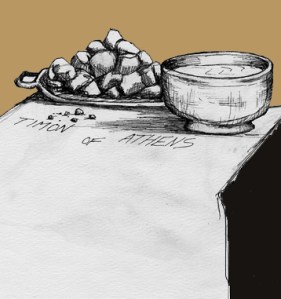
The news of Timon’s refusal is relayed to the city of Athens in scene 2 before turning to a lone soldier by Timon’s cave in scene 3. He expected to find Timon but instead he sees only a tomb. The illiterate soldier cannot reads the inscription so he uses some wax to make of copy of the writing and heads back to his captain, Alcibiades.
The final scene takes place just outside Athens, with Alcibiades’ army ready to besiege and conquer the city. The senators begin to plead with the general. They make the case that while he has just cause to seek retribution against some people in the city, that not everybody is equally guilty of his exile, that they just wanted to give him some time to cool his temper. In fact, it would seem that those people who did him wrong have died of an excess of cunning.
They invite him not to kill everyone but, if he really wants vengeance, to decimate the town instead, as in to kill one in every 10 people. They will not even oppose him. Timon relents and accepts instead to put to the sword whoever the senators will identify as the guilty parties and spare every one else.
At the very end, Alcibiades reads Timon’s epitaph and then enters the city, promising to help sets things right in Athens.
Is there a moral to this story? Was anything accomplished by Timon’s death? I’ll leave that up to you to decide.
Legendary sonneteer Maya Pankalla returns for sonnet 53.
This wraps up our eighth play and our final play of 2013!
Stay tuned for the upcoming speeches podcast. And send us your suggestions for which play you would like us to tackle next!
Join us by contributing to the Bard Brawl journal volume I at our Indiegogo page.
The table is set, the guests drenched in lukewarm water and the flatterers pelted with rocks. It time for act IV of Shakespeare’s tragedy, Timon of Athens!
Welcome back Brawlers. Last show Timon’s ‘friends’ were “touched and found base metal” by his servants so that Timon finally figured out that he was penniless and friendless and that pretty much no one but his servants cared that he was totally bankrupt.
With nothing left for him in Athens by the start of act IV, he decides that all human beings are disgusting, two-faced scumbags and so he does the only sensible thing and runs off to live in the wilderness by himself. Insert litany of curses and well-wishes: may your prostitutes be considered virgins, may the young steal from and beat up the old, may your state be a lawless cesspool fueled by avarice and lust.
So, it turns out that the only friends Timon has are his servants, with Flavius being particularly vocal about how it falls to the servants to try to help Timon out however they can. “Flavour’ Flavious runs off to find and continue to serve Timon at the end of scene 2.
Seems that by scene 3, Timon has moved into a cave with a view, at the edge of some woods, right by the seashore. Seems like things might be looking up for this foraging caveman misanthrope.
As he’s digging for some roots to eat, Timon finds some gold. Timon’s about to bury all of it again when he hears some marching music in the distance. He buries most of the gold but keeps some of it, so he can torment the other humans with it, very likely. Alcibiades, who has been banished from Athens and now gathers up an army to assault the city, wanders by Timon and his cave.
Alcibiades figures out who this is but has no idea what happened back in Athens and why Timon is out here in the woods. Just like we have no idea why Alcibiades is leading an army flanked by two prostitutes. But, seeing as they are there, Timon sees an opportunity to use them in the war effort: he gives them gold and asks them to infect every in Athens with the STDs they are undoubtedly carrying. Timon also gives Alcibiades gold to make sure that he slaughters everyone in Athens. Lovely.
As soon a Alcibiades leaves, Apemantus shows up. They swap insult and wish one another a long and painful life, full of suffering, before they quickly part ways.
When Apemantus exits, some bandits, having heard that Timon found gold, show up to steal it. Timon gives them the gold and sends them off to Athens to rob all of the lying thieves in Athens blind. And maybe slit a few throats while they’re at it.
Finally, Flavius shows up and offers his continued service to Timon. His former master is about to turn him away but Flavius manages to convince him that maybe not every human being is a totally reprehensible entity entirely bereft of honestly and worth. So, Timon amends his position: all of humanity needs to die, except for Flavius.So Timon gives him some money and chases him off.
What’s left now that Timon’s given all of his money away. Again?
With creditors knocking at his door, Timon turns to his friends to lend him a little money so he can avoid bankruptcy. He sends his servants out to see the three lords who he feels pretty confident will be able to bail him out.
Flaminius arrives at lord Lucullus’ house in act III, scene 1. Lucullus greets Timon’s servant warmly as he expects that he is here to deliver some sort of gift. When he discovers that Flaminius is there to ask for money, Lucullus puts on his best ‘I told him not to be so generous’ act and then tries to bribe Flaminius so he’ll pretend he wasn’t able to find Lucullus. Flaminius tosses the cash back at Lucullus then curses him (and all other selfish jerks like him) to be boiled in a vat of molten coins.
The next lord to be visited is Lucilius. By the start of this scene, he has apparently heard that Lucullus refused to bail Timon out. He finds it deplorable and says that of Timon had turned to him instead, he would have been happy to help him. And on that cue, Servilius enters. Lucilius also seems to think that Timon’s servant is here offering gifts at first. When he finds out that Servilius is here to beg some cash for Timon, Lucilius replies that he would love to be able to help Timon out but – wouldn’t you know? – he just spent the last of his available funds this very morning, just before Servilius arrived. What an unfortunate coincidence.
Are all of Timon’s friends flattering jerks? Surely Sempronius isn’t like Lucius, Ventidius, or Lucullus? At the start of scene 3, Sempronius seems disgusted by the fact that the others lords have refused to help Timon. Even worse, Sempronius is disgusted that he wasn’t asked first, as this might suggest that maybe Timon doesn’t like him as well as the other lords. So, if Timon doesn’t care for him as much and his close friends refused to bail him out, why should Sempronius have to help him out? He proclaims to Timon’s servant that any man who would dishonour him in this way won’t get any help from him.
With no one left to ask for money, Timon has locked himself up in his house in scene 4. In a hall in his house, his creditor’s servants want to be paid. Seems that the servants aren’t too keen to be collecting from Timon when they know full well that their masters walk around with the jewellery that Timon once gave them. As they wait, Timon’s messengers return to announce that they have failed to get any money for Timon’s debts.
Timon eventually enters the hall in a rage and is greeted by the collectors’ bills. He offers to pay with his blood and flesh and chases the servants out of his house. Once they are gone, he asks his servants to invite all of his former friends back to his estate for one final banquet.
We leave Timon behind for a moment as scene 5 takes place in the Athenian senate-house and features the general Alcibiades. It appears that one of Alcibiades’ soldiers was involved in the violent crime in Athens. The law calls from his execution but Alcibiades, as his commanding officer, is here to beg the senate for leniency. The senate refuses. When Alcibiades is a little too insistent in his critique of the thanklessness of the Athenian senate, they banish him from the city despite all of the wars he fought for them. This should remind you of another general who was forced to turn his back on his city.
The last scene of the act takes place in Timon’s house. The lords have all arrived for the feats and are commenting that clearly Timon’s need for money must not have been so great as they have heard. Timon greet them all and escorts them into the dining room where for each guest is layed out a covered dish. The lords sit down, Timon curses all of Athens’ flattering lords, and once the covers are removed, each guest sees that their meal is warm water and rocks. Timon slashes the water in their ungrateful faces and then drives them out in a hail of stones.
The craziest part of the whole thing is that none of the lords seems to have a clue as to why Timon would be pissed at them…
Penniless and friendless, What’s next for Timon? Find out next week!
Shout out to the Segal Centre’s production of Othello in its last weekend and the Shakespeare Theatre of New Jersey’s upcoming Pericles from Dec. 4 – 29.
Join us by contributing to the Bard Brawl journal volume I at our Indiegogo page.
Othello, directed by Alison Darcy. (courtesy the Segal Centre)
Daniel J. Rowe
It is one of Shakespeare’s most engaging and intriguing works: Othello, now playing at the Segal Centre in Montreal. It is a favourite of the Bard Brawl and watched with scrutiny by viewers. Check out brawler Eric Jean‘s review. Director Alison Darcy spoke with the Bard Brawl.
Bard Brawl:Othello is huge in scope and theme, and it’s been done a lot. Does that add pressure or do you enjoy that?
Alison Darcy: Both. I think it adds pressure and I kind of enjoy it. Of course everyone has their own ideas about the play and about Shakespeare and how it should be done, and I like the fact that there is no should and this is the way our team felt that it’s truth was being revealed in the most interesting way in the moment. This was what we wanted to offer from it. It’s interesting to challenge people with that because so many people have really strong preconceptions about how Shakespeare should be done. It’s interesting not to necessarily always follow that, but to go with what you think is the truth of the play.
B.B.: In the same sense don’t you find that often people allow a lot more exploration these days then they used to?
A.D.: For sure. Now, it’s almost expected to have your own interpretation, but it’s still, when it comes down to actual technique of the language or certain characters, people still have their reservations and their favourites and their favourite lines and their ideas of what things mean. Before it used to be more stylistically, they would say that it would have to be done in a certain period or a certain focus on the language in a very specific way, accents or whatnot. Now it’s more about interpretation, but still people have their preconceptions and they come out quite ferociously at times. People are quite willing to go to battle to defend their ideas of how Shakespeare should be done. Particularly this play.
B.B.: You use water as a metaphor throughout, and the final dramatic scene was very much centred on it. Can you tell me a bit about why you decided to use water in that way?
A.D.: For me it came from the text. It’s really prevalent in the text – water as a theme. It’s constantly referred to as being symbolically linked with deceit, and with passion. It says, ‘she’s false as water.’ A lot of the major themes are linked to water in the play, and so I was originally already playing with that. I also find that elementally, it’s very connected to the way the play moves. It’s a very quick-paced, mercurial kind of text, and it shifts and changes very quickly as does Iago’s mind and the way he moves and it feels like water to me.
The ending and the way I used the water in the ending? I like to leave it open to debate. People have been very vocal about it. Some people really didn’t like it, and some people absolutely love it. What’s more interesting to me is what people think it means. Some people are just absolutely baffled by it and others have very clear ideas about what metaphorically it meant. I have my own ideas about it of course, but I have no interest in didactically forcing that opinion on anybody else. It’s an allegory or it’s a metaphor and it’s there to be interpreted… It’s what I felt encapsulated that moment for me in the play. The fallout from the climax and the gushing of everything emotionally and psychologically that comes forth in that fifth act.
B.B.: You can’t do Othello without addressing race, but you don’t seem to push that theme far, and in not pushing the race card as far as you could have a lot of other themes emerge like the Emilia feminist line. She was really good.
A.D.: She’s amazing, and maybe it’s because I’m a female director, but I’ve always found the female characters in this play particularly moving. People often kind of hate Desdemona – not this version though, people have I think been liking this Desdemona. I always found it unfair for people to judge the character the way they did and I don’t find historically that Emilia gets her due, as such a strong character. I guess my leaning were in that direction to explore.
I wouldn’t say that I didn’t explore the racism. I think what I did do was change the conversation a bit, so that it wasn’t necessarily racism, but it was more about ‘outsiderism’, which is definitely something that is very strong in the play and they do treat him as an outsider, and I think that the exoticism of him and the separation of him constantly creates a personna that he allows himself to engage in: the story teller, the magnificent warrior that I don’t think he really is. I think he enjoys the language and the story telling, but when it comes down to it I think the insecurity that he has being part of this kind of society that doesn’t ever really accept him is then really used by Iago to draw him out of his safe zone.
I’ve always thought of the handkerchief as being a real symbol of who he is. It’s this ellaborate, exotic, foreign item that is valued for its exoticism and its beauty, and for how different it is. Everyone wants to get it copied. Everyone wants to have a piece of it.
Apparently at the time it was actually very gauche that – if you were within the same social class as someone – to ever show your wealth as being exceeding of theirs, so the only kind of way to make yourself better than your neighbour was to find exotic items and things from far away. It was to have these little secret closet collections.
I’ve often thought of Othello as, in a way, a rarity that’s been collected from a foreign land and brought to Venice and cherished because he’s different and odd. Therefore, his actual self, his sense of real self is muted by this idea of who he is; this exoticism. He even says the way he won over Desdemona was by telling these fantastical stories most of which we know are not true. I think he identifies with that idea of being a curiosity, and he thinks that that is his value.
So then when this handkerchief, which symbolizes the same kind of thing, is so easily dismissed or given away by her, it’s like she’s giving away his identity.
The handkerchief is a symbol of who Othello really is, according to the play’s director. Sean Arbuckle (Iago) – Photo by Andrée Lanthier; (courtesy the Segal Centre)
I feel like the play is really about sense of self and about the way that your identity can be stripped from you due to racism or whatever it may be. I think that’s what destabilizes him, not just the jealousy. Just becoming that jealous, it never really made sense to me, and it’s always a problem people have with the play. Why does he go so crazy so quickly? I feel it’s because Iago knows exactly the precision point how to attack him, and it’s with this sense of self. It’s also because Iago also his sense of self was undermined and taken away when his status as a warrior was taken from him by Othello.
Alison Darcy is the co-founder and co-artistic director of Scapegoat Carnivale Theatre. In addition to directing, producing and teaching theatre, she has been acting professionally since childhood.
Tickets can be purchased from the Segal Center box office, either by phone at 514-739-7944 or directly on the Segal Centre website site. Prices startfrom $24. The play runs until December 1st.
The Segal Center‘s production of Scapegoat Carnivale Theatre‘s Othello is a version of Shakespeare’s play in which the humours of the rain and sea seem to mirror the tempest at the heart of Othello.
Taking their cue from Othello’s accusation that Desdemona is “false as water,” Alison Darcy (director) and Joseph Shragge (dramaturgy) created a version of Othello which highlights the watery imagery which permeates Shakespeare text.
Andrew Moodie is Othello at the Segal Centre. Currently playing. Photo by Andrée Lanthier
As they describe, “water is present in the geography and language” throughout the play in the canals of Venice, the sea at Cyprus, the hypnotic currents of Othello’s storytelling and of course in Desdemona’s tears. This is foregrounded in this production in the ongoing sounds of waves and rainstorms and in the flickering blue light which submerges us in the same dramatic depths as the action taking place on stage.
The bare and unadorned dramatic space is used to great effect. The traditional Renaissance rapier-and-dagger sword fights were greatly appreciated by this Shakespeare and D&D nerd.
The staging of the final act of the play is particularly striking as a drape drops and hangs from the ceiling, serving triple duty as bed covering, curtain and murder weapon. A chilling portrayal of one of Western drama’s most famous homicides.
Despite this strong staging, the play does suffer from uneven acting at times.
As Othello, Andrew Moodie often lacked intensity and presence. In the first scene, when Othello is discovered by Brabantio and his men, Othello admonishes both his men and Brabantio’s to “Keep up [their] bright swords.” However, the delivery of the passage seemed flat, without conviction. While he did deliver some admirable performances at time – the seizure scene in act III springs to mind as particularly noteworthy – Moodie seemed to be searching for his character at various times throughout the play.
Moodie with Sean Arbuckle as Iago. Photo by Andrée Lanthier (courtesy the Segal Centre)
In contrast, Amanda Lisman quickly found her character and, particularly after the first act, delivered a strong performance as Desdemona. However, Julie Tamiko Manning, in the role of Emilia, was one of the stand-out roles of the evening.
Sean Arbuckle’s Iago was also excellent, switching seamlessly between counselling Roderigo to keep sending him money, implanting his poisonous suggestions into Othello’s psyche and playing at being just one of the boys with Cassio.
Maurice Podbrey offered a commanding performance as Brabantio in act I but Paul Hopkins’ Montano was, in my view, the weakest member of the company and made one thankful that he had only a minor part.
While the synergy between Iago and Othello seemed forced at times, the exchanges between Iago and Cassio, as well as those between Emilia and Desdemona, were not only inspired but made the Shakespearean verse seem as natural to the ear as everyday speech. Fortunately, Moodie and Lisman seemed well-matched as husband and wife and if this Othello failed to convince that he could command armies, he could at least persuade that he could charm Desdemona’s heart.
One of the most successful scenes of the production took place in act IV, scene 3 between Emilia and Desdemona. Emilia and Desdemona’s conversation about the infidelities of men, delivered so matter-of-factly by Julie Tamiko Manning and Amanda Lisman only a few moments before Othello arrives in the bedroom, perfectly captures and prepares the tragedy which is about the follow.
Despite its’ imperfections, this production of Othello remains a very successful staging of Shakespeare’s text and one definitely worth seeing.
Or why not offer the gift of jealousy and murder for the holidays this year?
Tickets can be purchased from the Segal Center box office, either by phone at 514-739-7944 or directly on the Segal Centre website site. Prices start from $24. The play runs until December 1st.
What did you think of act I? Kind of makes you want to have a good look at your own friends, doesn’t it?
Nonsense! You are rich in your friends, aren’t you? 😉
While the party’s in full swing within, a Senator arrives at Timon’s gate at the start of act II, scene 1. He’s disgusted that Timon should spend so much money on parties with his friends while he has outstanding debts to this senator. The Senator commands his servant Caphis to take debt bonds to Timon and not return until Timon pays up. The senator suspects that, when the money runs out, so will Timon’s friendships.
Flavius is just complaining about Timon’s careless spending when Caphis walking in to scene 2, speaking with Varro and Isidore’s servants. These men are also looking to collect on some outstanding debts. They intercept Timon as he returns from hunting. Timon tried to talk his way out of it but Caphis reminds him that his money was due six weeks ago and won’t take no for an answer. Flavius promises to deal with it for them right after supper and ushers Timon away.
The servants hang back to be made fun of by the Fool and Apemantus who, as Daniel points out, seem to be competing for the job of “guy who gets to say whatever he wants to Timon’s ‘friends’.”
After hearing about the current state of his finances, Timon tries to blame Favius for not mentioning any of this sooner. Flavius of course tell him that he tried to but that Timon wouldn’t hear it before. And now, even if Timon were to sell everything he has, that would only be enough to pay back about half the debt. While Falvius freaks out Timon calms him down and reminds him that as he has so many friends in good financial situations surely a few of them will be willing to help bail him out of this. But, turns out that Flavius has already approached some of these friends who gave him a bunch of excuses as to why they couldn’t help Timon. No big deal though: Timon’s buddy Ventidius – who he bailed out of jail in act 1 – just struck a rich inheritance so he’s sure that he’ll be more than happy to help out Timon.
Here are some of the characters introduced in this act:
Senator: This senator has lent money to Timon who does not appear to be in any hurry to pay him back. He comes armed with his legal documents to collect his debt.
Caphis: A servant to the Senator who comes knocking at Timon’s door to get the money he is owned.
Timon of Athens is a tragedy set in – you guessed it – Athens. Timon is a well-loved aristocrat who is extremely generous with his wealth. In other words, he’s a sucker surrounded by sycophants but he’s the only one who doesn’t see it.
First order of business, this is how you pronounce Timon’s name: /ˈtaɪmən/.
Seeing as that’s basically gibberish, here’s a clearer pronunciation guide: it’s Timon like Simon, not Timon like Timon and Pumba.
Moving on.
Only two scenes in this opening act but they cover a lot of ground. The play opens on a scene set inside one of the (probably richly appointed) halls of Timon’s house in Athens. A painter, poet, jeweller and merchant are discussing the fact that they each are hoping to win Timon as a patron, or to sell their products to him at an inflated price. We learn that this appears to be common practice and that Timon seems to operate under the motto of ‘no unreasonable offer refused.’
Eventually Timon arrives, followed by a messenger who tells him that his friend Ventidius is about to be carted off to debtor’s prison because he’s been unable to pay his debts. (Yes, unpaid invoices used to result in jail time, indentured service or flat-out slavery.) Of course, Timon cannot let his friend go to jail so he accepts to pay the debt on his behalf and asks the servant to bring him to dinner so he can eat the shirt of Timon’s back as well.
Hot on the heels of the this messenger comes an old Athenian gentleman who is upset because one of Timon’s poor servants wants to marry his daughter. No problem for Timon; he offers to match the dowry offered to allow Lucilius to marry her. No sooner has the old man walked off that the painter, poet, jeweller and merchant swoop in. However Apemantus, an ornery Athenian lord, calls them out for their self-interested flattery. Timon accuses Apemantus of being an arrogant and proud ass; Apemantus calls Timon out for being a sucker who spends his money buying false friends. (Apemantus is still going to eat Timon’s food though, and Timon isn’t going to kick Apemantus out for berating his guests.)
Scene II features the actual banquet itself. A bunch of lords and senators of Athens are in attendance, partying it up on Timon’s dime. Ventidius is there and thanks Timon for his hep in bailing him out of jail. In this short span, he has had a sudden and mysterious windfall: his father died and Ventidius inherited his fortune. He offers to pay Timon back twice the amount of his bail but Timon refuses to take his cash. In fact, he says, his bank account is always open for his friends.
More banter between Apemantus and Timon ensues and Timon threatens to banish Apemantus to the kiddy table. Timon then starts making speeches about how great his friends are and how he’s lucky to be able to take care of all of them. Some women dressed as Cupid and some Amazons then arrive to crash to party. After a dance, Timon feeds them too.
In the mood to hand out more gifts, Timon calls his servant Flavius to bring him a box of jewels. It would seem that Timon is in the habit of giving more than he can afford. Flavius tries to warn him that he’s broke even as he’s handing out jewels like they’re business cards. The party wraps up with everyone running off with their loot. Only Apemantus remains and he tries to get Timon to see that’s he’ being taken advantage of. Timon, of course, refuses to see it.
With that , here’s a short list of the major characters appearing in this act.
Poet, Painter, Jeweller and Merchant: Their titles pretty much sum it all up. These aren’t really fully fledged characters but are there to give Timon opportunities to give out more money than he can afford.
Timon: A naive and generous Athenian lord who’s not quite as wealthy as he thinks he is, in both his friends and his funds.
Apemantus: Honestly, Apemantus is a bit of a jerk. Is he right? Yes. Timon is being taken for a ride by all of his so-called friends. However, if your ‘friend’ was trying to point out your mistakes by being a sarcastic jerk, how likely would you be not to tell him to f-off? There’s a difference between flattery and tact, Ape-Mantis! (Sorry, I can’t help thinking ‘Godzilla vs Ape-Mantis’)
Alcibiades: He’s an Athenian general recently returned from battle. He’s actually one of Timon’s real friends.
Ventidius: This is the guy Timon bails out of jail. And who we now know is rich because his dad died and he inherited the fortune. Remember that because it might come back later.
Flavius: Timon’s servant and, it would appear, his chief bookkeeper. He’s the only guy who seems to know just how little money Timon actually has.
Surrounded by great friends, full of food and wine, where else could this play go but down, down, down! Should be entertaining.
Terry stopped by to give his interpretative reading of sonnet 38. Trust me, you want to stay for this one.
Stay tuned, Brawlers.
Join us by contributing to the Bard Brawl journal volume I at our Indiegogo page.
Welcome Brawlers – at long last – to the speeches podcast of King Lear!
King Lear is such an amazing play, filled to the brim with memorable speeches and scenes that we could have practically taken moments at random in the play and just posted that up. Instead, we decided to let you do the work for us.
Thanks, by the way. We appreciate it. We’ll pay you back later when we go viral.
“Hear me, my lord.”Act II, scene 4, lns 261-286 (Thanks to @everydayshakes for the suggestion!) Speakers: Goneril, Regan and Lear
In this scene, Lear is berating his daughters for wanting to take away his entourage. They state that he shouldn’t need them because they have servants to take care of him. lear, however, responds to them by pointing out that without those desires and wishes for things which are not strictly necessary for survival, nothing separates us from beasts. As he mentions, his daughters don’t need jewelry and fancy dresses to survive and yet they want them just the same. So, as he says, don<t ask me why I want these knights – I want them because I want them.
“These late eclipses in the sun and moon portend…”Act I, scene 2, lns 104-133 (Thanks to @theshakesforum for the suggestion!) Speakers: Gloucester, Edmund
Gloucester is giving us a lesson in astrology. He’s explaining that it’s only normal that the kingdom is being turned inside out given that the starts are themselves all out of whack. He appears to see disaster for humanity in every celestial event. As soon as he walks off-stage, Edmund tells us how he feels: what the hell does the day you were born on have to do with the decisions you make. You are the way you are because you choose to be, not because of some accident of birth.
“Away! the foul fiend follows me!”Act III, scene 4, lns 47-70 Speakers: Edgar, Lear, Fool, Kent
This is one of the many scenes where Edgar puts on his crazy hat and pretends to be Tom O’Bedlam, a wandering, mad, demon-haunted beggar. Why is he doing this/ To hide from Gloucester and everyone else trying to kill him. Parental advisory: includes a joke about nudity.
“Wisdom and goodness to the vile seem vile.”Act 4, scene 2, lns 39-69 Speakers: Albany, Goneril
The armies of France have landed in England and everyone is rallying to meet them on the field. Or, everyone except for Albany who has realized that Goneril is evil and that to fight on their side is basically to fight against Lear. In the end, he does decide to take to the field because he decides that English sovereignty is more important than this Goneril/Regan vs. Lear business. Here, Goneril is trying to get him to fight by calling him a pussy – “mew.”
“Howl, howl, howl, howl! O, you are men of stones.”Act V, scene 3, lns 263-319 Speakers: Lear, Kent, Edgar, Gentleman, Messenger, Albany
lear walk on stage holding the dead (?) Cordelia in his arms. Is this really how this is going to end? Don’t they deserve to be together one last time? Unfortunately, it is not to be and she is gone. We were going to include only the opening section but it’s such a powerful scene that we figured, what the heck: let’s let it run to it,s bitter end.
Next week (and it will be next week this time), something a little different from master Shakespeare? Something involving a shipwreck, maybe? And a happy ending?
To quote Kent: “Is this the promised end,” where Cordelia and Lear are reunited and live together for a few more years, where Lear is restored and we’re spared the worse case scenario?
In a word, nope.
In scene 1, Edmund and Regan are discussing whether or not Albany will have taken to the field or not; it seems that he has been wracked with doubt and remorse for his part in Lear’s mistreatment. They send a messenger to check on the news. Regan then asks Edmund if he truly loves her and not Goneril. She makes him swear to never have any private discussions with her and the sudden arrival of Goneril with Albany. Of course, the first thing Goneril says is that she would rather lose the battle than Edmund. Seems that Albany has chosen to take to the field in the end, motivated by what he sees as a French invasion to which they should all be opposed.
They all leave save Albany and Edgar shows up in disguise. He gives him the letter incriminating Goneril and Edmund – the one he was so conveniently was given by Oswald, remember? He tells him to read the letter before they take the field. Then, if they should win, to sound a duel so the disguised Edgar can bring his brother to justice.
The last word of the scene belongs to Edmund, however, as he considers his situation: he`s promissed to marry both. He’ll make use of Albany’s army for now but figures that once the battle is done, which ever sister wants him more can figure out how to get rid of Albany. We also learn that Albany intends to pardon Cordelia and Lear once the fight is done. Edmund can`t have any of that and plans to eliminate them.
The next scene is short exchange between Gloucester and Edgar which takes place while the battle rages around them. Edgar first makes Gloucester take shelter beneath a tree and promises that, should he survive the fight, he will take care of his father. Unfortunately, the battle does not go their way and Lear and Cordelia are taken prisoner. Edgar returns and tries to take his father with him to safety, but his father just wants to lie there and die. Edgar reminds him that the right thing to do is to endure this life until it is out time to go. Gloucester begrudgingly agrees and they leave.
Can it get any worse? In the words of Edgar, yes: “And worse I may be yet: the worst is not / So long as we can say ‘This is the worst.'”
Very uplifting stuff.
Bring on scene 3, the final scene of the play. Edmund orders Lear and Cordelia taken into custody. Lear is happy enough to simply be able tp spend his final days with his one honest daughter, even if it should be in jail. They are taken away. As soon as they are gone, Edmund sends a messenger with the order for their execution. Albany and the others come on the scene and Albany asks for Edmund to turn over the prisoners to him. Edmund tells him that he ordered them taken away but they can address this tomorrow. Albany does not approve of his temerity and calls him on his lack of authority: “Sir, by your patience, / I hold you but a subject of this war, / Not as a brother.” Or, in other words: “who the hell do you think you are?”
Regan is quick to defend her champion Edmund, stating that he basically has whatever authority Regan decides she wants to give him. In fact, she declares Edmond her husband and master. Albany tells him them that this decisions really isn’t theirs to make (Albany outranks the others because he is married to the eldest daughter. That should technically make him the next king and the king has the right to veto his family’s marriage plans.) Regan charges Edmund to fight Albany for his right but Albany instead arrests him. He shows them the letter and tells Edmund that there is someone here to challenge these claims.
Sure enough, at the third sound of the trumpet, Edgar (still in disguise) shows up to challenge Edmund, accusing him of being a traitor to his brother, father, country, gods and pretty much anything else you can think of. Edmund technically could choose to fight this duel because the challenger is not clear, but he decides that Edgar looks noble enough so says, “what the heck” and accepts the challenge.
Edmund was willing to use all the tricks to get his hands on the throne earlier but now he won’t use a legal technicality to avoid a fight. Why not? Pride? Again, who the hell knows.
Either way, they fight and Edmund falls.
Albany then accuses Goneril of being in on the plot and shows her the letter, which she does not deny. He sends someone after her because he seems worried that she will kill herself. Edmund acknowledges his crimes and asks to see who his challenger was. Edgar finally reveals his identity and is embraced by Albany. When Edgar explains how he hid himself, we learn that Gloucester dies of shock of the news of Edgar’s survival. He also explains that Kent was Caius, who had returned to watch over his king despite his banishment.
A messenger arrives with news that Goneril has stabbed herself but not before poisoning her sister Regan. That seems to jolt Albany into the sudden realisation that they totally forgot about Cordelia and Lear who are probably being murdered as they speak! Edmund decides that he wishes to atone in some small way for his actions (for no reason that I can tell) and gives them his sword to show to the captain so their lives might be spared.
As Edmund is being led off, the messenger runs off to deliver the message. Will he make it?
Lear walks onto the stage, holding Cordelia in his arms. Is she dead? Is there some life left in her? As Kent asks, is this death, or an image of death? While he seems to think that she is dead at first, he desperately wants her to still be alive. Lear himself killed her would-be executioner but was he able to do so in time. The audience at this point is likely expecting her to wake up. As we’ve discussed, the Lear story has been around for a while before Shakespeare, and in it Lear and Cordelia get to live together for a while before he passes away peacefully. But not here.
Despite his pleading, she’s gone and nothing can bring her back. We then learn that Edmond has killed himself but that hardly seems to matter. Lear finally dies next to his daughter. With this final scene, Kent walks off and Albany leaves the realm in Edgar’s care.
For over 250 years this ending was thought to be so bleak that the only version staged was a version re-written by Nahum Tate where Cordelia survives and married Edgar.
Everybody is dead, Lear’s line is ended and even his “poor fool is hanged.” What does all this mean? Is it even supposed to mean anything?
Join us next week where we look at speeches from King Lear and try to make some sense of the carnage.
Also, check out Dalya Alberge‘s Guardian article against the Bard Deniers who have been trying to prove he never wrote anything for the last decade.
If act III is the height of the storm, then act IV of King Lear takes us on walk through the devastation after the hurricane winds have begun to let up… sort of.
In the last act, Lear was cast out into the wilderness by his daughters. Gloucester was betrayed by his son Edmund and blinded by the cruel Cornwall and Regan. As for the fool? He’s wandered off-stage, never to be seen again.
In act IV scene 1, Edgar – still in disguise as Tom O’Bedlam – encounters his blinded father by the heath where he had previously taken shelter with Lear, Kent and the fool. When Edgar sees what has become of his father, he is moved to pity but somehow manages to keep up his disguise and offers to serve as his eyes. Gloucester pays Edgar to lead him to the cliffs of Dover. Gloucester’s intention is plain: he means to jump to his death.
It seems that Kent’s message made it to Cordelia and she is headed for England with an army from France and intends to reclaims the kingdom from her sisters and rescue Lear. Goneril, Edmund and Oswald are discussing the preparations for war at the start of scene 2. However, it seems that not everybody is equally committed to defend this territory from Cordelia’s armies. Albany appears to be all too happy that Goneril and Regan’s control of England is being threatened and appears to have very little intention of fighting. Fearing that she cannot trust her “Milk-liver’d man” Albany, Goneril places Edmund in charge of her forces. Additionally, she gives him some token of her affection to indicate that she has no love for Albany. of course, moments later Albany himself shows up to answer these charges of cowardice and instead accuse her of being cruel and heartless. When he hears that Gloucester has lost his eyes, he vows to avenge him.
By scene 3, the French forces has landed at Dover and made contact with Kent. We learn that the King of France has not accompanied this army as some pressing business called him back to France. We also learn that Cordelia was genuinely moved by Kent’s letters about her father. Surprise, surprise: she’s Lear’s good daughter. Kent informs them that Lear is in Dover and he leaves to bring him back to Cordelia.
The next scene is a short exchange between Cordelia and the doctor. He also sends out more men to find lear and bring him back. Cordelia asks him; can Lear be cured? The doctor appears confident that he can do so. Towards the end, a messenger arrives to inform Cordelia that the English forces are marching. She is ready to meet them and confesses that she is not here to conquer England but because she loves her father.
Oswald has made his way to Regan’s castle in scene 5. She asks about whether or not Albany’s forces has joined the battle on their side. Oswald says yes, but that Goneril is a better soldier as she is more committed to the cause. Regan also asks Oswald about a letter Goneril is asking him to deliver to Edmund. A jealous Regan asks about the contents of the letter but Oswald denies any knowledge of the contents. Regan does not seem convinced. She tells him to put Goneril on guard: she wants Edmund for herself and seeing as Cornwall is dead (did we miss something?), she’s a better match than she is. She also gives him a note to deliver to Edmund.
Edgar has lead Gloucester to the fields near Dover in scene 6 but he has no intention of letting his father commit suicide. Instead, Edgar vividly describes the imagined view from the cliffs of Dover to convince his father that they are at the right spot and then tells him to jump. However, Gloucester only falls a few feet and is greeted ‘at the bottom of the cliff’ by Edgar posing as some random passer-by. He acts amazed and tells Gloucester that his life has been miraculously saved when he flew down the cliff instead of falling. Edgar also describes how he appears to have jumped and escaped some devilish influence personified by the deamon-hunted Tom O’Bedlam.
That’s a really interesting scene. So much of Shakespeare’s theatre is descriptive. We’re not really used to this. Motion pictures can – and do – show us everything. If we were to depict this in a movie, there’s a good chance that we would see Edgar and Gloucester in what could pass for the fields outside Dover. Maybe Gloucester is standing on a small rise in the field – just high enough so he can feel like he’s falling for just a second before hitting the ground when he jumps. Perhaps we can actually hear the sound of the cliffs in the distance – or something that could pass for it. However, the whole point of this scene is that there’s nothing like that. It’s entirely dependant on Edgar’s description for its effect.
In some ways, maybe our eyes are getting in the way? Gloucester seems to think so.
Shakespeare often embeds these descriptive moments in his plays: he’ll tell us what time of day it is, have dialogue about where the action is supposed to be taking place, or even tell us what the weather is like. But really, it never happens on stage, it’s all in our minds just like Gloucester’s attempted suicide happens only in his mind.
And yet, in the same way that Gloucester’s make-belive miracle has made him stop thinking about suicide, these made-up scenes have lead us to think about suicide, suffering, infirmity, old age and madness. This scene is an elaborate argument in defense of the power of literature and storytelling.
Very meta. Very Shakespeare.
After this moment, King Lear wanders on stage. He is rambling about how he is the rightful king and how that is a title his daughters cannot take away from him. In fact, part of the evidence he points to is that his face is the mark of legal tender: it shows up on British money. Gloucester and Lear recognise one another and spend some time commiserating. Cordelia and Kent’s people find Lear and bring him off-stage towards Cordelia’s camp. Edgar and Gloucester remain behind. Oswald arrives on the scene and remembering what Regan told him earlier – that she wished she’s killed Gloucester after they blinded him – decides to kill Gloucester. Edgar interposed himself and stats speaking in a funny Eastern European or evil Bond villain accent.
They fight and Edgar kills Oswald. With his dying breath, he tells Edgar that if he’s looking to advance his station, he should deliver the letters Oswald is carrying to Edmond.
Why does he tell him this? Who the hell knows.
However, it’s just what you would expect at this point: the scene where the villain’s evil plot is completely revealed to the hero and the audience, thereby giving them the tools they need to oppose the villain. We learn that Edmund has made deals with both sisters and that the two sisters are planing on betraying one another for his sake. Edgar keeps the letters as evidence. He also finally reveals his identity to his father.
At long last, Lear and Cordelia are reunited in scene 7. It seems that the doctor has successfully cured him of whatever madness had possessed him. Cordelia thanks Kent for his loyal service and offers to proclaim his part in keeping Lear safe but Kent asks her not to, explaining that he still needs to keep his disguise for a while longer. After a few moments, Lear awakens. He is confused by the clean clothes he has on and believes himself to be dead for a few moments. He tells Cordelia that if she wants to be rid of him, he will gladly kill himself but she reassures him and they walk out together. Kent confirms Regan’s earlier statement: seems that Cornwall was killed but it’s not clear how he died… And I’m sure that Regan had absolutely nothing to do with that.
What’s going to happen next? I won’t give you any specifics, but I bet you’re not going to like it.
Tune in next week for the dramatic conclusion of King Lear! (And I can assure you that it will be dramatic!)





 Alison Darcy is the co-founder and co-artistic director of





 The Bard Brawl