BB: King Lear, Act I

Artwork - Leigh MacRaeArtwork – Leigh MacRae

Listen to or download the podcast.

Welcome Brawlers to the Bard Brawl’s recording of the first act of this, our fifth play.

And what a play it is! This is no Taming of the Shrew or Henry VI, part 1, scrappy dramatic undercards who hang in there on pure grit and desire despite their faulty technique and poor conditioning.

No. This is the main event, ladies and gentlemen.

Along with such plays as Hamlet, Julius Caesar and Othello, this one is a serious contender to the title of best play ever written, folks.

Get ready for King Lear!

Without further ado, then, let’s ring the bell!

The play opens in act I, scene 1 with Gloucester and Kent – two nobles of Lear’s court – talking about Kent’s son Edmond. There’s a lot of wordplay centering on the fact that Edmond is Gloucester’s bastard son (and no one seems to care that he’s standing right there listening to the whole thing). More importantly, we learn that King Lear’s about to do something completely nuts: he’s going to abdicate the throne, turn over the lands to his daughters and ‘retire’ with a hundred knights, which the daughters will be responsible for upkeeping. This is already a little sketchy but here’s the really crazy part: he decides to give the biggest or best portion of his kingdom to the daughter who loves him most. And so he has them take part in a ‘sucking-up-to-dad’ competition. Goneril and Regan jump right into it but Lear’s youngest daughter Cordelia refuses to play the game. Despite being Lear’s favourite, the old man misinterprets her silence as ingratitude and decides to deny her any land at all. He redistributes that portion between his two other daughter. Kent, his most loyal retainer, tries to reason with him but he is banished for his honesty in a fit of range in which lear speaks on of the most famous line of the play: “Peace, Kent! / Come not between the dragon and his wrath.” (Sends shivers down my spine, that line. We should all start using it in daily speech. Just saying.) After Kent is banished, Lear calls in Cordelia’s suitors, the Duke of Burgundy and the King of France. After they learn that Cordelia has been stripped of her dowry (a third of Lear’s lands), Burgundy rejects her. The King of france, however, recognises the value of her honesty and agrees to marry her. Whew – it’s on!

Actually, does this remind you of anything a little more recent, too?

As the first and legitimate son, his brother Edgar is in line to inherent all of Gloucester<s lands and titles. Of course, Edmund is not about to just take that lying down and t the start of scene 2, we surprise Edmond musing to himself and plotting to get his brother out of the picture. The world think’s a bastard is a bastard? Well, then he’ll show them a bastard they won’t soon forget. He forges a letter which is supposed to be written by Edgar and which discusses a plot for the two brothers to team up and kill dad. Then, the letter adds, when dad’s out of the picture and Edgar inherits everything, he’ll cut Edmund in for half. He fakes hiding the letter which just makes it irresistible to Gloucester who buys into the whole thing. Part two of the plan involves getting rid of Edgar so he can<t go to dad and say his jerk of a bastard brother made the whole thing up. So, Edmund takes Edgar aside and makes up some story that their father wants him dead because he suspects that Edgar is trying to kill him. Edmund tells him to run the hell away and that he’ll try to dead with Gloucester for him. Edgar runs off.

See how all this talk of bastards and inheritance is mirrored in the two main plotlines? Shakespeare gets to be really good at this stuff by this point in his career. Moving right along.

Act I, scene 3 is short but vital. Lear mentioned earlier that not only would he have a hundred knights in his entourage at all times but that he would split his time living with each of his daughters in turn. However, when Goneril hears that Lear has apparently hit her servant, she decides that she’s had enough of Lear and his rowdy knights. When she hears that they are making their way to her castle, she instructs her servant Oswald to be negligent in serving Lear. this way, she can trick Lear into giving her justification for reducing the number of his entourage. Lot of clever people in this play.

Despite being banished by Lear earlier, it’s clear from the start of scene 4 that he has no intention of abandoning the old king now. He disguises himself and offers his services to Lear who accepts. Oswald arrives and informs lear that Goneril and her husband Albany will not be greeting him because they are sick. One of Lear’s knights points out that they’ve totally been dissed. Lear hits Oswald who takes issue with that but Kent steps in and shows Oswald out of Lear’s presence. Lear calls his fool to him and as soon as he arrives on the scene, the fool lays into Lear. All of his arguments basically come down to this: “You crazy old coot! By splitting your crown and kingdom into pieces, you’ve left yourself with nothing. Even I’m better off than you are because while you’re not a king anymore I’m still a fool.” Something like that. After quite of bit of this between Lear, Kent and the fool, Goneril shows up and she’s pissed. She asks Lear to reign in his entourage and to wisen up. He of course refuses and gets insulted, but of course there’s nothing he can do about it now. She tells him he;ll have to downsize his entourage to fifty knights. Not happy at all about any of this, he says ‘the hell with this’ and decides to go see Regan who he hopes will treat him with a bit more respect. Goneril, however, has already sent off a letter to her sister and they’ve both agreed that they’ve had enough of their father and his buddies watching the Habs game and getting drunk on their dollar. I think we can see where this is going.

In the final scene of the act, Lear sends Kent to Gloucester with a letter explaining what has happened at Goneril’s and telling him to expect Lear shortly. (Seems that Regan and her husband Cornwall are staying at Gloucester’s castle at the moment.) The rest of the scene is an exchange between Lear and his fool. While Lear hopes that Regan will give him a warmer welcome, the fool predicts that she’ll be just like Goneril. Then, for a brief moment, Lear seems to realize how much he has wronged Cordelia when he stripped her of her share of his lands and banished her to France. The fool interrupts him and rubs a little salt in the wound by reminding Lear that it was a really dumb move to give up his house as now he has to live at the mercy of merciless daughters.

We’ll get into the succulent barbecued meat of King Lear in our next post but in the mean time, as always, here’s a list of some of the main characters appearing in King Lear:

  • King Lear: The aging King of England. He has no sons so decides instead to retire and split the kingdom between his three daughters.
  • Goneril: Lear’s eldest daughter. She is married to the Duke of Albany.
  • Albany: Goneril’s husband. A bit of a pushover with a good heart. Nowhere near the ruthlessness of Cornwall.
  • Regan: Lear’s second daughter and arguably the meanest of the bunch. She is married to the Duke of Cornwall.
  • Cornwall: Regan’s husband. Like her, he’s a ruthless and sadistic.
  • Cordelia: Lear’s youngest daughter. While she loves him the most, she is disowned by her father because she refuses to indulge in flattering him.
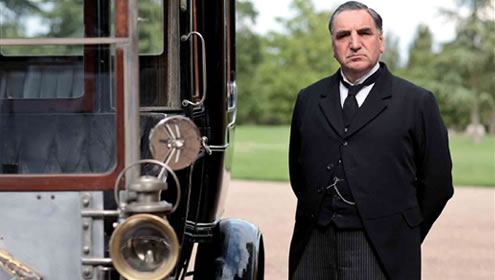
  • Kent: One of Lear’s oldest and most loyal advisors, he continues to serve Lear in disguise after he is banished. Stephanie points out in the show that Kent’s kind of like a Mr. Carson from Downton Abbey. You know, this guy – Mr. Carson as Kent?
  • Fool: This is Lear’s fool or court jester. One of Shakespeare’s best fools.
  • Oswald: A servant to Goneril and Regan.
  • Gloucester: A nobleman of Lear’s court, and the father of Edgar and Edmund. While loyal to Lear, he’s unable to help him and pays a high price for trying to do so.
  • Edgar: Gloucester’s legitimate son who is being framed by Edmund. He is loyal to his father and like Kent with Lear, he disguises himself to stay near Gloucester.
  • Edmund: Gloucester’s bastard son. He plots to overthrow his father and eventually tries to play the two sisters against each other in the hopes of being king.
You might have noticed that a crap ton of stuff happens in this act? Well, get used to that pace because the intensity’s about to get ramped way up for act II.

Check out Jessica Winter’s article on Lear for Slate Magazine that was mentioned in the podcast.

Bonus sonnet 19 read by Kayla Cross.

IMG_2902

Stay in Touch Brawlers!

Follow @TheBardBrawl on Twitter.

Like our Facebook page.

Email the Bard Brawl at bardbrawl@gmail.com

Subscribe to the podcast on iTunes

King Lear (1987), Jean-Luc Godard (director)

Zoey Baldwin

An Attempt to Wade Through Jean-Luc Godard’s King Lear

Before watching Jean-Luc Godard’s King Lear, I was a bit wary of the film’s length. How on earth did Godard manage to condense Shakespeare’s seventh-longest play into 90 minutes?

In short: he didn’t. Godard’s 1987 adaptation hardly resembles the Bard’s original work. But I don’t think that was the director’s intention. French cinema’s most revered, revolutionary (and occasionally reviled) filmmaker turned a tragic piece of theatre into an exploration of art as a whole. Which works in theory, but in execution is dense and bewildering.

Godard’s rendition is set in a post-Chernobyl world. All traces of art have been destroyed. Peter Sellars (not to be confused with the Peter Sellers of Dr. Strangelove fame) plays William Shakesper Junior the Fifth, a Bard descendant who has been charged with restoring the work of his ancestor. (Yes, the spelling of Shakespeare is off, but I looked it up on IMDb and apparently this is what the director intended.)

In a parallel and occasionally overlapping storyline, a woman named Cordelia (Molly Ringwald) and her father, a Russian mobster named Mr. Learo (Norman Mailer) are at a coastal resort. Shakesper appears to be in and out of the same resort, and Cordelia’s relationship with her father inspires him. Shakesper borrows words from their conversations (which he creeps on in cafés) to craft the lines in his restored King Lear. After a while, however, we are not sure whether Cordelia exists, or if Shakesper has invented her.

He sums up Cordelia’s relationship with her father in a way that mirrors my own confusion about the film: “Obviously this man was power. Obviously this girl was virtue. They’re fighting. I don’t know what the issue is.”\

Most of what has been preserved of Shakespeare’s Lear exists in the film in the form of voiceover. Many lines are uttered in the film, sometimes simultaneously, often behind unmatching images. Lear’s “You must bear with me, I am old and foolish” (Act IV, sc. vii) and the fool’s “Have more than thou showest, / Speak less than thou knowest, / Lend less than thou owest, / Ride more than thou goest, / Learn more than thou trowest, / Set less than thou throwest” (Act I, sc. iv) make eerie appearances. The words are often presented in an ominous fashion, whispering behind images of flickering candles and medieval paintings of angels.

Another aspect of the film that must be addressed is the narrative device of tableaus. Occasionally, words will flash across the screen: “King Lear : A Study,” “3 Journeys into King Lear,” “King Lear: Fear and Loathing,” “Nothing”  and “No Thing” are a few that we see.  These devices are used to mimic the human thought process of rediscovery, perhaps.

The idea of “nothing” and silence is a major concept throughout the film. At the beginning of Shakespeare’s King Lear, the king is old and has decided to divide up his kingdom amongst his three daughters. He will give the largest portion of the kingdom to the daughter who most convincingly swears her love. Goneril and Regan sing their father’s praises, but Cordelia, the youngest daughter, says nothing. The Godard film focuses largely on this notion.

The Shakesper character sums up the weight of Cordelia’s refusal to suck up to her father quite nicely. He describes her silence as “a violent silence”: “But Cordelia is not mute. It’s not that she hasn’t said anything. She has said nothing. No thing. Everything that conspires and organizes itself around her silence, that wants to silence her silence, this produces violence.”

There is also a segment of the movie (which is not in any kind of logical order) where Shakesper journeys into the woods and meets a man named Edgar (Leos Carax), another Lear character, sitting by the water. Edgar and his girlfriend Virginia (Julie Delpy) aid Shakesper on his path to discovery. It seems like these two people are meant to represent the simple minds we would all have if no art existed in the world.

Art makes us think and explore levels of reality. I feel like Godard is trying to make his audiences see the value of interpreting art in your own way and not just swallowing one artist’s vision.

But talk about avant-garde—yikes.

Godard’s King Lear is not suited for impatient viewers. I spent most of the 90 minutes scratching my head and struggling with the overwhelming cacophony of sound. The entirety of the film is punctuated by the sound of screeching seagulls, car horns and violent string music. This is only addressed at one moment, where Shakesper happens upon a crazy professor, played by Godard himself, and asks: “There’s a lot of noise around here, huh? What’s it for? What’s it all for, professor? Please!”

In case you hadn’t guessed, the professor never answers. Godard never tells us what any of it is for.

And, of course, like any deep film, King Lear closes with Woody Allen as a character named Dr. Alien, who edits all of Shakesper’s film that materialized out of nowhere on the ground in the woods a few minutes earlier.

Oh, and SPOILER ALERT, Cordelia dies.

There’s a repeated shot of her splayed out like Jesus on the beach in a white gown. Her father sits holding a large stick and looking out over the ocean.

“King Lear: a cLEARing” flashes across the screen. A seagull squawks in an attempt to pierce my eardrums.

Shakespeare would have been proud…?

<object width=”410″ height=”341″ id=”veohFlashPlayer” name=”veohFlashPlayer”><param name=”movie”

Zoey Baldwin is an unabashed grammar nazi, procrastibaker and television addict. She attended Shakespeare camp for five summers in her native California because she is allergic to mosquitoes. She’s in her last semester of the journalism graduate diploma program at Concordia University.

Stay in touch, Brawlers!

Follow @TheBardBrawl on Twitter.

Like our Facebook page.

Email the Bard Brawl at bardbrawl@gmail.com

Artwork - Leigh MacRae
Artwork – Leigh MacRae

BB: Short Poems, sonnets 1-17 Complete

Artwork - Leigh Macrae
Artwork – Leigh Macrae

A special treat today for those who like their poetry commentary-free: we’ve gathered up the first 17 sonnets together into one recording. If you haven’t had a chance to listen to these sonnets in order, here’s your chance!

Listen to Shakespeare’s first 17 sonnets – here

Download the podcast.

For further discussion of the sonnets, visit past podcasts/blog posts below:

Sonnets 1-5

Sonnets 6-11

Sonnets 12-17

Next week: back to our regularly scheduled program when we start one of Shakespeare’s most famous plays.

But you’ll have to tune in to find out which one!

artwork - Leigh McRae
Artwork – Leigh Macrae

Stay in touch, Brawlers!

Follow @TheBardBrawl on Twitter.

Like our Facebook page.

Email the Bard Brawl at bardbrawl@gmail.com

BB: Short Poems, Sonnets 12-17

Artwork - Leigh McRae
Artwork – Leigh MacRae

This podcast did not upload to iTunes originally. I’m reposting in the hopes that I’ve corrected the problem. Apologies from the Bard Brawl.

— DJR.

This week, we’re continuing with the next six sonnets in Shakespeare’s cycle, sonnets 12 to 17. As always, these sonnets are read by our lovely volunteer sonneteers.

Listen to or download the podcast.

Here’s where you can listen to sonnets 1-5, and 6-11, in case you missed them the first time.

So, why have we arbitrarily decided to end our recording with sonnet 17? Because (as those who have been following along will know) these first 17 of Shakespeare’s sonnets are generally lumped together because they are all addressed to an unknown young nobleman and written to encourage him to go forth and multiply.

This group of 17 sonnets has since been given the oh-so-poetic name of “procreation sonnets” by Shakespearean scholars.

Sonnet 12 (Episode: Henry VI, Part I, Act V, Read by: Kayla Cross)

Kayla Cross
Kayla Cross

When I do count the clock that tells the time,
And see the brave day sunk in hideous night;
When I behold the violet past prime,
And sable curls all silver’d o’er with white;
When lofty trees I see barren of leaves
Which erst from heat did canopy the herd,
And summer’s green all girded up in sheaves
Borne on the bier with white and bristly beard,
Then of thy beauty do I question make,
That thou among the wastes of time must go,
Since sweets and beauties do themselves forsake
And die as fast as they see others grow;
And nothing ‘gainst Time’s scythe can make defence
Save breed, to brave him when he takes thee hence.

Argument: When I look at the signs of time’s passage like the sky darkening as the sun sets, or leaves falling from trees when winter’s coming, it makes me think about your beauty. let’s be honest: you’re not getting any younger, and sooner than you think, you’ll be dead and gone. But, beauty grows as fast as it fades. Don’t leave yourself defenseless against the passage of time – have some kids!

Sonnet 13 (Episode: Merchant of Venice, Act V, Read by: Stephanie E.M. Coleman)

Stephanie E.M. Coleman

O, that you were yourself! but, love, you are
No longer yours than you yourself here live:
Against this coming end you should prepare,
And your sweet semblance to some other give.
So should that beauty which you hold in lease
Find no determination: then you were
Yourself again after yourself’s decease,
When your sweet issue your sweet form should bear.
Who lets so fair a house fall to decay,
Which husbandry in honour might uphold
Against the stormy gusts of winter’s day
And barren rage of death’s eternal cold?
O, none but unthrifts! Dear my love, you know
You had a father: let your son say so.

Argument: You’re not going to be around forever so you should give away some of your good looks away. You’re really only leasing your beauty – you’ll lose it unless you can find someone to inherit it. And seeing as you inherited it from your father who took good care of it, make sure to have a son who can be thankful to you for having kept your family attractiveness in near-mint condition.

Sonnet 14 (Episode: Merchant of Venice, Act I, Read by: Maya Pankalla)

Maya Pankalla
Maya Pankalla

Not from the stars do I my judgment pluck;
And yet methinks I have astronomy,
But not to tell of good or evil luck,
Of plagues, of dearths, or seasons’ quality;
Nor can I fortune to brief minutes tell,
Pointing to each his thunder, rain and wind,
Or say with princes if it shall go well,
By oft predict that I in heaven find:
But from thine eyes my knowledge I derive,
And, constant stars, in them I read such art
As truth and beauty shall together thrive,
If from thyself to store thou wouldst convert;
Or else of thee this I prognosticate:
Thy end is truth’s and beauty’s doom and date.

Argument: Listen, I can’t predict the future by looking at the stars, the planets or the weather. But, I can see in your eyes that truth and beauty go hand in hand. So, if you won’t have any kids then I can predict this: truth and beauty will die when you die. (And that’s bad.)

Sonnet 15 (Episode: Merchant of Venice, Act IV, Read by: Melissa Myers)

Melissa Myers
Melissa Myers

When I consider every thing that grows
Holds in perfection but a little moment,
That this huge stage presenteth nought but shows
Whereon the stars in secret influence comment;
When I perceive that men as plants increase,
Cheered and cheque’d even by the self-same sky,
Vaunt in their youthful sap, at height decrease,
And wear their brave state out of memory;
Then the conceit of this inconstant stay
Sets you most rich in youth before my sight,
Where wasteful Time debateth with Decay,
To change your day of youth to sullied night;
And all in war with Time for love of you,
As he takes from you, I engraft you new.

Argument: Everything that grows is perfect and ripe for just a few moments, and appearances are often deceiving. Also, the same sun watches over both plants and people. So, when I see that you are fresh-looking and beautiful and will be always, I need to remind myself that this is not really the case: time and decay are killing you even as we speak. But, while time takes away your youth and beauty, I give it back to you in my poetry!

Sonnet 16 (Episode: Merchant of Venice, Act II, Read by: Miki Laval)

Miki Laval
Miki Laval

But wherefore do not you a mightier way
Make war upon this bloody tyrant, Time?
And fortify yourself in your decay
With means more blessed than my barren rhyme?
Now stand you on the top of happy hours,
And many maiden gardens yet unset
With virtuous wish would bear your living flowers,
Much liker than your painted counterfeit:
So should the lines of life that life repair,
Which this, Time’s pencil, or my pupil pen,
Neither in inward worth nor outward fair,
Can make you live yourself in eyes of men.
To give away yourself keeps yourself still,
And you must live, drawn by your own sweet skill.

Argument: Why don’t you wage war with time properly and find a better way to defeat it than to rely on my poetry? There are plenty of women right now who would love to have your kids which, let’s face it, make better duplicates than paintings. My poetry just isn’t going to be good enough, man. You need to use your own… er, pen to create a copy of yourself.

Sonnet 17 (Episode: Henry VI, Part I, Act III, Read by: Hannah Dorozio)

Hannah Dorozio
Hannah Dorozio

Who will believe my verse in time to come,
If it were fill’d with your most high deserts?
Though yet, heaven knows, it is but as a tomb
Which hides your life and shows not half your parts.
If I could write the beauty of your eyes
And in fresh numbers number all your graces,
The age to come would say ‘This poet lies:
Such heavenly touches ne’er touch’d earthly faces.’
So should my papers yellow’d with their age
Be scorn’d like old men of less truth than tongue,
And your true rights be term’d a poet’s rage
And stretched metre of an antique song:
But were some child of yours alive that time,
You should live twice; in it and in my rhyme.

Argument: No one’s going to believe my poems about you in the future even if it’s filled with details about just how awesome you are. Really, my poems will leave out way more than they can show. They’ll just think I made all of this stuff up. Unless one of your descendants were around so they could see that you live again: in your son’s life and in my kick-ass poems!

(Podcast recorded and edited by Daniel J. Rowe, Show notes by Eric Jean)

Stay in touch, Brawlers!

Follow @TheBardBrawl on Twitter.

Like our Facebook page.

Email the Bard Brawl at bardbrawl@gmail.com

BB: Short Poems, Sonnets 6-11

artwork - Leigh McRae
artwork – Leigh McRae

It’s been a while since the last (and first) Bard Brawl’s sonnets podcast but we’re back with the second installment of Shakespeare’s sonnets, as read by our lovely sonneteers. And just in time for Saint-Valentine’s day.

I’ve taken the liberty of ‘translating’ the main argument (that’s sort of the plot or central progression of images of the poem) into something close to my own version of everyday English.

Listen to the podcast – here

Download the podcast.

Sonnet 6 (Episode: Coriolanus, Act V, Read by: Laura Pellicer)

Laura Pellicer
Laura Pellicer

Then let not winter’s ragged hand deface
In thee thy summer, ere thou be distill’d:
Make sweet some vial; treasure thou some place
With beauty’s treasure, ere it be self-kill’d.
That use is not forbidden usury,
Which happies those that pay the willing loan;
That’s for thyself to breed another thee,
Or ten times happier, be it ten for one;
Ten times thyself were happier than thou art,
If ten of thine ten times refigured thee:
Then what could death do, if thou shouldst depart,
Leaving thee living in posterity?
Be not self-will’d, for thou art much too fair,
To be death’s conquest and make worms thine heir.

Argument: Don’t let old age get to you! Find a way to bottle some of those youthful good looks for later… hey, I have an idea: if you have ten kids and they have ten kids, then you’ll have a hundred copies of your awesomeness! FYI, if you don’t then the only people who get a piece of your beauty are the worms who will eat your corpse. Just saying.

Sonnet 7 (Episode: Henry VI, Part I, Act I, Read by: Melissa Myers)

Melissa Myers
Melissa Myers

Lo! in the orient when the gracious light
Lifts up his burning head, each under eye
Doth homage to his new-appearing sight,
Serving with looks his sacred majesty;
And having climb’d the steep-up heavenly hill,
Resembling strong youth in his middle age,
yet mortal looks adore his beauty still,
Attending on his golden pilgrimage;
But when from highmost pitch, with weary car,
Like feeble age, he reeleth from the day,
The eyes, ‘fore duteous, now converted are
From his low tract and look another way:
So thou, thyself out-going in thy noon,
Unlook’d on diest, unless thou get a son.

Argument: In the morning (and when you’re young) everybody looks up admiringly at you. And even when you get a little older but are still young-ish like sun at noon, then people still want to be and get with you. But once you’re old and ugly, no one cares to pay any attention to you anymore. So, unless you have a son, you will die alone and unnoticed. (Ouch!)

Sonnet 8 (Episode: Taming of the Shrew, Act IV, Read by: Virginie Tremblay

Virginie Tremblay
Virginie Tremblay

Music to hear, why hear’st thou music sadly?
Sweets with sweets war not, joy delights in joy.
Why lovest thou that which thou receivest not gladly,
Or else receivest with pleasure thine annoy?
If the true concord of well-tuned sounds,
By unions married, do offend thine ear,
They do but sweetly chide thee, who confounds
In singleness the parts that thou shouldst bear.
Mark how one string, sweet husband to another,
Strikes each in each by mutual ordering,
Resembling sire and child and happy mother
Who all in one, one pleasing note do sing:
Whose speechless song, being many, seeming one,
Sings this to thee: ‘thou single wilt prove none.’

Argument: Why are you annoyed by beautiful music? If you’re annoyed by harmony that’s because they’re making fun of your refusal to seek out a harmonious marriage. In the end, a family is like music with father, mother and child where together the create something beautiful and proper. Their message? You can’t make either music or children alone.

Sonnet 9 (Episode: Taming of the Shrew, Act III, Read by: Kayla Cross)

Kayla Cross
Kayla Cross

Is it for fear to wet a widow’s eye
That thou consumest thyself in single life?
Ah! if thou issueless shalt hap to die,
The world will wail thee, like a makeless wife;
The world will be thy widow and still weep
That thou no form of thee hast left behind,
When every private widow well may keep
By children’s eyes her husband’s shape in mind.
Look what an unthrift in the world doth spend
Shifts but his place, for still the world enjoys it;
But beauty’s waste hath in the world an end,
And kept unused, the user so destroys it.
No love toward others in that bosom sits
That on himself such murderous shame commits.

Argument: Oh, I get it: you don’t want to find a wife because you’re afraid that you’ll just make her sad if you die before her. But, think about how much worse it would be to die with no children? Then everybody else will be bawling because there’s no one around with your special blend of dashing good looks. At least a widow can remember her husband through her children! So, if you don’t have any kids you destroy yourself. And so that makes you a murderer for being so selfish and self-centered.

Sonnet 10 (Episode: Taming of the Shrew, Act V, Read by: Maya Pankalla)

Maya Pankalla
Maya Pankalla

For shame deny that thou bear’st love to any,
Who for thyself art so unprovident.
Grant, if thou wilt, thou art beloved of many,
But that thou none lovest is most evident;
For thou art so possess’d with murderous hate
That ‘gainst thyself thou stick’st not to conspire.
Seeking that beauteous roof to ruinate
Which to repair should be thy chief desire.
O, change thy thought, that I may change my mind!
Shall hate be fairer lodged than gentle love?
Be, as thy presence is, gracious and kind,
Or to thyself at least kind-hearted prove:
Make thee another self, for love of me,
That beauty still may live in thine or thee.

Argument: You’re kind of a jerk, you know that? All of these people love you and yet you don’t love any of them back! In fact, you’re willing to kill yourself and deny everyone your wonderful self. You’re getting older by the minute and you should totally deal with that ASAP instead of just pretending it’s not happening. How can I convince you to have a kid? If you won’t do it for yourself, then have a little pity and do it for me.

Sonnet 11 (Episode: Coriolanus, the Speeches, Read by: Esther Viragh)

Esther Viragh
Esther Viragh

As fast as thou shalt wane, so fast thou growest
In one of thine, from that which thou departest;
And that fresh blood which youngly thou bestow’st
Thou mayst call thine when thou from youth convertest.
Herein lives wisdom, beauty and increase:
Without this, folly, age and cold decay:
If all were minded so, the times should cease
And threescore year would make the world away.
Let those whom Nature hath not made for store,
Harsh featureless and rude, barrenly perish:
Look, whom she best endow’d she gave the more;
Which bounteous gift thou shouldst in bounty cherish:
She carved thee for her seal, and meant thereby
Thou shouldst print more, not let that copy die.

Argument: As you get older, you kids will grow up and eventually look like you do now, pre-old man. having kids is the beautiful, wise and right thing to do. Not having kids is stupid and you’ll grow old senile and alone. What if everybody decided not to have kids? Thin in thirty years there would be no one left. Sure, ugly people shouldn’t have kids but, come on: you’re one of the pretty ones! So, print up some copies of yourself for the sake of the human race!

Stay tuned for more poetry coming soon!

(Podcast recorded and edited by Daniel J. Rowe, Show notes by Eric Jean)

Stay in touch, Brawlers!

Follow @TheBardBrawl on Twitter.

Like our Facebook page.

Email the Bard Brawl at bardbrawl@gmail.com

Scotland, Pa. (2001), Billy Morrisette (writer/director)

Jay Reid

“We’re not bad people, Mac.  We’re just underachievers that need to make up for lost time.” – Pat McBeth.

If Maura Tierney said that to me, I’d probably be okay with killing my jerk of a boss too.  Tierney plays Pat McBeth, writer/director Billy Morrisette’s Lady MacBeth in Scotland, PA, his unusual adaptation of the Bard’s Scottish classic Macbeth.

A lot of guys will do crazy things for love, but James LeGros’s “Mac” (Macbeth) certainly takes it the extra mile.  Tierney is the type of hot, cool chick with a wicked streak that a lot of guys would probably do unspeakable things for (not that I ever did).  Sure she can be a bit crazy and mean, but she’s got a certain appeal for men looking for something more than the typical girly chick.  She’s the type of girl who could chug more beers than your pals.  The type of girl who doesn’t mind having sex in the back room of a fast food joint.  The type of girl that brightens up your life and you’d do anything for because you want to keep her happy and you don’t want to screw it up. Mac, poor hapless schmuck that he is, gets sucked into her scheme to move up the fast food chain at the local burger joint where they both work.

Morrisette relocates the play from the castles and moors of Scotland to a thriving restaurant in a sleepy Pennsylvanian suburb in the 70s, which means the soundtrack is going to be chock full of classic rock hits.  Unfortunately, most of the tracks are from Bad Company, but despite the lack of variety, it’s still appreciated. If you don’t like the movie, you’ll probably enjoy the music at least.

The burger joint is run by Norm Duncan (James Rebhorn).  He’s a bit of dorky dad, trying to push his sons into taking over the family business, although they seem more interested in being rock stars or exploring their sexuality than managing their father’s legacy.  Norm steals good ideas from the underappreciated Mac, who actually works hard at his job and does have an interest in taking over the restaurant.  Norm is about to take Mac’s best idea, a drive-through window, and make a huge profit.  Does he thank Mac?  Apparently not enough or there would be no movie.  He makes one of his disinterested sons into a manager instead of Mac, which is really the last straw for this struggling burger flipper and his wife.  Tired of getting passed over, Mac and Pat take matters into their own hands, leading to one of the most ridiculous and hilarious ways to dispatch a character in Shakespeare’s history.  Without giving too much away, it involves a deep fryer.

The film’s most interesting characters are Mac and Pat, while the others are broadly drawn spins on Shakespeare’s characters.  They will make you laugh, but it’s hard to invest in any of them.  So when they start getting killed off as Mac slaughters his way to the top, you just kind of shrug.  So it goes.

Christopher Walken has an interesting turn as Lieutenant MacDuff who investigates Norm’s death after Mac and Pat take over the restaurant and turn it into McDonalds style fast-food joint.  Walken plays typical Walken, amusing and menacing at the same time.  While he puts some pressure on the main characters with his presence, he isn’t really much of a foil.  The last battle between him and Mac lacks drama, and while I wasn’t expecting an epic sword fight, it seems a bit anticlimactic.

There are plenty of clever spins on scenes and characters in the original story in Scotland, PA, and each of the changes fit the setting in the film.   Yes, Lady Macbeth/Pat has something that won’t come off her hands, but it isn’t blood.  And the three witches are in there, but they’ve been transformed into three stoners who hang around an amusement park.  One of them (Amy Smart), dresses like a fortune teller, promising Mac future glory in the restaurant business.

Scotland, PA is more of a dark comedy than anything else, but it’s perhaps only funny for the serious Shakespeare fan.  Other than that, aside from a few fun scenes, it’s fairly unremarkable, which is why it might be hard to find on DVD.  It lacks the drama and tragedy of the original story, which makes it difficult to invest in the outcome of events.  You can invest in the love story between Mac and Pat, who strive to achieve success as underachievers.

It’s a Macbeth adaptation that is about more than ruthless ambition.  Mac may be interested in becoming a big shot, but he does everything because he loves Pat and wants to make her happy.  While Pat may come across as manipulative, she sees her husband struggling and wants more for him and for herself.  She wants to live the good suburban life, full of big houses, flashy cars and swimming pools.

It seems odd to set Macbeth in a burger joint, since killing your way to owning a restaurant pales in comparison to becoming King of Scotland, but it works within the setting of 1970s America – the Me Decade.  The characters in the film are so well established that you understand that taking over this restaurant and making it into a successful business means as much to them as becoming King.  They are down and out, slaving away in their menial jobs and drinking themselves into a stupor in some suburb like every other poor sap and for a brief moment, they see a chance to take their piece of the American Dream.  Would you really blame them for trying?

Jay Reid is the Bard Brawl social media co-ordinator and contributor to its blog and podcast. His short film Byline is in post-production and due out later this year.

Looking for Richard (1996), Director Al Pacino

Laura MacDonald

Prologue

Was ever woman in this humour wooed?
Was ever woman in this humour won?
                        Richard III, 1. 2

As anyone who has lived with me can attest, I am a notoriously grumpy movie watcher and as this video was popped into the DVD player I muttered, “There better not be any special features.  This movie is, like, all special features.  All behind the scenes stuff…grumble, grumble…”

To which my much better half replied, “That’s pretty much what a documentary is, sweetie.”

I responded with silence (silence and the sound of a chip bag being opened).

Looking for Richard and Finding Al

It’s a docu-drama type thing.

Al Pacino

Spot on, Al.  Spot on.

Touted as a behind-the-scenes look at the production of an American film version of Richard the III, featuring one of Shakespeare’s most villainous of villains, we watch the tension, the struggle and the efforts to understand Shakespeare from a modern day perspective and yet, here’s the catch: there is no movie being filmed.

This is the movie.  Richard the III is not.

Looking for Richard is a movie about Al Pacino playing Richard.  Cultivating the perfect scenario where he can rule the Shakespearean landscape as he sees fit, cutting and pasting the text to meet his aim, charming famous actors into joining him in his ill-defined endeavour, ruling the silver-screen…his way.

Sound familiar?  Richard as King, Al as director.

Hmmmm…

Now, after tactlessly implying that Al Pacino is an amoral, murderous, covetous scoundrel, I will follow up by saying that I really did enjoy some of his directorial choices.   The aim, as stated early in the film, is to make Shakespeare accessible to an American audience.  I believe that they have achieved this in Looking for Richard – that by the end of the movie we, the audience, do find him.

By allowing us to sit in on the table readings and the discussions and debates that ensue, we learn about the play along with all the famous players in this film (Hey! That’s the premise for the Bard Brawl).  As audience members, we aren’t intimidated because we can see that we are not the only ones who are confused.  Even the seasoned actors are more than a little bit muddled. We are merely joining the ranks of centuries of confused Shakespeare-o-phobes.

We are also given a glimpse at the common-folk as Pacino and co. take a casual walk down a New York street falling into lockstep with locals who give their two cents on Shakespeare.  They meet resistance (“It sucked”).  They meet clichés (“To be, or not to be”). They meet pragmatic Brits (“He’s a great export”).  They also meet a wise-beyond-his-toothless-grin man who believes that Shakespearean language gives us access to our feelings and that, “if we felt what we said we’d say less and mean more.”

Yeah, what that guy said.

Pacino also does a beautiful (albeit an overt) job of juxtaposing the urban New York landscape with the opening lines from Richard the III and we start to see how that Shakespeare can thrive in modernity.  Thrive but not without obstacles.  We watch as Pacino and his gregarious cohort Frederick Kimball try to seek inspiration by travelling to England to visit the actual birth room of Shakespeare only to be interrupted by the sound of sirens.  Alternatively, there is a lovely brief moment when Pacino is walking down some city street and we can hear the sound of horse hooves clopping by.

It gives a whole new meaning to the word timeless.

Another shining moment in the film is when Kimball is explaining iambic pentameter by comparing an iamb to an anteater:

And five of them: Da-da da-da da-da da-da da-da.  Make a pentameter line, five iambs.  An iamb is like an anteater. Very high in the back and very short, little front legs: da-DA!

You just can’t beat a solid anteater analogy.

What falls short in Looking for Richard are the scenes from the “movie they are filming”; all the characters seem considerably more believable with their backwards baseball caps, messy hair and civvies.  Their Elizabethan garb becomes a distraction and actually goes against their effort to make Shakespeare accessible to an audience that is not familiar with the plays.  This is not to say that it never works but, in the context of this film, when we are being thrown from rehearsal to table work and back, from in-costume to baseball cap to in-costume again; from trendy Ray Bans to bejeweled crowns, it is a lot to take in .  Pacino, speaking about the language of Shakespeare, asserts that it is not difficult.  He just says, “you have to tune up”.  I would suggest that he take his own advice when it comes to the costume as well – our eyes need to get accustomed to the floppy hats, over-sized crowns and Alec Baldwin in a puffy Seinfeldian shirt.

Truth be told, I started getting anxiety while watching Looking for Richard but was too scared to ask if the movie version of Richard III was ever really produced because if it was, I might have to watch it.  One of the scholars in the film stated that “The action of the play, the sense of exciting movement is Richard’s finding out the point beyond which people won’t go.” I believe that sentiment holds true for this film as well.

Epilogue

An honest tale speeds best, being plainly told.
                        Richard III, 4. 4

In terms of introducing an unfamiliar play to the general masses, Pacino was on the right track by stacking the deck with so many familiar faces: Alec Baldwin, Derek Jacobi, Sir Arthur John Gielgud, Winona Ryder, Kenneth Branagh, the principal from The Breakfast Club (though he has no lines, let alone a gem like “Don’t mess with the bull, young man.  You’ll get the horns”) and Kevin Spacey, to name a few.  We get a peek at the struggle and discovery involved in putting up Shakespeare for a modern day audience.  Or at least the struggle involved with thinking of putting it up.  And since struggle and discovery are the ingredients to every good quest, I say it’s worth embarking on the journey…as long as you have plenty of chips.

Laura Macdonald

Richard III (1955), Laurence Olivier (director)

Daniel J. Rowe

Though in a certain sense dated, Olivier’s Richard III is a great piece of film largely thanks to the director/star’s scene chewing greatness.

When looking at William Shakespeare’s work on film, one will, in a very short time, collide with “cinema’s first great Shakespearean artist“, the godfather of them all, Sir Laurence Olivier.

Richard III is the final of his three directorial efforts (he acted in eight); the other two being Hamlet (1948) and Henry V (1944). He began what Orson Welles and Kenneth Branagh continued. Branagh, like Olivier, started his bard-on-film odyssey with Henry V. Sir Kenneth followed that promise by bumbling through roles he had no business playing (Hamlet, Iago), and hasn’t done much for a while. Here’s hoping he doesn’t decide to cast himself as R III.

Olivier’s Richard III suffers from one thing: age. It is hard for a contemporary viewer to appreciate the film when Richard Loncraine’s 1995 adaptation is staring us in the face. Sir Ian McKellen’s Richard is just so sexy. The ascetic of Olivier’s R III suffers datedness in three respects: costumes, set and music. Oh the music. So bad.

By the way, are we a little fast and loose with the knighthoods Windsors? I guess all it takes is making a few Shakespeare movies and you’re in.

The “it’s dated” criticism, even with the billowy tights and static sets, misses the forest for the trees however (ask Macbeth the consequences of that). Richard III is always about the title character. If Richard is good, so goes the production. Olivier is, surprise, surprise, very good. He bounces through his manipulation of the Yorkish court with the cheshire cat grin of a true sadist. He loves what he’s doing, and dreads it in the same scene at times. His soliloques to camera are chilling, as are his “friendly” moments with his nephews. Olivier, as per normal, chews up the scenery.

His directorial choices, as well, work. He splits speeches and changes the order or scenes to make the very confusing plot of the play make a little more sense. He opens with the court, so we can at least see the characters of Richard’s opening soliloquy. Of course the opening, “Now is the winter of our discontent,” loses a little power if not performed loud and proud on fade in.

The use of shadows is a little obvious. Yes we get it, Richard is a shadowy figure whose only pleasure is to “spy my shadow in the sun and descant on mine own deformity.” The director’s choice is understandable, as is the Edward court brightly lit, Richard court gloomy lit decision.

A particularly good scene is Richard’s coronation. Lady Anne (Claire Bloom) plays torture victim off Richard’s Machiavel creating a gut wrenching balance of hell that is the last York king’s court. The murder of Clarence (Sir John Gielgud) is harsh, hard to watch and perfect in its callousness. Gielgud, another knight, it should be noted, was called the greatest Shakespearean actor of the 20th century; he was in Branagh’s Hamlet and died in 2000. He directed his own version of Hamlet in 1964.

The historical Richard III has recently found his way into the headlines with the discovery of a skeleton thought to be his under a carpark. His historical footprint has been as much outlined by Shakespeare as any scholar, and thus the play remains important.

Olivier’s Richard III is worth the watch. Richard ranks with Hamlet, Macbeth, Lear and Othello as Shakespeare’s finest and most difficult characters. Any bard brawler must appreciate the role, and catch a master knee deep in the guck. Olivier is a master.

Note to Queen Elizabeth II: We bard brawlers are part of the commonwealth and waiting for our knighthoods.

Daniel J. Rowe is c0-creator of the Bard Brawl.DSC_0180

10 Things I Hate about You (1999), Director Gil Junger

Laura MacDonald

The Taming of the Shrew is not exactly the first Shakespeare play that would come to mind if you wanted to make a modern-day rom-com romp aimed at (let’s face it) teenage girls. And yet, somehow, director Gil Junger managed to make it work with 10 Things I Hate about You; a loosey-goosey adaption of the play. While you may not have known it is an adaptation of Shakespeare, you most certainly would have known it as the movie that first introduced us to the late Heath Ledger’s dreamy smile.

Why so serious, indeed.

Oh, and there were other people in it too.

The Taming of the Shrew is a notoriously misogynistic play. I mean, the rampant sexism is left unmasked even in its title. Critics and directors have taken different stances when it comes to Kate’s final speech, some reading it as a literal proclamation of submission to the husband, others reading it with an air of mischievousness and controlled rebellion. How you read it is up to you, but presumably the writers saw a glimmer of hope in Kate and were inspired to revive the play and transform it for an audience with more modern sensibilities.

Within the first few minutes of the film we are given the obligatory teen movie walk through their high school campus and all its clique-dom. This scene is an almost carbon copy of a scene from Clueless (1995) which is, interestingly enough, an adaption of Jane Austen’s Emma. Modern sensibilities, my butt! These tongue-in-cheek tours around the campus work to reinforce the established social hierarchies in the same way that Shakespeare’s introduction with Christopher Sly immediately brings them into the foreground in The Taming of the Shrew.

The teens in Clueless and 10 Things I Hate About You are reminded, as people have been reminded for centuries, that there are just some people who you cannot touch.

In this case, those people are Bianca Stratford (Larisa Oleynik) and Kat Stratford (Julia Stiles). They are reminded for two very different reasons; Bianca in that she is beautiful and fills out her floral sun dress nicely and Kat because, in short, flowers wilt when she walks by. We are first introduced to Kat with Joan Jett’s “I don’t give a damn about my reputation” blasting from her car radio. Apropos? Yes. Heavy-handed? Perhaps. But we get the point. She is not to be trifled with.

The shrew has balls. The shrew is also beautiful and indiscriminately bares her navel. The Joan Jett song, while effective, is actually misleading; Kat’s reputation, albeit as a “muling, rampalian wench” has been carefully cultivated over the years.

Ms. Perky: People perceive you as somewhat…
Kat Stratford: Tempestuous?
Ms. Perky: “Heinous bitch” is the term used most often.

For good reason, as it turns out. We are offered an explanation for her “tempestuous” attitude. And therein lies the inherent difference between The Taming of the Shrew and 10 Things I Hate about You – you respect Kat. You like her. And, by the end of the film, you understand her anger. I mean, sixteen year old me wanted to be her; to sit on my couch wearing a crop-top reading “The Bell Jar” or to be so waifish that I could balance (comfortably!) on a balcony railing doing something awesome like sketching or reading “The Feminine Mystique.”

Unfortunately, the feminist angle doesn’t stand up to the test of time. Watching it this time around I had to ask myself why, to show that she is letting her guard down, did she have to be seductively dancing on a table. I mean, how many strip clubs has this feminist high school student been to? And did she really have to cry in front of the whole class when she read her version of sonnet 141? In The Taming of the Shrew even Kate’s final speech is delivered sometimes defiantly, sometimes stoically, always confidently; never snivelling. Especially since Patrick Verona was no Petruchio.

Patrick (Heath Ledger) takes on the role of Petruchio rendering the violent misogynist into a tough-on-the-outside-tender-on-the-inside kind of scone (with Vegemite on it, of course). His bad boy persona quickly falls to the wayside as he undertakes the impossible feat of dating Kat Stratford. Cue Hollywood formula – he ends up kinda, sorta, didn’t-know-he-was-gonna, falling for her. A huge divergence from the play is that he is trying to relate to her, not break her. This is what ultimately softens her; there is a mutual respect.

While I love the movie, it is ultimately unbalanced in its love of all things Shakespeare. The colloquial/valley girl/teen lingo is punctuated with well placed quotes from Shakespeare such as, “I burn, I pine, I perish” (Act I, i). This works. The high school English teacher rapping Sonnet 141 – amazing. The song “Cruel to be Kind” by Letters to Cleo as a reference to a line from Hamlet, I can dig it. But then, it is revealed late in the movie that Kat’s best friend (who up to that point has barely been in the movie, by the way) is a Shakespeare devotee claiming that she is not simply a fan but that they are “involved.” This reference to the bard feels a little heavy-handed and I personally would have been happier if it had been left as simply a poster of Shakespeare in her locker where Jonathan Taylor Thomas should have been. Sometimes less is more.

I wonder if he ever got my letters.

And now is the time that I devolve into the obligatory “Things I hate” segment of the analysis (sorry, folks, I had to).

10 things I hate about this movie (even though I love this movie):

I hate that Patrick does not hold Kate’s hair back when she is hurling. She had a lot of hair.
I hate that Kate goes in to kiss him after hurling; it doesn’t seem to bother him. Gross.
I hate that Bianca and Cameron kiss tenderly despite the fact that his nose is bleeding.
I hate Kate’s version of sonnet 141 (and the poem the movie is named after) essentially sucks right up until the last couplet. And it makes her sound like a flake.
I hate that we don’t see the porno-writing-guidance counsellor with her “quivering bratwursts” nearly often enough.
I hate that we don’t see Larry Miller as the overbearing OB/GYN father nearly enough “Kissing isn’t what keeps me up to my elbows in placenta all day long.” Brilliant.
I hate that this is yet another teen movie that perpetuated the myth of the grand gesture (picture John Cusack standing in the rain with ghetto blaster over his head – now think back on your own life).

Laura MacDonald

I hate that there are too many navels in this movie. Too many.

I hate that I couldn’t make this rhyme.

But mostly I hate the way I don’t hate this movie. Not even close, not even a little bit, not even at all.

Why not watch the whole thing?

Laura still plays for the Bard Brawl farm team and studied English Literature and Playwriting at Concordia University.

Up ↑