BB: Twelfth Night, Act III – (Re)Redux

Artwork - Leigh MacRae
Artwork – Leigh MacRae

“… he is a devil in private brawl,” – Sir Toby Belch, III, iv.

Welcome back Brawlers and Happy New Year!

Let’s keep the party jumping with act III of Twelfth Night!

What’s in store for this act? Probably a lot of things that we would call bullying today. Although if we were to bully anyone, we could do worse than to pick on Malvolio. Seems to me like someone’s a little light on Elizabethan holiday spirit. What better way to send a message than through public humiliation? I can’t think of any.

Turns out we’ve already reprised this podcast back when we were working on our first issue of ‘Zounds! (Which remains me that you can get your copy of issues 1 and 2 here, and that you can send submission for the upcoming Mad King issue here.)

But I’m sure you’ll forgive us as not only is this a particularly rockin’ and raucous episode but it was also our farewell brawl for Brawlers-for-life power couple  “Second” Jay Ovenden and Zoey Baldwin.

So here’s to all the Brawlers out there, near and far.

And to those who cannot be with us, I’ll shotgun an extra bear just for you.


Listen to or download the podcast.


Viola (still in disguise as Cesario, of course) is waiting outside of Olivia’s house at the start of act III. She is waiting to be admitted with yet another suit from Orsino and is engaged in a witty exchange by Feste, the clown. The two exchange a bunch of jokes about husbands being fools, words being whored out through misuse and overuse, with some punning about the young Cesario ‘wanting’ a beard thrown in for good measure: The beard she ‘wants’ is attached to Orsino’s face, get it?

While she waits, Andrew Aguecheek and Sir Toby arrive and invite Viola in. Before they can enter, however, Olivia meets with them and is left alone with ‘Cesario.’ Olivia is enraptured by ‘Cesario’ and tries to get him to drop his suit on behalf of wooing for himself. She confesses to the ploy with the ring intended to get Cesario back here but Viola doesn’t bite. Viola says ‘Cesario’ won’t return given that it will be impossible to convince Olivia to love Orsino but Olivia ask that Cesario return anyhow, ‘just in case’ he might be able to convince her somehow…

It seems the Aguecheek saw the whole exchange between Cesario and Olivia in the garden and has decided, at the start of scene 2, that he has no chance with Olivia and should probably just leave. Fabian and Sir Toby convince him that what he needs to do is demonstrate his valour by challenging Cesario to a duel. Sir Toby asks him to write a challenge letter which he will deliver to Cesario. Seems like this is another prank and Sir Aguecheek just another fool. Maria arrives and informs that Malvolio’s all dressed up and ready to make a fool of himself.

Antonio catches up to Sebastian on his way to Illyria in scene 3. Despite the danger to himself, Antonio is moved to help Sebastian. We find out that the reason Antonio is a wanted man is because he stole from Orsino and was recognised in fleeing. He hands Sebastian some money and agrees to meet him at an inn called ‘The Elephant.’

Scene 4 is a monster of a scene, with a lot going on.

As the scene starts, Olivia is waiting impatiently for Malvolio. He arrives dressed as the letter suggested, with his bright yellow stocking, cross-gartered. Olivia immediately assumes he’s lost his mind and ask him to go to bed… which of course he takes as an invitation. He starts quoting bits of the letter as he kisses Olivia’s hand. She, of course, has no idea what the hell he’s talking about.

When Cesario is announced, Olivia asks Maria and Sir Toby to take care of the maddened Malvolio. Malvolio, though, assumes that this is just a test and that he’s supposed to exercise his ‘new authority’ over Sir Toby. They toy with him a bit and when Malvolio walks off, they decide to ties him up and put him in a dark room. Sir Andrew then arrives with his challenge letter. As it is a letter which would betray that Aguecheek is a moron, Sir Toby decides to deliver the challenge to Cesario himself, in his own words.

Olivia and Cesario are in the garden replaying the same scene: Olivia trying to convince Cesario to love her, Cesario trying to convince Olivia to love Orsino. When they take their leave, Sir Toby approaches Cesario and issues Aguecheek’s challenge. Of course, Viola is ignorant of any offense she might have given Aguecheek so she asks Sir Toby to find out what exactly Aguecheek is accusing her of. She asks Fabian about Aguecheek cheek and he describes him as a dangerous and skillful warrior. Sir Toby gives basically the same description of Cesario. While both of the combatants hope the combat will be avoided, Sir Toby manipulates them into it and they are interrupted by Antonio as they draw their swords. He has clearly confused Viola for Sebastian. (The impossible identical twins, remember?)

Moments later, some officers arrive and arrest Antonio. Thinking that he’s speaking with Sebastian, Antonio asks for his money back to bail him out of this mess. Viola denies having the money but offers half of what she has to help him. Antonio is incensed that ‘Sebastian’ has denied him but he is taken away by the guards. Viola slips away with Andrew Aguecheek and the others giving chase.

Cue Benny Hill theme song.

Who will be Zoey and Jay’s successors? You’ll have to listen to act IV to find out.

Sonnet 42 read by Jack Konorska.

Stay in Touch Brawlers!

Follow @TheBardBrawl on Twitter.

Like our Facebook page.

Email the Bard Brawl at bardbrawl@gmail.com

Subscribe to the podcast on iTunes

BB: Twelfth Night, Act II – Redux

Artwork - Leigh MacRae
Artwork – Leigh MacRae

Welcome back Brawlers to the Bard Brawl!

Hope you’re nice and buzzed because today we continue with our special Twelfth Night redux of Twelfth Night with act II.

Finally got those yellow stockings you were pining for this Christmas? Tonight’s the night to bust a New Year’s Eve fashion move and rock those cross-gartered wonders in all their glory!

(Send pictures)

If you didn’t get your yellow stockings – like that Nintendo you kept asking for and not getting because you were told that there just wasn’t room in Santa’s sleigh – you can use the line that was used on me as a kid: Ah! There’s always next year!

Listen to or download the podcast.

In the first act of the play, Viola disguises herself as Cesario, the young eunuch page in service to Orsino. Olivia has continued to refuse his advances but though better of his envoy, Cesario. A bit of a problem for everyone involved in that scenario…

Oh, but what do we have here at the start of act II? Why, a young man, washed up on the shore, who bears a striking resemblance to Viola in her Cesario disguise? Hmm… wonder where Shakespeare’s going with that. Anyhow, this is Viola’s brother Sebastian who she thinks is dead but who is – as we can see – very much alive. He was found washed ashore by this Antonio fellow. Sebastian decides that he’ll seek out Orsino (presumably to figure out a way home) and, despite having enemies in Orsino’s court, Antonio is moved by his love for the young man and decides to follow him anyway.

Malvolio, whom Olivia had sent after Cesario, catches up her in scene 2 and gives her a ring. When Viola tries to turn down the ring because it is not hers, Malvolio insists that not only is it her ring but that she threw at Olivia. Malvolio drops the thing on the ground and leaves. This is where Viola realises that maybe her disguise was a little too good. Ooops.

We return to Olivia’s house for scene 3 where Toby Belch, Sir Andrew and Feste the clown are singing, drinking and generally making a racket. Maria comes to tell them to quiet down nut the noise brings Malvolio. He immediately tells Sir Toby that he is only welcome here if he can check his excesses at the door. Sir Toby’s response? Something along the lines of “who the @$&# do you think you are?” He reminds Malvolio that his self-righteous behaviour might make him feel important but he’s still just a twerp. Like my 11 year old niece, Malvolio stomps off to go tell Olivia. They decide that they’ll play a (kind of mean) prank on him to take him down a peg: Maria will forge a fake letter to make Malvolio think that Olivia is in love with him. This is basically going to lead him to make a fool of himself.

This next scene is a little complicated to explain but actually quite simple. Orsino is listening to music when Viola arrives. He notices that ‘Cesario’ seems to be showing the signs that he’s fallen in love. Orsino. Seeing as he can’t feed is own appetite for love, he figures he can at least get some enjoyment
from hearing about ‘Cesario’s’ love interest. Of course, seeing as he is the object of Viola’s love, a lot of his questions are answered with: “she’s kind of a lot like you are. Like exactly.” Orsino says some stuff about how much better men are at love than women but Viola then tells him a story about her ‘sister” unrequited love to show that women love deeper than men. Orsino sends her back to Olivia’s house for more wooing!

The last scene of act II takes place in Olivia’s garden. Sir Toby, Sir Andrew and Maria have brought a friend, Fabian, along to watch Malvolio make a fool of himself. They all hide in the bushes. Malvolio walks on the stage talking to himself about how great it would be to be a count. He starts thinking of precedents to ladies marrying underlings. He imagines kicking Sir Toby out, having the run of the house. Eventually, he finds the letter written by Maria. Of course, he decides to read it aloud and describe his thoughts about the cryptic love letter. He ‘brilliantly’ deduces that the letter is written by Olivia and was left there on purpose for him to find it. Emboldened by this letter, he determines to follow its instructions and confess his love to Olivia. Of course, the gawkers chase after him so they won’t miss seeing him be shot down by Olivia.

The letter Malvolio finds mentions that its mysterious author wants to see Malvolio in yellow stocking, “cross-gartered.”

Before the advent of elasticized socks, men wore their socks up to their knees held up by straps or garters. It seems that there were several ways of gartering your socks. The “regular” way would have had the garters running down the side of the leg, parallel to the leg. Cross-gartering instead runs the straps or bands in a criss-cross pattern up the calf and to the knee.

Here’s how that might have looked:

Yellow Stockings, Cross-Gartered

I have no idea just how bad of a fashion faux-pas this would have been in Shakespeare’s day but I’ll take a guess. If we translate that into contemporary terms, the letter might as well have said: “I would really love for you to wear these skin-tight black and fluorescent green bicycle shorts when we go out for brunch with my mother this weekend.”

While I mentioned that Feste is the clown in the play, the real clown – in many ways – is Malvolio. He’s the one everybody’s laughing at. And I’m guessing that Malvolio would have looked just as ridiculous to Shakespeare’s audience as he does to us wearing those bright yellow sock, cross-gartered.

If, like me, you like taking pleasure at the misfortunes of others, you won’t want to miss the next act!

Sonnet 50 read by  sonneteer Erin Marie Byrnes.

Stay in Touch Brawlers!

Follow @TheBardBrawl on Twitter.

Like our Facebook page.

Email the Bard Brawl at bardbrawl@gmail.com

Subscribe to the podcast on iTunes

BB: Twelfth Night, Act I, REDUX

Artwork - Leigh MacRae
Artwork – Leigh MacRae

Welcome back Brawlers to the Bard Brawl! And I’m sorry.

It’s my fault (that’s me as in Master of the English Renaissance, Eric Jean) that you’ve been waiting so patiently for the Bard brawl podcast to return. There was this little thing I’ve been calling The %$#!ing Thesis™ which was gobbling up most of my days but now that’s I’m done writing about King Lear and Kurosawa’s Ran, it’s time to rock some Shakespeare!

You know, just for fun and stuff.

With holiday schedules being what they are, we weren’t able to round up a posse to press-gang a new play into service for the Brawl. We’ll get on that in the new year. Instead, we decided that we’d revisit a play in the spirit of Shakespeare’s Christmas holidays, Twelfth Night!

See, while we’ve got Christmas presents and New year’s eve merrymaking, Shakespeare’s Christmas was a twelve day, no holds barred bash where servants were free to poke fun at their masters, where people drank and ate to excess and everyone could just let loose for a few days before getting back to the business of day-to-day living. Think of it like two weeks at an all-inclusive where nothing has any real consequences and where the best state of being is festive drunkenness.

But before that, just a tiny bit of business.

The third edition of ‘Zounds! which was scheduled for late 2014 will instead come out in early 2015. While we had intended to do three a year, we’ve realised that putting together a magazine takes a bit of work and costs a chunk of change. Surprise. So instead we’ll go with two a year for now and see about getting some funding to ramp up production.

That’s good news for you though because it means that we’re still accepting submissions for the next issue which we’re calling Mad King! It also gives you time to go back and get the first two issues if you haven’t yet. Which you should totally do here.

If you’ve got an article or art submission you’ve been sitting on don’t bogart it, spread it around! Check out our submission guidelines here.

So as I said the first time around… waddaya say to a little bit of cross-dressing, mistaken identity and drunken merriment where no one dies and which doesn’t end with the kingdom falling into chaos? I thought so.

Take Sir Toby’s advice. This play is best enjoyed with a drink in hand. (Might I suggest an eggnog, a nice bourbon or some bubbly?)

Listen to or download the podcast.

Act 1, scene 1 starts with the Duke Orsino sitting around with his musicians, pathetically pining after Olivia. His servant Curio asks him if he will go hunting ‘the hart’ and Orsino tells him that he is already hunting the finest ‘heart’ that beats, Olivia’s. Punderful. (Harts, for reasons that should be obvious, came up pretty often in love poetry in the Renaissance. Here’s a pretty popular example from Sir Thomas Wyatt, a man who had the misfortune of loving the same woman as Henry VIII.) Orsino’s messenger, Valentine (really Shakespeare?), arrives and informs Orsino that Olivia would not see him but sends the message that she has refused to take on suitors as she wishes to concentrate on mourning her lost brother. Morbid? Not if you;re Orsino, apparently.

The next scene, scene 2, takes place on the coast of Illyria. (Here’s a link.) There has been a shipwreck and Viola is one of the survivors. With her, the only other known survivor, the captain of the ship. The captain tells her they are in Illyria, in the lands governed by Duke Orsino. As a single woman with no resources and allies, Viola realised that she is vulnerable so she decides the enlist the captain’s help to disguise herself as a boy-eunuch and offer her services to the duke until she can figure out more about her situation.

Sir Toby belch stumbles onto the stage at the start of scene 3. He seems to think that she’s spent way too much time and energy mourning her dead brother and that she should lighten up and start worrying about the living. Specifically, it seems that Sir Toby is trying to fix his niece Olivia up with a certain Andrew Aguecheek whose chief quality is that he has money, although it seems that he’s not very good at holding on to it. In fact, he’s a total witless and clueless loser without a thought of his own. He makes a complete mess of his meeting with Maria, confusing terms of address with her name. In fact, he gets totally pwned by Maria. More drinking ensues.

The next scene is a short exchange between Duke Orsino and ‘Cesario’ (Viola in diguise). Not sure what the hiring process was like but Orsino seems to believe that ‘Cesario’ will be able to gain access to Olivia because he’s got gorgeous boyish features… As a final aside before the scene ends, Viola confesses that while she needs to woo Olivia on Orsino’s behalf, she herself has fallen for him.

In this final scene of act I we return to Olivia’s house. It seem her clown Feste has returned from some trip. She’s in no mood to laugh, though she bears Feste’s barbs lightly. Malvolio seems annoyed by Feste but Olivia calls him out for taking himself too seriously. ‘Cesario’ (Viola) is announced at the door but is initially refused entrance. However, it seems that like Orsino, Olivia cannot resist young boyish pages ans she allows Viola to enter. Viola starts with her rehearsed speech from Orsino but the two women quickly get into a war of wits which seems, in the end, only to inflame Olivia’s desire for the messenger, not the message. She tells Viola that she refuses Orsino’s advances but that she would willingly love to have a Cesario of her own… Viola leaves but Olivia, in order to make sure that ‘Cesario’ comes back, sends him a ring which she claims he left behind.

As you usual, we’ll end this week’s post with a list presenting the major characters in Twelfth Night. Hope it helps though this play is nowhere near as confusing as Henry VI part 1 or Taming of the Shrew:

  • Duke Orsino: The duke’s a love-obsessed fool who start of the play madly in love with Olivia. Honestly, he doesn’t really do much besides pine and complain. By the end of the play, he’ll hook up with Viola instead.
  • Viola: The main heroine of the play, Viola washes ashore in Illyria and disguises herself as a boy – Cesario – who is a page to Duke Orsino. Of course, she falls in love with him but all he wants her to do is woo Olivia on his behalf. She has a twin brother who looks exactly like her. Like, exactly. Somehow.
  • Sir Toby Belch: Olivia’s rowdy, drunk uncle. He seems to be the ringleader of a small group of drunken merry-makers. He takes a special pleasure in mocking the uptight Malvolio.
  • Maria: Lady Olivia’s servant. She takes the initiative in mocking Malvolio, who she feels is too uptight and serious. She’s eventually shack up with Belch.
  • Sir Andrew Aguecheek: One of Toby Belch’s friends and a suitor to Olivia. He’s basically a spineless, blubbering moron who Toby keeps around to fund his drinking and make fun of.
  • Feste, the Clown: This is lady Olivia’s clown or jester though, really, everyone spends most of their time laughing at Malvolio. He’s often considered one of Shakespeare’s best clown characters.
  • Olivia: A widow in mourning… although she’s not really mourning her husband, but her brother. Anyhow, she doesn’t want anything to do with Orsino. However, he does find his servant ‘Cesario’ to be to her liking. If only there was some way that could work out…
  • Malvolio: Olivia’s chamberlain, his job is to care for Olivia’s house. So, that makes him a middle-management administrator. Of course, Malvolio sees himself as upwardly mobile and dreams of marrying Olivia… which leaves him wide-open to Maria’s pranks. Think of him as the ugly ancestor of the strong protestant work ethic.
  • Sebastian: Viola’s twin brother. To be honest, he doesn’t have much of a personality though Viola tells us that her Cesario is copy of Sebastien in manner and dress. So, basically, Sebastian is a poor (wo)man’s Viola.
  • Antonio: An older gentleman who cares for Sebastian when he washes ashore in Illyria.

So get ready for act II, where Jay Reid… er, Sir Toby has a few more drinks and this party really gets going!

Sonnet 48 read by first time sonneteer Eric Fortin.

(Also, how awesome is Leigh’s artwork for Twelfth Night?)

Stay in Touch Brawlers!

Follow @TheBardBrawl on Twitter.

Like our Facebook page.

Email the Bard Brawl at bardbrawl@gmail.com

Subscribe to the podcast on iTunes

She’s the Man (2006), Andy Fickman (director)

Twelfth Night is fast approaching, so now’s the time to approach Twelfth Night. (See what we did there? Of course you did!)

In order to celebrate along with Shakespeare – and buy us some time while we get our act together for 2105 –  we’ll be reposting our Twelfth Night podcasts starting tomorrow.

Want to get back into the swing of things before our sweet voices hit your ears again?

We got you covered.

Check out Zoey Baldwin’s review of the film She’s The Man (an adaptation of Twelfth Night). And once you’re read that, watch the full film which we have so helpfully linked at the bottom of the page!

Enjoy and see you next time!

Zoey Baldwin

High school soccer movie She’s the Man’s hardly a match for Twelfth Night.

Twelfth Night, or What You Will—Shakespeare’s hilarious tale of mistaken identity and unrequited love—begins with a shipwreck on the shores of Illyria.

Or, in the case of the 2006 film She’s the Man, on the soccer pitch at Illyria boarding school. No one is presumed dead in this case; Sebastian Hastings (James Kirk (not the captain of NCC-1701-A)) has gone to London to play with his band without his parents’ knowledge.

After the girls soccer team at her school gets cut, his twin sister, Viola (Amanda Bynes), takes this as an opportunity to play soccer on her level—with the boys. And a wig. And a rather unconvincing voice timbre.

Viola hatches the switcharoo idea after her mother, who is dying for a debutante daughter, says, “Sometimes I think you might as well be your brother.” And one gratuitous salon montage underscored with an uppity chick rock cover of “You’re Gonna Make it After All” and complete with stick-on Yosemite Sam moustaches later, Viola sets her plan in action.

She tells each of her conveniently divorced parents she’s at the other’s house, and sets off for Sebastian’s new school. (Of course, this only works because no one at Illyria has met Sebastian yet.)

When Viola starts posing as Sebastian, she suddenly dons an awkward, half-southern accent and saying things like “Word, g-money.” Problems arise when her dreamy roommate, Duke Orsino (Channing Tatum) spots her tampons. To get out of the awkward situation, Viola sticks a tampon up her nose, claiming she uses them for nosebleeds.

Much like the play, Viola and Duke work out an arrangement. Viola will help Duke woo the gorgeous blonde Olivia (Laura Ramsay), and Duke helps Viola improve her soccer skills so she can make first string and kick her ex-boyfriend’s butt in the season opener. Too bad Viola is falling for Duke the whole time, and he thinks she’s her brother. Ruh-roh! Drama, drama, drama, happy ending ensues. I won’t spoil it for you.

There are a number of components in the film that could leave you scratching your head. Tatum’s Duke never seems suspicious that he’s living with a co-ed. I’m willing to suspend disbelief a little bit, but she’s not remotely convincing. The wig isn’t bad, sure, but how do the heart-to-hearts and awkward moments in the locker room not tip Duke off? And how does Olivia not realize she’s flirting with a girl?

As is the case with the original play, there’s no use trying to make sense of how a set of fraternal twins (of opposite genders) would be confused for one another. Or how when Sebastian suddenly returns from London/his watery grave, Olivia has no idea she wasn’t crushing on him all along. And so on.

This is all well and good. The play is not meant to be deep. But though the Bard’s original version is a light romp, it is filled with genuine laughs, pranks and chaos. She’s the Man, on the other hand, relies on kissing booths, debutante balls and chemistry lab partner dynamics. (Yes, Olivia falls for Viola/Sebastian in chemistry. What are the odds of that?!)


In addition to a fair dose of cheesiness:

a number of my favorite characters aren’t done their full justice—namely the staff in Olivia’s court like Feste, Maria, and the perpetually drunk Sir Toby Belch and Sir Andrew Aguecheek. True, in She’s the Man Duke has two teammates named Toby and Andrew, but they are in high school and, sadly, never drunk. (Just kidding! Stay in school, kids.)

We do get a solid dose of Malvolio in Olivia’s obsessive sidekick Malcolm Festes, but we never get to see him in yellow, cross-gartered stockings, which is disappointing. He even has a pet tarantula named Malvolio, which he pretends to lose in an attempt to prevent Viola/Sebastian from hooking up with Olivia.


The most famous verses work their way into the film, as expected, but it’s actually the only one that does. “Be not afraid of greatness: some are born great, some achieve greatness, and some have greatness thrust upon them” is used as a cliché line from Duke after Viola’s true identity is revealed in the middle of their season opening soccer game. A bit out of context, if you ask me, considering that we see that line in Malvolio’s big speech when he reads the letter Maria writes to fool him into thinking Olivia holds a torch for him.

You might be asking yourself, why should I support a celebrity who’s spinning off the rails? But people, this is Amanda Bynes pre-bizarre Twitter habits. Whatever she claims has not snapped inside her head definitely hadn’t snapped yet, so this movie’s pretty easy watching.

She was cute once! I promise. Any All That fans out there?

If Bynes’ presence puts you off, perhaps your attention might be redeemed by Channing Tatum’s irresistible charm. Besides Tatum, the only other beacon in the movie is David Cross (Oops. I mean David Cross) as Illyria’s overly friendly headmaster, Horatio Gold. But even an Arrested Development alum can’t fully rescue this awkward, unconvincing adaptation.

Plus, let’s face it, no high school Shakespeare film will ever touch what 10 Things I Hate About You did for The Taming of the Shrew. (Heath Ledger’s adorable serenade of “Can’t Take My Eyes Off of You” is forever burned on my brain.)

She’s the Man is pretty bland. I’d recommend it for sick days, if it comes on TBS or Bravo or something. Don’t go out of your way.

Stay in Touch Brawlers!

Follow @TheBardBrawl on Twitter.

Like our Facebook page.

Email the Bard Brawl at bardbrawl@gmail.com

Subscribe to the podcast on iTunes


Two wives, two religions, one bombastic king in New Jersey

Daniel J. Rowe

The winds of fall were starting to cool, the leaves were in their final stages of clinging to the branches in Madison, New Jersey, and at long last, after years apart, the souls of Bard Brawl and Shakespeare Theatre of New Jersey met. Finally.

After a failed attempt to catch Pericles, Prince of Tyre last season thanks to a “snow storm” (come on New Jersey) we traveled to the quaint town of Madison and took in Henry VIII.

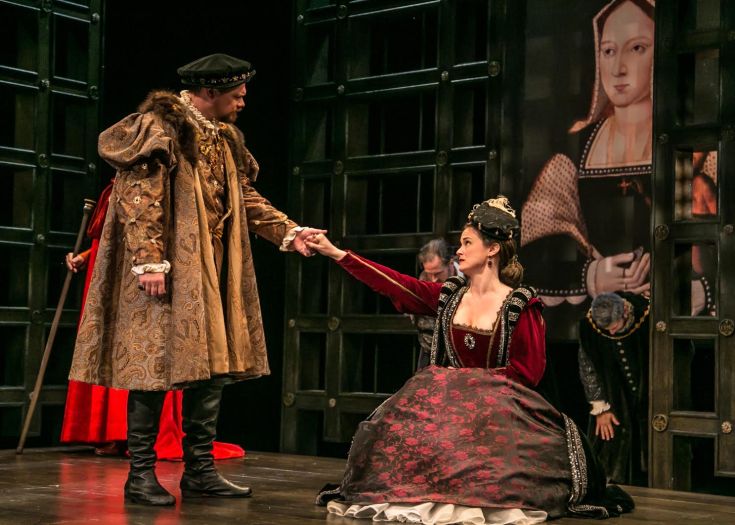
King Henry (David Foubert) greets his faithful wife, Queen Katherine (Jessica Wortham). Photo: © Jerry Dalia, The Shakespeare
King Henry (David Foubert) greets his faithful
wife, Queen Katherine (Jessica Wortham). Photo: © Jerry Dalia, The Shakespeare

Let’s first give a big fits pump and major props to @ShakespeareNJ for putting on a play so rarely produced. Come to think of it, I don’t think I’ve ever seen Henry VIII on a playbill anywhere.

Alas, for those of you who didn’t catch it, we are sorry that you are too late. It was worth the fare.

As discussed often at the Bard Brawl (both podcast and blog), the play suffers from two facts that keep theatre companies from putting histories like Henry VIII on. (1) History plays are very complicated to those who aren’t familiar with the epoch and (2) the late plays where authorship may be questioned are sometimes avoided. It is what it is.

Fortunately for me, I went through a bit of a Henry VIII kick a while ago and have seen A Man For All Seasons, the incredibly addicting Tudors series, the unwatchable Other Boleyn Girl and David Starkey‘s two documentary series on the subject. I get obsessed sometimes.

To say familiarity with the characters helped in engaging Paul Mullins‘ production of Henry VIII would be an understatement, but that’s not a criticism of the play. Mullins’ direction is tight and on point and the story is followable if confusing. The confusion has nothing to do with the production. Shakespeare’s audience would have known the story well and would not have needed explanation on who was who and why that lord was important or not.

A friend that went with me admitted that she (a) understood nothing of what anyone was saying, but (b) really enjoyed the performance.

How did the paradox come to pass?

The characters’ words are hard to filter through at times and there is a lot of dialogue. The actors, however, emote and bounce off each other well and the audience can follow who is aligned with who, who is jealous, who is torn, who is tragic and so on.

Cardinal Wolsey (Philip Goodwin), and the Duke of Buckingham (Thomas Michael Hammond) stand out in their respective roles, and leave memorable imprints. Both have great arcs that go from powerful and pompous to tragic and torn.

Two roles that really need to be amped up with intensity in the production were Anne Bullen (Katie Wieland) and Henry himself (David Foubert). Both actors are very good, but sometimes are overshadowed by those they share the stage with. The story and importance of these two requires that they be comets among asteroids. Something about Bullen (sometimes Boleyn) makes the king change everything. This is a big ask, but one that needs to be answered.

Queen Katherine (Jessica Wortham) is another that chews up the stage even if something in me wishes she played the part more Spanish. (Katherine is of Aragon after all).

At this point I’m nitpicking. The criticisms do not in any way take away from the joy in watching the performances.

Mullins is apt and on point with bringing characters in and out of the story, filling the stage with tension and drama and leaving theatregoers satisfied in the end. Particular points gained for keeping the set simple, costumes on point and not adding too much that shifts attention from the characters.

Having only caught the show in its last week, I feel it my duty to put a huge plug in for the upcoming Much Ado About Nothing that hits the stage December 3. Let’s just hope there are no “snow storms.”

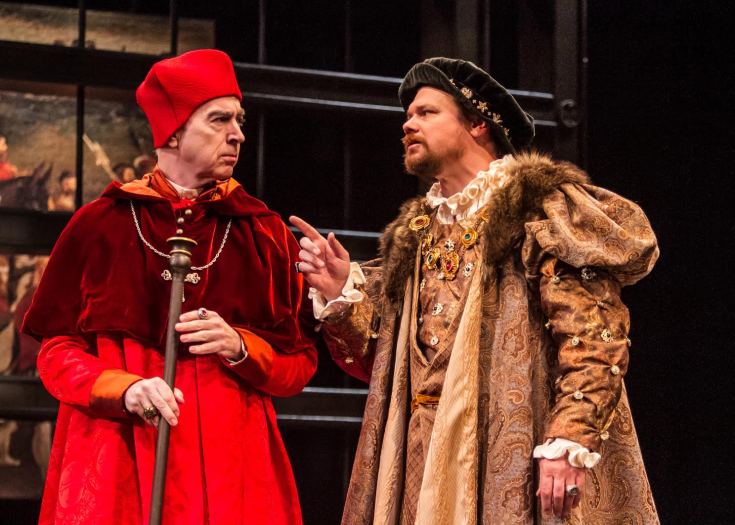
King Henry (right, David Foubert) consults with his trusted advisor, Cardinal Wolsey (Philip Goodwin). Photo: © Jerry Dalia,  The Shakespeare Theatre of New Jersey
King Henry (right, David Foubert) consults
with his trusted advisor, Cardinal Wolsey (Philip Goodwin). Photo: © Jerry Dalia,
The Shakespeare Theatre of New Jersey

BB: Richard II, the Speeches

Artwork - Andre Simoneau
Artwork – Andre Simoneau

(Podcast recorded and produced by Daniel J. Rowe, blog written and edited by Eric Jean)

Welcome back Brawlers to the speeches podcast of our tenth play, Richard II.

Listen to or download the podcast, or better yet subscribe on iTunes.

We also discuss the merits of bottled beer, stubbed-nosed or otherwise, versus tall cans.  Special treat: there may also be a nod to the brilliance of Captain Jean-Luc Picard (aka Patrick Stewart) in Star Trek: First Contact.

Enjoy!

“Should dying men flatter with those that live?” Act II, scene 1
Speakers: Richard II, John of Gaunt
John of Gaunt’s loaded and near-death. King Richard pays him a visit to his dying uncle in the hopes that the old man will die soon so he can gobble up his lands and cash. However, as his death-bed speech Gaunt tells Richard that he’s the one who in danger of dying because he’s killed his own uncle Gloucester and now surrounds himself with flatterers who are likely to run to henry as soon as he gets back to England.

“Where is the duke my father with his power?” Act III, scene 2
Speakers: Duke of Aumerle, Richard II
Things are looking pretty grim for Richard. None of his so-called friends have shown up to fight on his side. He’s screwed and he knows it. And he wants everybody else around to know that he’s royally screwed and to finally stop feeding him bullshit and telling him what he wants to hear. He knows now that kings rarely make it to retirement and that for all of his kingly privilege, he’s just like everybody else, a nobody.

“Ascend his throne, descending now from him…” Act IV, scene 1
Speakers: Duke of York, Henry Bolingbroke, Bishop of Carlisle
Surrounded by his buddies, Henry Bolingrbroke agrees to take the throne and reign as Henry IV! Except the Bishop of Carlisle have a few issues with that. See, as kings are anointed by God people can’t just decide to replace the king with someone lese. Even if they take his power, Richard II is still the rightful king. Carlisle warns that they’ll be hell to pay if they go through with this.

Henry IV’s not too happy to hear this so he just has him arrested. Problem solved.

“Great king, within this coffin I present” Act 5 V, scene 6
Speakers: Exton, Henry Bolingbroke
It only makes sense that so long as Richard II is still around, there will be a bunch of people who refuse to accept that Henry IV is the new king. Life of course would be so much simpler if Richard would just meet with an unfortunate accident and disappear from The Tower. Seems like henry might have let that slip so Exton took his cue and did the dirty work. He then comes back to court to claim his reward except that henry doesn’t want this shit to reflect poorly on him.

So can you spell scapegoat? Yup, that’s right: E-X-T-O-N.

That’s it for play number ten Brawlers! Stay tuned for our next play in the next week or two and for announcements about the upcoming 3rd volume of ‘Zounds!

Zoey Baldwin returns to the brawl and brings us a lovely reading of Sonnet 56.

And hey! Buy ‘Zounds! You’ll never regret or forget it. Volume II is OUT NOW.

brassknucklestshirt1.png

Stay in Touch Brawlers!

Follow @TheBardBrawl on Twitter.

Like our Facebook page.

Email the Bard Brawl at bardbrawl@gmail.com

Subscribe to the podcast on iTunes

Or leave us a comment right here!

← Back

Thank you for your response. ✨

Richard II, Act V

Artwork - Andre Simoneau
Artwork – Andre Simoneau

(Podcast recorded and produced by Daniel J. Rowe, blog written and edited by Eric Jean)

Welcome back Brawlers to the final act of our tenth play, Richard II.

Listen to or download the podcast, or better yet subscribe on iTunes.

Bolingbroke has the crown in hand  and Richard’s been sent to the tower, so it’s all over right? Bring on the hookers and blow and incriminating British tabloid pictures!

Nope. Hank Bolingbroke’s not in the clear yet.

When scene 1 opens, Richard’s wife is waiting for him along the road which leads to the tower to say goodbye before he gets locked up for good. She seems ready to give up but Richard tries to convince her to forget about this whole Queen business and run off to France before things get ugly. And the Northumberland shows up to tell him he’s going to Pomfret instead of the Tower. That can’t be good. Richard accuses Northumberland of helping Henry Bolingbroke to the throne and believes that sooner or later Northumberland will turn on Henry.

Too right, Richard. That one’s called Henry the Fourth but you won’t be around to see it. Your wife might survive but she’ll be long gone to France by then. She wasn’t in the sequel.

Back at the Duke of York’s palace the duchess of York gives us a portrait of Richard and Henry popular appeal: while the people were pumped about Bolingbroke, they threw garbage as Richard as he walked by with his armed escort. Thankfully though, York did okay in the change of leadership and even managed to plead on his son Aumerle’s behalf that he was totally committed, 100% to the new regime. Yup. No traitorous thoughts  or loyalty to Richard at all.

Except there’s this sealed letter poking out of Aumerle’s jacket which says that he, Carlisle and a bunch of other nobles are planning to overthrow the new king. Dad’s pissed but there’s only one thing this NARC can do: run off to the king and rat his son out! Mom’s suggestion: just go tell the new king you’re sorry and that you won’t hang out with those losers if you can just be part of the team, even if that means being Rutland the towel boy.

You’d think you’d try a little harder to hide something like that from your dad. I bet York never found Aumerle’s secret weed stash. (Look for his special snuff-box, the one with the white rose on it and the Latin inscription which translates to: “Death to the Lancastrians.” Joke explained here.)

In scene 3 we learn that Henry’s got a deadbeat son when York busts in demanding to speak to the king. He spills the beans on his son and when Aumerle and his mother get there. York pleads with the king to kill Aumerle for his dishonour and Aumerle swears up and down that he really wasn’t into this whole rebellion thing and that the others pressured him into it. The duchess begs for her son’s life and King Henry forgives him. He doesn’t forgive the others though. They’re still going to die.

Scene 4 is super short but it’s kind of important: Lord Exton decides that because he overheard King Henry talk about how much better things would be if Richard weren’t around, he would probably get a huge reward if he went off and killed him on his own initiative.

So off he goes. He finds Richard in his cell, passing the time by debating with himself whether he’s better off now, in prison, or when he was king and surrounded with sycophants. He’s also pretty pissed that even his horse Barbary has betrayed him: it seemed happy to be carrying King Henry around instead of his sad sack. The jail keeper comes in with his supper so Richard asks him to taste the food first but Exton’s ixnayed that. Richard knows the jig is up so he goes into Hulk mode and snatches the keeper’s axe and offs him. He hacks down another servant before Exton finally runs in and kills him.

Except what seemed like such a good idea before kinda seems like a bad idea all of a sudden.

Henry’s feeling pretty good in the final scene: the conspirators have all been found or killed and things are looking up when Exton comes in with the dead king in tow. Too bad Henry isn’t feeling it. Oh sure, he’s happy that Richard’s gone but why oh why did he have to be murdered! Oh the humanity of it all! How could you, Exton? (Is anybody buying this yet?)

Quick everyone! Look over there: a Crusade in the Holy Land! Looks like fun so let’s join in!

And they lived happily ever after until the first few lines of Henry IV, part 1.

Stay tuned for the Richard II speeches podcast, followed by act I of a play which may have appeared in the pages of the last ‘Zounds!

David Kandestin rejoins the brawl and delivers a magnetic reading of sonnet 49.

And hey! Buy ‘Zounds! You’ll never regret or forget it. Volume II is OUT NOW.brassknucklestshirt1.png

Stay in Touch Brawlers!

Follow @TheBardBrawl on Twitter.

Like our Facebook page.

Email the Bard Brawl at bardbrawl@gmail.com

Subscribe to the podcast on iTunes
Or leave us a comment right here!

← Back

Thank you for your response. ✨


And hey! Buy ‘Zounds! You’ll never regret or forget it. Volume II is OUT NOW.brassknucklestshirt1.png

Stay in Touch Brawlers!

Follow @TheBardBrawl on Twitter.

Like our Facebook page.

Email the Bard Brawl at bardbrawl@gmail.com

Subscribe to the podcast on iTunes
Or leave us a comment right here!

← Back

Thank you for your response. ✨

Beyond the Mountain Productions’ Bard Fiction, Directed by Christopher Moore

Bard Fiction
Bard Fiction

Take one part Tarantino classic Pulp Fiction,  add in an equal measure of Shakespeare, and stir. What you get is Bard Fiction, a play which presents many iconic scenes of Tarantino’s classic film as if they had been written for the stage by Shakespeare.

Come to think of it, this would have made a great ‘Zounds! submission… Ennoble Marsellus, turn Vincent and Jules into household servants, swap out knives and halberds for guns…

Anyhow, the plot of the play follows the script of Pulp Fiction and the humour of Bard Fiction comes from watching these familiar scenes and seeing how they come out once they’re run through the Bardifier.

(The Bardifier is a complex series of linguistic algorithms codes and supervised by writers Aaron Greer, Ben Tallen & Brian Watson-Jones. It’s a complicated machine. We don’t really understand how it works, and maybe it’s just magic. But we can guarantee that it does work. Trust us!)

Out of the gate, the play is uproariously funny.

First, you get the scene where Ringo (Tim Roth) and Yolanda (Amanda Plummer) are planning to rob the patrons of the dinner. Plenty of foul language language most foul!

The effect of knowing exactly how the scene is going to play out but being surprised at every turn by Shakespearean turn of phrases tickles both the early 90s film freak and the Shakespeare nerd in you. In fact, it’s amazing how little impact the shift from Tarantino’s language to Shakespeare’s actually has on the pacing of the scenes. Did the writers discover the inherently Bardic soul at the heart of Pulp Fiction?

Next come Vincent and Jules (short for Vincenzio and Julius of course), riding in their horse-drawn cart. taking about the differences between England and France. Cue the bardifier! You put in Big Mac and Royale with cheese and out comes Cottage pie or hachis parementier.

See? I told you it works!

This is damned funny stuff, at least at first.

As the novelty starts to wear off though, Bard Fiction becomes less uproariously funny and more, well, just plain funny. Thankfully, the writers realised this as well so instead of getting a recreation of the whole film, Bard Fiction presents a sort of greatest hits and runs a little over an hour.

It’s still really entertaining right up to the end but by the end of the play, that pony’s run about as far as this idea can take.

Still, is there anything more Bard brawl-tastic then the idea behind Bard Fiction? It’s definitely in the spirit of the Bard Brawl and ‘Zounds! which means that if you like either of these two things, you’ll have a great time with this play.

Bard Fiction isn’t a deep exploration of the state of Shakespeare in the 21st century or a thoroughly researched and cogent analysis of the construction of dialogue in the early 90s films of Quentin Tarantino.

It’s just a whole lot of fun and goes to show that the theatre, and Shakespeare’s theatre, doesn’t need to be elitist hard to get into.

Today is the last day Bard Fiction is showing at the Mainline Theatre so head down there and get yourself a ticket,  or check out one of Beyond the Mountain Productions’ upcoming shows!

And hey! Buy ‘Zounds! You’ll never regret or forget it. Volume II is OUT NOW.brassknucklestshirt1.png

Stay in Touch Brawlers!

Follow @TheBardBrawl on Twitter.

Like our Facebook page.

Email the Bard Brawl at bardbrawl@gmail.com

Subscribe to the podcast on iTunes
Or leave us a comment right here!

← Back

Thank you for your response. ✨

The Bard Brawl is currently accepting submissions to the third edition of ‘Zounds! a Bard Brawl Journal. 

Join us.

Artwork - Stephanie E.M. Coleman
Artwork – Stephanie E.M. Coleman


For the third instalment of the greatest English Renaissance themed journal in the history of the universe we have chosen a theme inspired by the halls of power corrupted by ambition, greed, vengeance and sometimes straight up psychological trauma:

madking

“O! let me not be mad, not mad, sweet heaven;
Keep me in temper; I would not be mad!”
– King Lear, 1.5.51


William Shakespeare’s work is littered by the acts of mad kings. The most obvious example to use as inspiration is Lear, but scratch the surface of Richard III, Richard II, Henry IV, John, Leontes and many more and one can always find a little of the crazy.

Be as literal or as abstract as you like, but always be brawly.

As a bonus, ‘Zounds! is running its first ever writing and art contest in this edition.


It is highly recommended that you pick up a past copy of ‘Zounds! to get an idea of the type of material we print. You can order a copy here.


Email your best creative non-fiction, fiction, artwork or poetry submissions to bardbrawl@gmail.com

Use high resolution JPEGs for artwork.


Stay in Touch Brawlers!

Follow @TheBardBrawl on Twitter.

Like our Facebook page.

Email the Bard Brawl at bardbrawl@gmail.com

Subscribe to the podcast on iTunes

Or leave us a comment right here!

← Back

Thank you for your response. ✨

BB: Richard II, Act IV

Artwork - Daniel J. Rowe
Artwork – Daniel J. Rowe

(Podcast recorded and produced by Daniel J. Rowe, blog written and edited by Eric Jean)

Welcome back Brawlers to the Bard Brawl’s tenth play! (trumpets sound)

This week, we bring you act IV of Shakespeare’s The Life and Death of Richard the Second. We know that’s not the catchiest title so we figured we’d give Shakespeare the Bard Brawl boost and help him find a better title. Cast your vote for your favourite alternate title here!

Listen to or download the podcast, or better yet subscribe on iTunes.

Only one scene in act IV but it’s a long one!

Bolingbroke ‘s gathered with his supporters in Westminster Hall in London and it’s time to start settling scores. Bolingbroke accuses Bagot of killing the Duke of Gloucester but Bagot, who’s pretty sure his number is up, is looking to take someone with him so he accuses Aumerle of conspiring against Gloucester and Henry Bolingbroke.

Of course, Aumerle denies the whole thing and challenges Bagot to a fight but Bolingbroke forbids them from fighting.

Sounds familiar?

Then Fitzwater accuses Aumerle of lying so Aumerle threatens to fight it out with him. Henry Percy jumps in on Fitzwater’s behalf and Surrey steps in for Aumerle. Bolingbroke puts his foot down: no vigilante justice this time because Aumerle is going to stand trial.

And then the Duke of York arrives and announces that Richard is giving up his throne and names Henry Bolingbroke to be the new king.

Thing is, the Bishop of Carlisle isn’t too happy about this. Kings are supposed to be chosen by God. You don’t get to just swap them out when you feel like it. Even the king can’t make a new king. So after he’s finished giving his speech about it, they arrest him for treason. Naturally.

To make sure no one can challenge Henry’s claim, they bring Richard out so he can formally hand over the crown. You know, so everyone will know that everything is above-board. Just to be sure, they have Richard confess to a list of crimes which Bolingbroke and company has so thoughtfully prepared for him to read.

It seems Richard’s having second thoughts about the whole thing. He’s taking stock of his life, trying to figure out what’s next for this unpopular, deposed ruler. Customer service representative? Life coach? Long-haul truck driver?

Or probably just a royal corpse.

Richard tries to stall but time’s up. Once he’s made everything official, they cart him off to the Tower.

As soon as everyone leaves, Aumerle turns to the Bishop of Carlisle: “So, we got a plan to get rid of this jackass Bolingbroke?”

This should be good!

The Lord of St. Leonard, Mark Della Posta, returns to the pod and delivers sonnet 39 with all the cunning and style of Roberto “the Manimal” Luongo.

And hey! Buy ‘Zounds! You’ll never regret or forget it. Volume II is OUT NOW.brassknucklestshirt1.png

Stay in Touch Brawlers!

Follow @TheBardBrawl on Twitter.

Like our Facebook page.

Email the Bard Brawl at bardbrawl@gmail.com

Subscribe to the podcast on iTunes

Or leave us a comment right here!

← Back

Thank you for your response. ✨

Up ↑